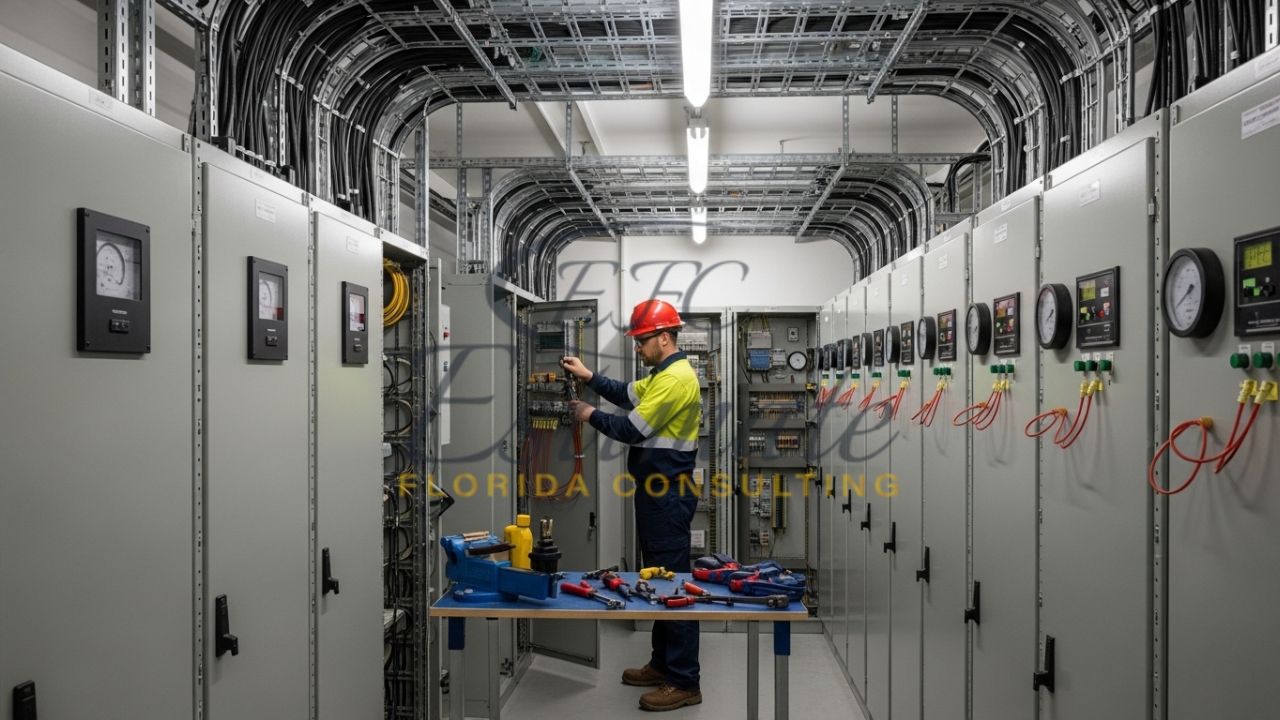
Florida’s commercial construction industry demands advanced commercial electrical services, strict electrical code compliance, and accurate electrical cost estimating. From office buildings, warehouses, retail centers, healthcare facilities, and industrial properties to mixed-use commercial developments, commercial electrical contractors in Florida deliver safe, reliable, and energy-efficient commercial electrical systems that support long-term building performance.
Due to Florida’s hurricane exposure, coastal corrosion risks, humidity, evolving energy regulations, and Florida Building Code requirements, commercial electrical construction requires licensed electrical contractors, precise execution, and detailed planning from early design through final inspection.
Estimate Florida Consulting provides professional commercial electrical cost estimates in Florida, helping general contractors, developers, electrical subcontractors, and property owners plan electrical scopes accurately, control construction budgets, and reduce project risk.
Role of Commercial Electrical Contractors in Florida Construction
Commercial electrical contractors Florida play a vital role in delivering commercial electrical installation services that ensure safety, reliability, and energy efficiency. Their scope covers electrical system design coordination, power distribution, lighting systems, emergency power, fire alarm installation, grounding, and low-voltage systems.
Experienced Florida contractors design scalable electrical infrastructure that supports tenant improvements, future expansion, higher electrical demand, and long-term operational efficiency for commercial buildings and industrial facilities.
Electrical Engineering Coordination With Architects and Engineers
Successful Florida commercial projects depend on strong electrical engineering coordination. Commercial electrical contractors collaborate with architects, structural engineers, MEP consultants, and general contractors to integrate electrical layouts, conduit routing, panel locations, and equipment rooms into the building design.
Early coordination improves constructability, minimizes MEP clashes, reduces rework and change orders, and ensures electrical systems align with architectural intent, structural limitations, tenant power loads, and future technology upgrades.
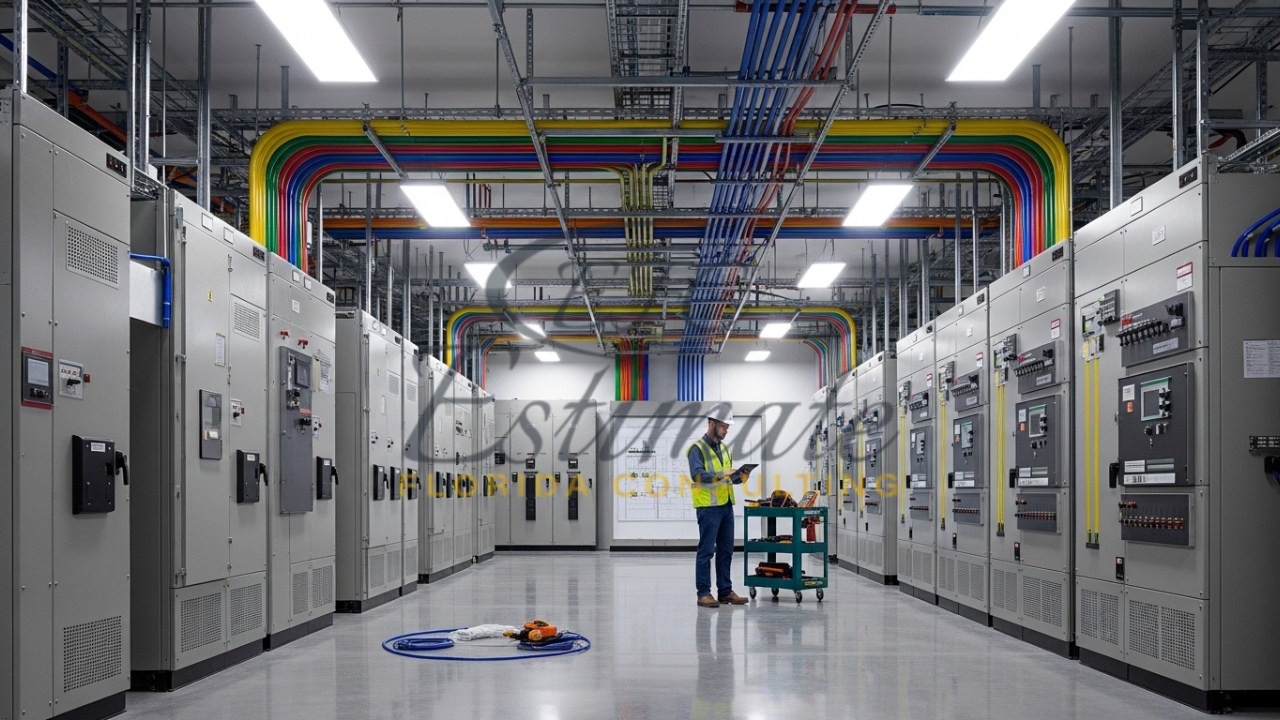
Power Distribution Systems and Switchgear Installation
Power distribution systems are the backbone of commercial electrical construction in Florida. Contractors install main electrical services, switchgear, transformers, distribution panels, feeders, and branch circuits designed for safe and reliable power delivery.
Proper commercial power distribution design improves load balancing, voltage stability, surge protection, and operational safety. Large industrial buildings, warehouses, and data facilities often require redundant feeders, sectionalized switchgear, backup power integration, and lightning protection systems.
Commercial Electrical Systems for Office Buildings
Office buildings require flexible commercial electrical installations to support interior lighting, workstation power, structured cabling, access control, and life-safety systems. Florida commercial electrical contractors design systems that adapt to changing tenant layouts, higher plug loads, and modern office technology.
Energy-efficient LED lighting systems, lighting controls, occupancy sensors, and power management solutions help reduce operating costs while improving employee comfort, productivity, and building energy efficiency.
Electrical Infrastructure for Retail and Mixed-Use Developments
Retail and mixed-use developments require adaptable commercial electrical systems to support tenant electrical loads, storefront lighting, signage power, exterior lighting, security systems, and emergency lighting.
Florida commercial electrical contractors design code-compliant electrical infrastructure that balances flexibility, durability, and reliability, allowing tenants to customize spaces without costly electrical upgrades and reducing future retrofit expenses.
Electrical Systems for Healthcare and Medical Facilities
Healthcare electrical systems require the highest level of reliability and redundancy. Florida commercial electrical contractors must meet NEC healthcare requirements, Florida Electrical Code standards, and emergency power regulations.
Typical medical facility electrical scopes include redundant feeders, critical branch circuits, backup generators, transfer switches, grounding systems, and life-safety lighting, ensuring uninterrupted power for medical equipment, imaging systems, and patient care areas.
Temporary Power and Construction-Phase Electrical Services
Temporary power systems are essential for commercial construction projects. Florida commercial electrical contractors install OSHA-compliant temporary electrical services to support power tools, site lighting, construction trailers, hoists, and jobsite operations.
Proper construction-phase electrical planning improves jobsite safety, productivity, scheduling efficiency, and reduces electrical hazards during active construction.
Commercial Electrical Construction Costs in Florida
Commercial electrical construction costs in Florida vary based on building type, electrical load requirements, system complexity, energy-efficiency goals, and project location. Electrical scopes represent a significant portion of commercial construction budgets, making accurate electrical cost estimating essential.
Commercial Electrical Cost Per Square Foot (Florida)
| Building Type | Electrical Cost (Per Sq Ft) |
| Standard Commercial Buildings | $9.10 – $19.50 / sq ft |
| Office Buildings | $10.40 – $20.80 / sq ft |
| Retail & Mixed-Use Developments | $9.75 – $18.85 / sq ft |
| Warehouses & Distribution Centers | $8.45 – $16.90 / sq ft |
| Healthcare & Medical Facilities | $19.50 – $28.60 / sq ft |
| Data Centers & High-Tech Facilities | $23.40 – $39.00 / sq ft |
Electrical System Scope and Cost Breakdown
Commercial electrical system costs are divided across multiple scopes, including power distribution, lighting, emergency power, fire alarm systems, grounding, and low-voltage infrastructure. Each system impacts the total electrical budget differently depending on occupancy type and redundancy requirements.
| Electrical Scope | Cost Range (Per Sq Ft) |
| Power Distribution & Panels | $2.60 – $5.20 / sq ft |
| Interior & Exterior Lighting | $1.95 – $4.55 / sq ft |
| Emergency Power & Generators | $1.30 – $3.90 / sq ft |
| Fire Alarm & Life-Safety Systems | $1.00 – $2.60 / sq ft |
| Low-Voltage & Data Systems | $0.90 – $2.30 / sq ft |
| Grounding & Lightning Protection | $0.65 – $1.95 / sq ft |
Commercial Electrical Cost by Building Size
Electrical installation costs increase with building size, service capacity, and system complexity.
| Building Size | Estimated Electrical Cost |
| 10,000 sq ft | $91,000 – $195,000 |
| 25,000 sq ft | $227,500 – $487,500 |
| 50,000 sq ft | $455,000 – $975,000 |
| 100,000 sq ft | $910,000 – $1.95M |
| 250,000 sq ft | $2.27M – $4.88M |
Inland vs Coastal Florida Electrical Cost Impact
Project location significantly affects commercial electrical pricing in Florida. Inland projects follow standard electrical requirements, while coastal construction demands additional protection.
| Location Type | Cost Impact |
| Inland Florida Projects | Standard electrical pricing |
| Coastal Florida Projects | 10%–20% higher |
Coastal projects require corrosion-resistant electrical materials, wind-rated equipment, surge protection devices, enhanced grounding, and hurricane-resistant electrical systems, increasing overall construction costs.
Licensing, Permits, and Florida Electrical Code Compliance
Licensed commercial electrical contractors in Florida must comply with the Florida Electrical Code (NEC-based), local Authority Having Jurisdiction (AHJ) requirements, and inspection standards. Proper permitting, inspections, and code-compliant installation are essential to avoid delays, failed inspections, and legal risks.
Importance of Accurate Commercial Electrical Cost Estimating
Commercial electrical cost estimating plays a critical role in budget control, risk management, and bid accuracy. Detailed electrical estimates include material takeoffs, labor productivity analysis, equipment pricing, permit allowances, and contingency planning.
Estimate Florida Consulting delivers Florida-specific electrical estimates that reduce change orders, scope gaps, and cost overruns, ensuring smoother project execution.
Why Choose Estimate Florida Consulting for Commercial Electrical Estimates?
Estimate Florida Consulting provides professional commercial electrical estimating services in Florida for general contractors, electrical subcontractors, developers, and engineers.
Our estimates are based on Florida labor rates, current material pricing, NEC requirements, and local construction conditions, helping clients improve bid competitiveness, cost certainty, and financial control.
Conclusion
Hiring experienced commercial electrical contractors Florida is essential for delivering safe, energy-efficient, and future-ready electrical systems. With Florida’s strict codes, climate challenges, and rising construction costs, accurate electrical planning and cost estimating protect budgets and long-term building performance.
Call 561-530-2845 to speak with Estimate Florida Consulting and receive accurate commercial electrical cost estimates in Florida.
Frequently Asked Questions
- What services do commercial electrical contractors in Florida provide?
Commercial electrical contractors in Florida handle complete electrical scopes, including power distribution systems, lighting installation, emergency and backup power, fire alarm systems, grounding, low-voltage wiring, and electrical system coordination with architects and engineers. They ensure all systems meet Florida Electrical Code and local AHJ requirements.
- How much does commercial electrical work cost per square foot in Florida?
Commercial electrical costs in Florida typically range from $8.45 to $39.00 per square foot, depending on building type. Warehouses and offices fall on the lower end, while healthcare facilities and data centers require higher-cost, redundant electrical systems.
- Why are coastal Florida commercial electrical projects more expensive?
Coastal Florida projects cost 10%–20% more due to hurricane exposure, salt-air corrosion, higher wind-load requirements, enhanced grounding, surge protection, and the need for corrosion-resistant electrical materials and equipment.
- Do commercial electrical contractors in Florida handle permitting and inspections?
Yes. Licensed commercial electrical contractors manage electrical permits, inspections, and code compliance with the Florida Electrical Code (NEC-based) and local authorities. Proper permitting helps avoid inspection failures, delays, and costly rework.
- What electrical systems are required for healthcare and medical buildings in Florida?
Healthcare facilities require critical and life-safety electrical systems, including redundant feeders, essential branch circuits, emergency generators, automatic transfer switches, grounding systems, and uninterrupted power for medical equipment, in compliance with NEC healthcare standards.
- How early should electrical contractors be involved in commercial construction projects?
Commercial electrical contractors should be involved during the early design phase. Early coordination with architects and engineers reduces MEP conflicts, improves constructability, lowers change orders, and ensures electrical systems support future expansion and tenant needs.
- What factors impact commercial electrical construction costs in Florida?
Key cost drivers include building size, electrical load requirements, system complexity, energy-efficiency goals, redundancy needs, location (inland vs coastal), permitting requirements, and Florida labor rates.
- Why is accurate commercial electrical cost estimating important in Florida projects?
Accurate electrical cost estimating helps control budgets, reduce risk, prevent scope gaps, and improve bid accuracy. Florida-specific estimates account for code requirements, climate conditions, labor productivity, and material pricing to avoid costly overruns.