
Building a home in Florida is not just about choosing a floor plan; it is about embracing an architectural heritage that thrives in a subtropical climate. Spanish-style architecture, characterized by its cooling stucco walls, iconic red clay tiles, and seamless indoor-outdoor living, remains the gold standard for Florida luxury and coastal living. However, in 2026, the financial landscape of residential construction is more complex than ever. From fluctuating material prices to stringent new building codes, homeowners and developers need more than a “ballpark” figure; they need a precise Spanish-style houses cost estimator.
At Estimate Florida Consulting, we bring over 12 years of specialized experience and a portfolio of 1,000+ professional estimates to the table. We understand that a Spanish-style home isn’t just a house—it’s an intricate assembly of specialized trades, from master ironworkers to skilled stucco artisans. This guide provides an expansive, data-driven look at what it takes to bring these Mediterranean dreams to life in the current Florida market, ensuring your project remains “bankable” and resilient against budget overruns.
🏛️ Get an accurate Spanish-style house construction estimate before you build in Florida.
The Anatomy of a Spanish-Style Home in Florida
To accurately estimate costs, one must first understand the architectural requirements that define the style. Authentic Spanish Colonial or Mediterranean Revival homes are not merely “stucco boxes.” They require specific structural and aesthetic elements that drive both material and labor expenses.
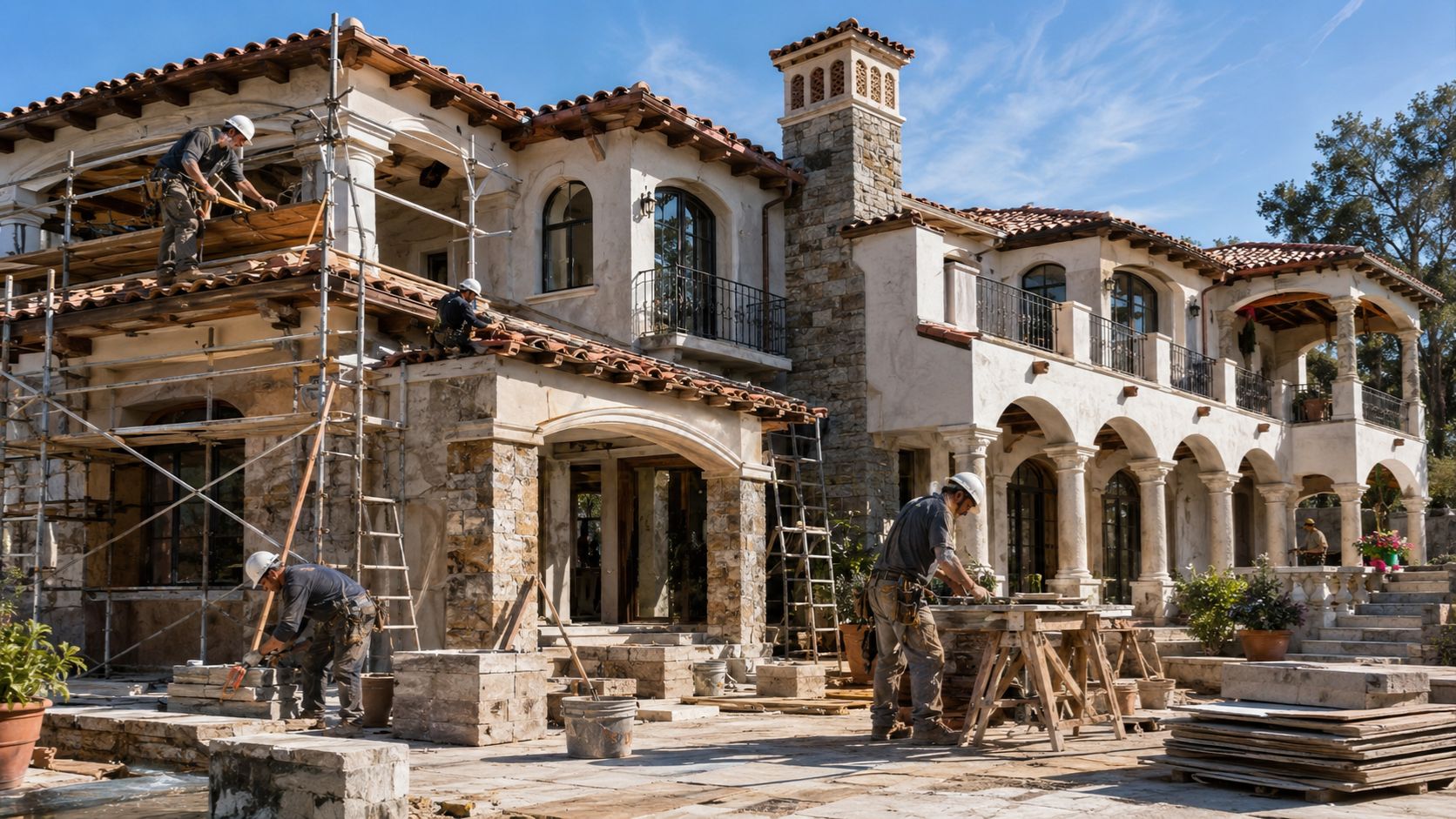
Stucco Exteriors and Arched Openings
The smooth, textured finish of stucco is synonymous with this style. In Florida, stucco is favored for its weather resistance and its ability to reflect heat. However, achieving the iconic “arched” look for windows and doorways requires complex framing and specialized lathing, which increases labor costs compared to standard rectangular framing.
Red Clay Barrel Tile Roofs
This is the most defining—and often the most expensive—feature. Clay tiles offer superior insulation and durability in hot climates but are significantly heavier than asphalt shingles. This weight necessitates reinforced roof trusses and structural support, a factor often missed by generic online calculators.
Wrought Iron and Ornate Details
Custom ironwork for balconies, gates, and window grills adds a sense of history. These are typically custom-made pieces that require skilled craftsmanship, with costs ranging from $500 to $2,000 per unit.
2026 Construction Cost Breakdown
Understanding the per-square-foot metrics is essential for high-level planning. In the 2026 Florida market, the quality of finishes shifts the budget dramatically.
| House Quality Tier | Average Cost per Sq. Ft. | Estimated Total (2,500 Sq. Ft. Home) |
|---|---|---|
| Standard / Builder Grade | $150 – $200 | $375,000 – $500,000 |
| High-End / Custom | $250 – $300 | $625,000 – $750,000 |
| Luxury / Ultra-Custom | $350+ | $875,000+ |
Note: These figures represent vertical construction costs and do not typically include land acquisition or major site-work like pool installation.
💰 Avoid costly surprises with a detailed Spanish-style home cost estimate.
Component-Wise Material Costs
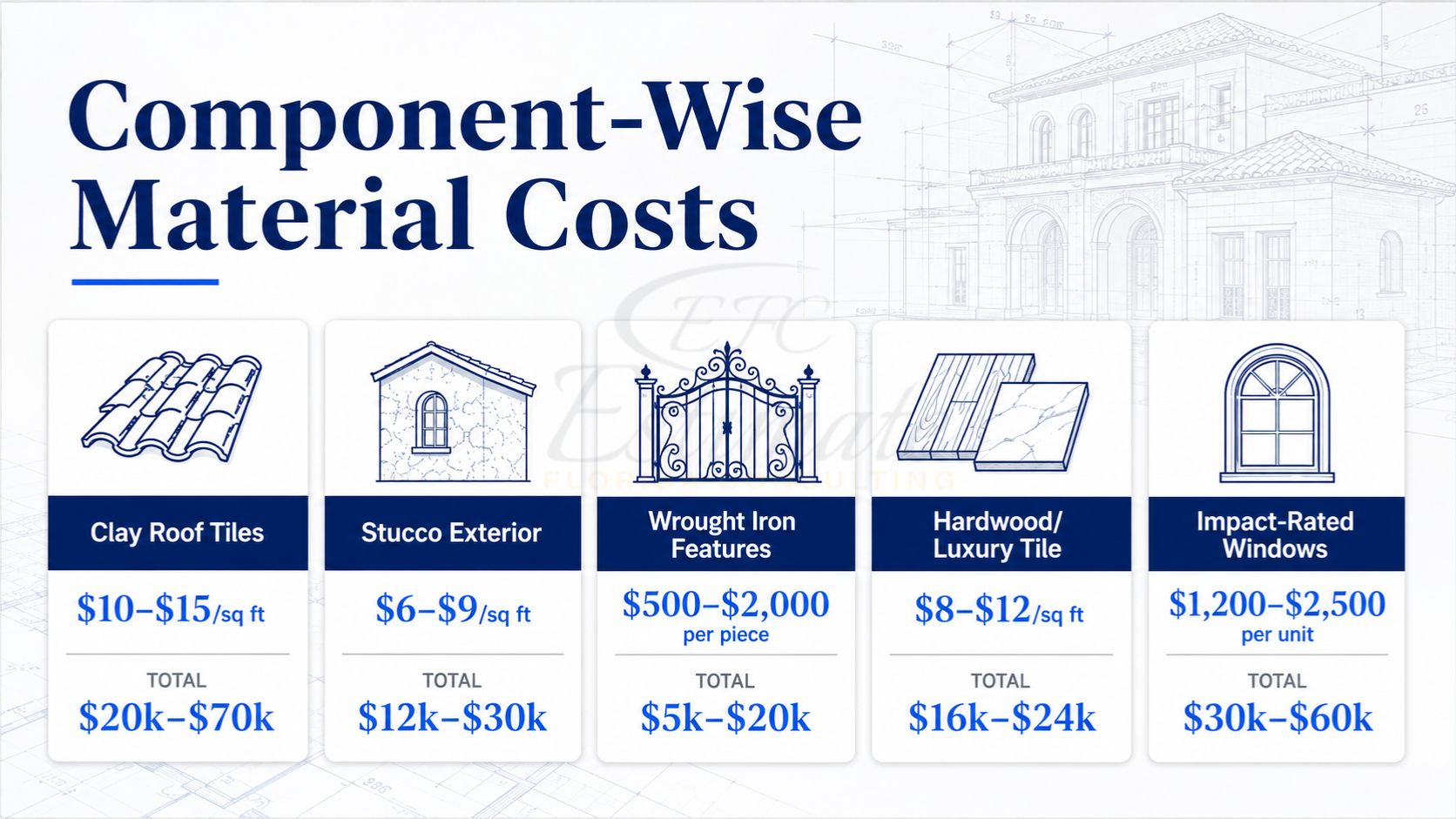
Materials represent a significant portion of the total budget. Below are the 2026 estimates for key Spanish-style materials in Florida:
| Material Component | Cost per Unit / Sq. Ft. | Estimated Total for Average Build |
|---|---|---|
| Clay Roof Tiles | $10 – $15 per sq. ft. | $20,000 – $70,000 |
| Stucco Exterior | $6 – $9 per sq. ft. | $12,000 – $30,000 |
| Wrought Iron Features | $500 – $2,000 per piece | $5,000 – $20,000 |
| Hardwood / Luxury Tile | $8 – $12 per sq. ft. | $16,000 – $24,000 |
| Impact-Rated Windows | $1,200 – $2,500 per unit | $30,000 – $60,000 |
Key Factors Influencing Your Budget
When using a Spanish-style houses cost estimator, several variables can cause the price to swing by 20% or more.
1. Geographical Location
Florida is not a monolith. Construction in Miami or Naples involves higher labor rates and more expensive permitting than in Ocala or Tallahassee. Furthermore, coastal projects must account for saltwater corrosion-resistant materials and higher wind-load requirements.
2. Design Complexity
Spanish architecture often includes courtyards, loggias, and sprawling footprints. These designs increase the “perimeter-to-floor-area” ratio, meaning you have more exterior wall and roof surface per square foot of living space, driving up costs for stucco and tile.
3. Site Conditions and Impact Fees
In areas like Tampa or Miami, local municipality impact fees can range from $10,000 to $30,000. Additionally, if your site is in a flood zone, you may be required to elevate the foundation, adding $25,000 to $50,000 to your base cost.
🏗️ Build smarter with detailed quantity takeoffs and cost breakdowns.
Florida-Specific Requirements & Regulations
The Florida Building Code (FBC) is one of the most stringent in the nation due to hurricane risks.
- HVHZ Compliance: If you are building in the High-Velocity Hurricane Zone (Miami-Dade and Broward Counties), every element—from the way clay tiles are fastened to the impact resistance of the stucco—must meet extreme standards.
- Impact Glazing: Spanish-style homes often feature large, arched windows. In Florida, these must be impact-rated to withstand debris during a storm. This can add $5,000+ per large arched window unit.
- Structural Reinforcement: Because clay tiles are heavy, the roof structure must be engineered to hold that weight while resisting upward wind lift during a hurricane.
Material Comparison: Authenticity vs. Economy
Homeowners often look for ways to achieve the Spanish look while staying within a tighter budget.
| Feature | Authentic Option (Higher Cost) | Budget-Friendly Alternative |
|---|---|---|
| Roofing | Two-piece Barrel Clay Tiles | Concrete Tiles or Synthetic Spanish Tile |
| Walls | Three-coat Hard Coat Stucco | EIFS (Synthetic Stucco) |
| Flooring | Hand-painted Saltillo Tile | Wood-look or Stone-look Porcelain Tile |
| Accents | Custom Wrought Iron | Pre-fabricated Aluminum with Iron Finish |
While alternatives can save 15–20% upfront, they may not offer the same longevity or “thermal mass” benefits as traditional materials.
New Construction vs. Renovation
Choosing between building from scratch or renovating an existing Spanish-style home is a major financial decision.
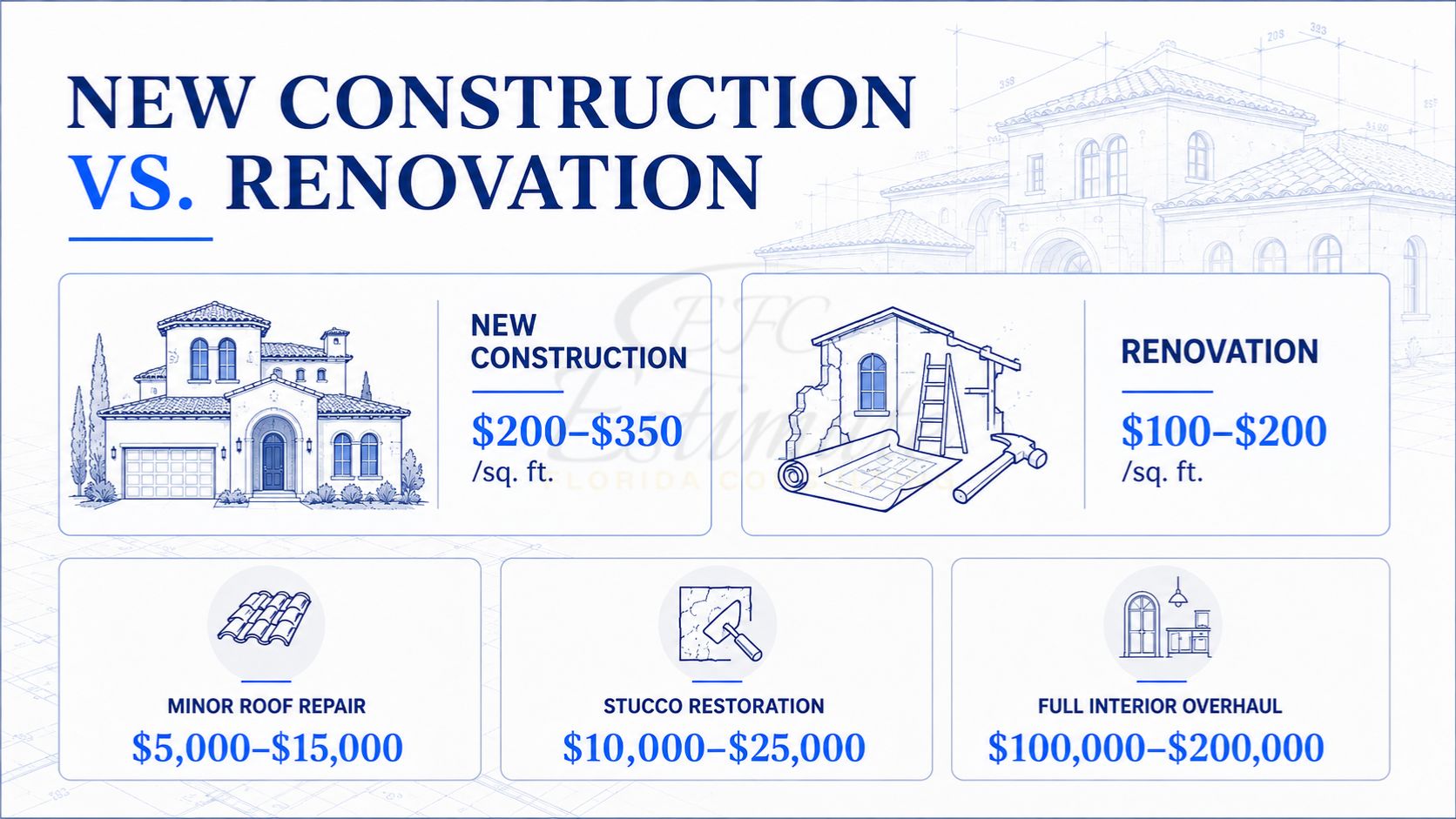
- New Construction ($200–$350/sq. ft.): Offers the advantage of modern hurricane-proof engineering and total customization but requires a higher initial investment.
- Renovation ($100–$200/sq. ft.): Generally more cost-effective but often reveals “hidden” costs like outdated electrical systems or structural damage to old stucco.
| Project Scope | Estimated Cost Range |
|---|---|
| Minor Roof Repair | $5,000 – $15,000 |
| Stucco Restoration | $10,000 – $25,000 |
| Full Interior Overhaul | $100,000 – $200,000 |
Energy Efficiency & Sustainability
Spanish-style homes are naturally energy-efficient due to their thick walls and reflective roofs, but 2026 standards allow for further optimization.
- Solar Integration: Clay tile roofs can be fitted with integrated solar shingles or hidden panels, costing $10k–$25k but saving up to $2,500 annually.
- High-Efficiency HVAC: Essential for managing Florida’s humidity within a large, open-concept Spanish floor plan.
- LED Lighting: Modernizing interior fixtures can save $200–$400 per year on utility bills.
📞 Request your Florida Spanish-style house construction estimate today.
How to Use a Spanish-Style Houses Cost Estimator
To get a “bankable” estimate, follow this systematic approach used by professionals:
- Determine Net Square Footage: Measure all living areas plus “under-roof” spaces like porches and carports.
- Assign Material Grades: Will you use luxury clay tiles or standard concrete?
- Factor in Labor by Trade: Account for specialized artisans for stucco and ironwork.
- Add Soft Costs: Include 10–15% for permits, architectural fees, and inspections.
The Basic Formula:
Total Cost = (Square Footage × (Material + Labor Rate)) + Impact Fees + Soft Costs
Plan Spanish-Style Home Scope Before Pricing
A reliable Spanish-style home budget begins with the architectural assemblies that make the design distinct. Enclosed and under-roof area, foundation conditions, framing for arches and openings, exterior stucco system, clay or concrete tile roofing, impact-rated windows and doors, custom ironwork, exterior hardscape, interior finish level, and mechanical systems should be organized as separate scope lines. This prevents a high-detail Mediterranean design from being compared to a standard house only by interior square footage.
Florida wind exposure, roof-tile weight, structural connections, salt-air durability where applicable, site access, drainage, permitting, and specialty-trade lead times should be listed as project assumptions. A measured scope and current Florida trade-pricing data give owners, developers, and design teams a clearer foundation for early budgeting and later bid comparison.
Related estimating support: new house construction cost calculator, construction cost estimator in Florida, roofing estimating services Florida, and window replacement cost estimator.
Frequently Asked Questions (FAQ)
- Is it more expensive to build a Spanish-style house than a traditional one?
Yes, typically. The weight of the tile roof and the complexity of stucco application and arched framing generally make Spanish-style homes 10–15% more expensive than standard “ranch” or “traditional” builds. - How much does a clay tile roof cost for a 2,500 sq. ft. home?
Based on 2026 data, you should budget between $40,000 and $70,000 for a professional clay tile installation, including the necessary structural reinforcements. - What is the most expensive part of building a Spanish-style home?
The “shell” of the house—specifically the combination of the foundation, framing for arches, and the clay tile roof—represents the largest single expense block. - Do I really need impact windows in Florida?
Yes. Beyond safety, Florida building codes in most regions require them, and they are essential for obtaining affordable homeowners’ insurance. - How long does a professional construction estimate take?
At Estimate Florida Consulting, we provide detailed, multi-trade breakdowns in just 1-2 business days. - Can I use concrete tiles instead of clay?
Yes, concrete tiles are more budget-friendly and offer similar aesthetics, though they may lack the natural color variation and “thermal mass” properties of authentic clay. - Are Spanish-style homes energy efficient?
Very. The light-colored stucco reflects sunlight, and the heavy tile roof provides excellent thermal insulation, keeping the interior cool in Florida’s heat. - What are “soft costs”?
Soft costs include non-tangible expenses like architect fees, building permits ($5k–$15k), and engineering inspections. - Why is labor for stucco so expensive?
Authentic stucco is applied in multiple layers and requires a high degree of skill to ensure a smooth finish that won’t crack under Florida’s intense sun and humidity. - Do you estimate for renovations too?
Absolutely. We provide detailed estimates for stucco restoration, roof replacement, and full interior remodels.
Conclusion: Build Your Legacy with Precision
Navigating the 2026 Florida construction market requires a blend of architectural appreciation and financial rigor. With costs for Spanish-style homes ranging from $200 to over $350 per square foot, there is no room for guesswork. Whether you are a developer planning a new luxury community or a homeowner restoring a historic Mediterranean gem, a professional Spanish-style houses cost estimator is your most valuable tool.
Don’t let your project be stalled by unexpected impact fees or material price spikes. Get a code-compliant, market-accurate breakdown that ensures your bid—and your building—stands the test of time.