Reinforced masonry cost in Florida is a key consideration for structural masonry construction, reinforced CMU wall systems, load-bearing block walls, and hurricane-resistant building assemblies used in residential, commercial, and multi-family projects. When contractors and developers use a masonry construction cost estimator Florida, they must account for wind-resistant masonry design, high-strength masonry materials, coastal construction conditions, and strict code-compliant masonry detailing.
Florida’s construction environment is driven by high wind-load zones, impact-rated wall systems, salt-air exposure, and regional labor constraints, all of which increase masonry installation costs, block wall pricing, and structural wall construction budgets. Reinforced masonry remains one of the most reliable systems for long-term durability, storm resistance, and structural integrity.
Understanding Reinforced Masonry Construction in Florida
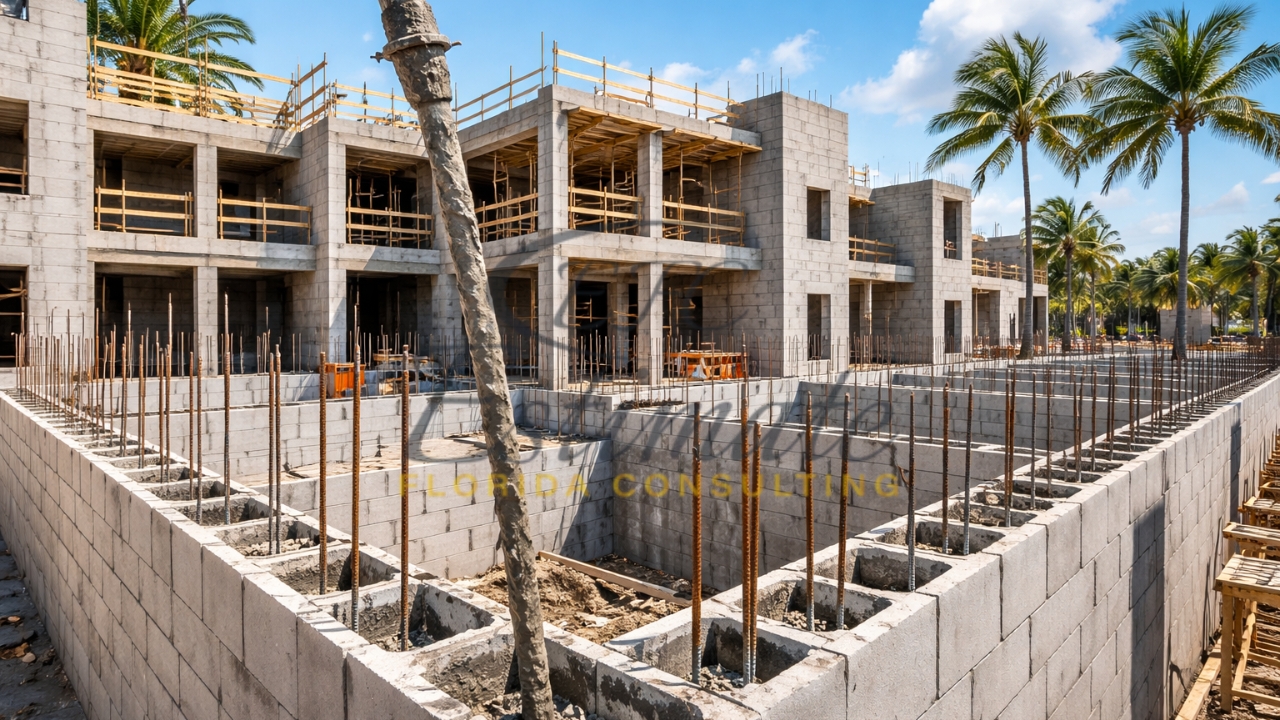
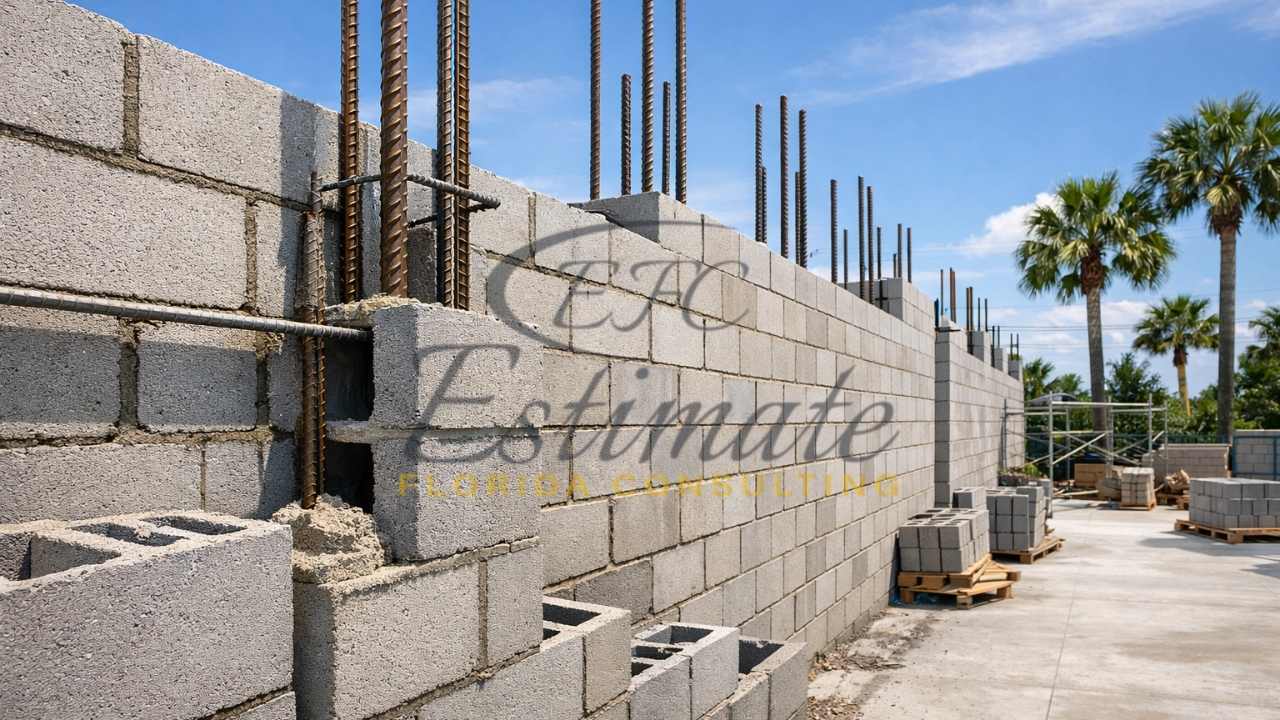
Reinforced masonry construction refers to engineered masonry wall systems where concrete masonry blocks, steel reinforcing bars, and cement-based grout act together as a unified structural element. Vertical reinforcement, horizontal bond beams, reinforced lintels, and grouted cells improve shear resistance, lateral load capacity, and overall wall strength.
In Florida construction, reinforced masonry is widely used for exterior structural walls, commercial masonry buildings, multi-story developments, institutional facilities, and essential service structures. Compared to standard CMU construction, reinforced masonry requires engineering calculations, special inspections, higher material volumes, and skilled masonry crews, all of which increase construction cost per square foot.
Florida Building Code Requirements and Cost Impact
Reinforced masonry construction in Florida must comply with the Florida Building Code (FBC), which governs masonry reinforcement spacing, wind-load resistance, impact protection, and continuous load paths. These regulations apply to structural masonry walls, reinforced block assemblies, and hurricane-rated wall systems.
Meeting these requirements increases costs through closer rebar spacing, fully grouted CMU walls, reinforced bond beams, engineered wall-to-foundation connections, and roof diaphragm anchorage. In addition, mandatory masonry inspections, grout lift verification, and reinforcement placement checks add labor and coordination costs but ensure long-term performance and structural safety.
Average Reinforced Masonry Cost in Florida
Reinforced masonry pricing in Florida depends on wall height, reinforcement density, building occupancy type, construction complexity, and regional labor markets. Accurate budgeting typically requires a professional masonry construction cost estimator Florida that reflects real-world site conditions.
Reinforced Masonry Cost Per Square Foot – Florida
| Building Type | Cost Range (Per Sq Ft) |
| Residential Reinforced CMU Walls | $31 – $53 |
| Commercial Structural Masonry | $39 – $73 |
| Multi-Family Masonry Construction | $42 – $77 |
| Institutional / Hurricane-Rated Masonry | $49 – $91 |
These figures include reinforced block materials, steel reinforcement, grouting operations, masonry labor, and standard inspection allowances, but exclude architectural finishes or specialty coatings.
Reinforcement Steel Costs in Structural Masonry
Steel reinforcement is one of the most significant cost drivers in reinforced masonry wall construction. Florida projects often require tight vertical rebar spacing, continuous horizontal reinforcement, reinforced corners, jamb bars, and lintel reinforcement around wall openings.
Due to high reinforcement ratios, steel price volatility, and labor-intensive placement, rebar can represent 20%–30% of total masonry system costs. Projects with high wind exposure, tall wall assemblies, or multi-story masonry construction typically experience higher reinforcement expenses.
Grouted Masonry Wall Systems and Pricing Impact
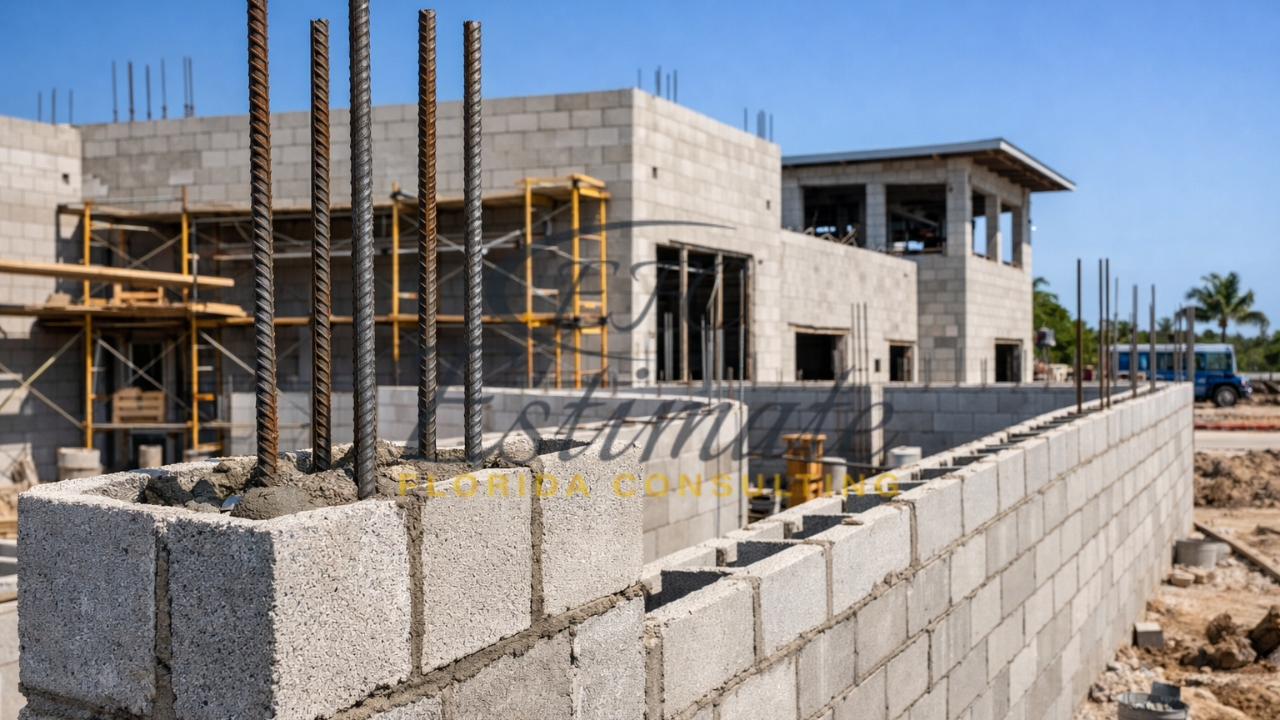
Grouted CMU wall systems are essential for achieving structural masonry performance in Florida. Exterior walls and load-bearing assemblies often require fully grouted masonry cells to meet wind-resistance and impact-resistance standards.
Grouting increases material consumption, equipment usage, and labor supervision, while reducing installation speed. Factors such as wall height, cell congestion, reinforcement density, and access conditions directly influence grouting costs, making this phase one of the most expensive aspects of reinforced masonry construction.
Reinforced Masonry Labor Cost in Florida
Reinforced masonry labor involves specialized masonry skills, including rebar installation, bond beam construction, grout placement, and inspection coordination. Productivity is typically lower than standard block work due to complexity and sequencing requirements.
| Region | Labor Cost (Per Sq Ft) |
| South Florida | $17 – $28 |
| Central Florida | $14 – $25 |
| North Florida | $13 – $22 |
Labor costs vary by region based on workforce availability, inspection enforcement, and project demand, with coastal and metropolitan areas generally at the higher end.
Reinforced Masonry Cost by Building Type
Reinforced masonry pricing varies depending on structural load requirements, occupancy classification, wall height, and design complexity.
| Building Type | Cost Range (Per Sq Ft) |
| Warehouse & Industrial Masonry | $28 – $53 |
| Retail & Office Masonry Construction | $35 – $63 |
| Educational Facility Masonry | $42 – $77 |
| Healthcare & Hospital Masonry | $49 – $91 |
| Multi-Story Commercial Masonry | $53 – $98 |
Projects with essential occupancy, higher risk categories, or complex architectural layouts typically require heavier reinforcement and fall toward the upper cost range.
Florida-Specific Cost Drivers in Reinforced Masonry Construction
High-Velocity Hurricane Zones (HVHZ)
In Florida’s High-Velocity Hurricane Zones—primarily in South Florida—reinforced masonry construction must meet some of the most demanding structural requirements in the country. HVHZ regulations mandate impact-resistant masonry wall systems, closer rebar spacing, higher grout strengths, and enhanced anchorage details to resist extreme wind pressures and flying debris. These assemblies often require additional engineering reviews, shop drawings, and special inspections, which increase preconstruction and compliance costs. Contractors must also use approved materials and tested assemblies, limiting supplier options and raising material pricing. As a result, both labor hours and per-square-foot masonry costs increase compared to non-HVHZ regions, especially for commercial and multi-story projects.
Coastal Corrosion Protection
Coastal masonry construction in Florida faces constant exposure to salt-laden air, high humidity, and moisture intrusion, all of which accelerate steel corrosion. To extend service life and maintain code compliance, reinforced masonry walls frequently incorporate epoxy-coated or stainless-steel reinforcement, galvanized ties, corrosion-resistant anchors, and increased concrete cover over rebar. These protective measures significantly raise material costs and often slow installation due to stricter handling and placement requirements. In addition, coastal projects may require enhanced waterproofing, sealants, and crack-control detailing, further increasing total masonry system costs while reducing long-term maintenance risks.
Wall Height and Structural Complexity
As wall height increases, reinforced masonry construction becomes substantially more complex and labor-intensive. Taller masonry walls require engineered scaffolding systems, certified fall-protection measures, and extended material staging, all of which add to jobsite overhead. Structurally, higher walls must resist greater wind loads, leading to larger CMU sizes, heavier reinforcement schedules, bond beams at closer intervals, and multi-lift grouting procedures. These factors increase labor hours, inspection requirements, and equipment usage. Complex wall geometries, architectural offsets, and load-bearing conditions further compound costs by requiring skilled masons, precise layout work, and closer coordination with structural engineers.
Reinforced Masonry vs Standard CMU Wall Construction
| Feature | Standard CMU Walls | Reinforced Masonry Walls |
| Structural Capacity | Limited | High |
| Wind & Hurricane Resistance | Moderate | Superior |
| Code Compliance in Florida | Limited | Fully Compliant |
| Construction Cost | Lower | Higher |
| Durability & Service Life | Moderate | Excellent |
Reinforced masonry provides superior structural stability, storm resilience, and long-term performance, particularly in Florida’s demanding climate.
Construction Timeline and Lifecycle Cost Benefits
Reinforced masonry construction timelines are influenced by inspection sequencing, reinforcement placement, grout curing, and coordination with other trades. These factors can increase project duration and overhead costs.
However, reinforced masonry offers long-term benefits such as reduced maintenance, improved storm resistance, lower repair frequency, and extended building lifespan, making it a cost-effective solution over the full building lifecycle.
Masonry Construction Cost Estimator Florida – How Estimate Florida Consulting Helps
Using a professional masonry construction cost estimator Florida ensures accurate budgeting for reinforced block construction, structural masonry walls, and commercial masonry projects. Estimate Florida Consulting provides detailed estimates that account for:
- Reinforced CMU quantities
- Structural steel reinforcement schedules
- Grout volumes and labor productivity
- Florida-specific code compliance
- Regional labor and material pricing
Our estimates support contractors, developers, and property owners with reliable cost data for informed decision-making.
Conclusion
Reinforced masonry construction in Florida represents a higher upfront investment compared to standard CMU systems, but it delivers unmatched structural performance, hurricane resistance, and long-term durability in one of the most demanding construction environments in the United States. Factors such as Florida Building Code compliance, High-Velocity Hurricane Zone requirements, coastal corrosion protection, dense reinforcement schedules, and skilled labor availability all contribute to increased reinforced masonry costs per square foot. However, when these systems are evaluated over the full building lifecycle, reinforced masonry consistently proves to be a cost-effective solution due to reduced maintenance, improved storm resilience, and extended service life.
By using a professional masonry construction cost estimator Florida, project stakeholders can accurately account for material quantities, reinforcement steel, grouting operations, inspections, and regional labor pricing. With detailed, Florida-specific estimating support from Estimate Florida Consulting, contractors, developers, and property owners can confidently plan reinforced masonry projects that are code-compliant, budget-accurate, and built to withstand Florida’s extreme environmental conditions.
Frequently Asked Questions (Top Queries)
1. How much does reinforced masonry cost per square foot in Florida?
Reinforced masonry in Florida typically ranges from $31 to $91 per square foot, depending on building type, wall height, reinforcement density, wind-load requirements, and regional labor rates. Hurricane-rated and institutional buildings usually fall at the higher end of this range.
2. Why is reinforced masonry more expensive in Florida than other states?
Florida reinforced masonry costs are higher due to strict Florida Building Code requirements, High-Velocity Hurricane Zone standards, impact-resistant wall assemblies, corrosion protection measures, and mandatory inspections that increase both material and labor expenses.
3. How much does rebar add to reinforced masonry wall costs?
Steel reinforcement commonly accounts for 20% to 30% of total reinforced masonry costs. Projects with tighter rebar spacing, taller walls, or higher wind exposure will experience higher reinforcement and labor costs.
4. What is the labor cost for reinforced masonry in Florida?
Reinforced masonry labor costs generally range from $13 to $28 per square foot, depending on location. South Florida and coastal areas tend to have higher labor rates due to inspection requirements, workforce demand, and complex construction conditions.
5. Are fully grouted CMU walls required in Florida?
Many exterior and load-bearing masonry walls in Florida must be fully grouted to meet wind-load, impact-resistance, and structural performance requirements. Fully grouted systems increase material usage and labor but significantly improve strength and durability.
6. How do High-Velocity Hurricane Zones affect masonry costs?
HVHZ construction requires impact-rated masonry systems, higher grout strengths, closer rebar spacing, special inspections, and approved assemblies, all of which raise reinforced masonry costs compared to non-HVHZ regions.
7. Is reinforced masonry worth the higher cost compared to standard CMU walls?
Yes. Reinforced masonry offers superior wind resistance, structural capacity, durability, and lifecycle performance, making it a smart long-term investment for Florida projects exposed to hurricanes and severe weather.
8. How can a masonry construction cost estimator help control project budgets?
A masonry construction cost estimator Florida provides accurate material takeoffs, labor projections, reinforcement schedules, and code-compliance allowances, helping owners and contractors avoid cost overruns and plan reinforced masonry projects with confidence.