
In the high-stakes world of Florida construction, the structural integrity of a building isn’t just a design choice—it’s a matter of survival. Rebar, or reinforcing bar, serves as the essential skeleton of any concrete structure, providing the tensile strength necessary to withstand massive loads and environmental pressures. For contractors and developers in 2026, understanding the cost of rebar installation is critical for maintaining project profitability, especially as market fluctuations and labor shortages continue to impact the industry.
At Estimate Florida Consulting, we specialize in providing high-precision structural rebar estimating and material takeoffs. In this guide, we will break down the realistic pricing for rebar installation in 2026, focusing on the unique requirements of the Florida market, from coastal corrosion protection to heavy wind-load specifications.
Average Cost of Rebar Installation in 2026
The total cost for rebar in a project typically includes the raw material price, delivery, and professional installation labor. In 2026, the combined cost of rebar installation generally ranges from $1.54 to $4.41 per square foot for most standard residential and commercial slabs.
When looking at it from a weight perspective—which is how most large-scale Florida infrastructure and commercial projects are bid—you can expect total costs to fall between $2,500 and $7,000 per ton once materials, labor, and logistics are accounted for.
Recent market reports indicate that steel prices have seen a significant “surge” heading into 2026, making precise estimation more valuable than ever for contractors trying to avoid budget overruns.

Rebar Material Cost Breakdown
Material pricing is influenced heavily by the type of steel and its intended application. In Florida, “standard” often means higher-than-average specifications due to salt air exposure and hurricane-resistant building codes.
| Rebar Type | Cost Per Ton (Average) | Cost Per Linear Foot | Primary Florida Use Case |
|---|---|---|---|
| Carbon Steel | $1,080 – $1,440 | $0.60 – $0.90 | General foundations, inland slabs |
| Epoxy-Coated | $2,160 – $3,000 | $1.20 – $1.80 | Bridge decks, coastal infrastructure |
| Galvanized | $2,400 – $2,800 | $1.32 – $1.76 | High-humidity areas, salt-spray zones |
| Stainless Steel | $3,000 – $4,200 | $4.95 – $9.90 | Marine structures, sea walls |
| Fiberglass | $2,400 – $3,600 | $1.44 – $2.40 | Magnetic neutrality (hospitals), non-corrosive |
The Impact of Rebar Size on Material Price
While the price per ton remains relatively consistent across sizes for the same material type, the diameter significantly affects how much coverage you get per ton. For instance, #4 rebar (1/2 inch) weighs approximately 0.668 pounds per foot.
Typical linear foot pricing by size includes:
- #3 (3/8″): $0.44 – $1.38 per foot
- #4 (1/2″): $0.55 – $1.93 per foot
- #5 (5/8″): $0.77 – $2.48 per foot
⚡ One accurate rebar estimate today can save thousands in unexpected construction costs tomorrow.
Rebar Installation Labor Cost
Labor is a substantial portion of the how much does rebar installation cost equation. In Florida, the labor market for 2026 remains tight, with a projected national shortage of over 439,000 workers. This scarcity often drives up wages for skilled rebar tiers.
Florida-Specific Labor Rates
In Florida, labor rates for rebar installation typically range from $48 to $120 per hour, depending on the complexity of the reinforcement and the expertise of the crew. When calculated by the square foot, the rebar labor cost per foot usually falls between $1.10 and $1.93 per square foot.
For large-scale commercial or infrastructure work, labor is often quoted by the ton:
- Standard Projects: $1,800 – $3,600 per ton
- Complex/Heavy Infrastructure: $3,600 – $5,400 per ton
Cost Per Square Foot vs. Per Linear Foot
Understanding which metric to use is vital for accurate structural rebar estimating.
- Per Linear Foot: Best for preliminary material ordering and smaller residential items like footing runs or lintels. It helps you understand the direct material cost of a single bar.
- Per Square Foot: This is the industry standard for slab-on-grade work (driveways, patios, house slabs). It incorporates the spacing of the grid (e.g., 12″ on center) and the labor required to tie the entire field.
For example, a 24′ x 24′ (576 SF) two-car driveway in Florida typically requires 814 – 880 linear feet of rebar, resulting in a material cost of $330 – $1,100.
Key Factors That Affect Rebar Installation Cost
Several variables can shift your estimate from the low end to the high end of the spectrum:
- Hurricane & Wind Load Requirements: Florida’s building codes often require denser rebar spacing and thicker gauges (such as #5 or #6) in foundations and tie beams to resist uplift forces during tropical storms.
- Coastal Proximity: If your project is within 1,000 feet of the ocean, standard black steel may not be sufficient. The concrete rebar installation price Florida contractors pay often increases because they must use epoxy-coated or stainless steel to prevent rust-jacking.
- Market Fluctuations: Steel is a global commodity. Tariffs and supply chain disruptions can cause prices to spike without warning.
- Project Complexity: Intricate designs, such as curved pool walls or multi-story commercial foundations, require more cutting, bending, and specialized tying, which increases labor hours significantly.
- Site Accessibility: If a concrete pump or crane is required to move heavy rebar bundles onto a high-rise deck, logistics costs will rise.
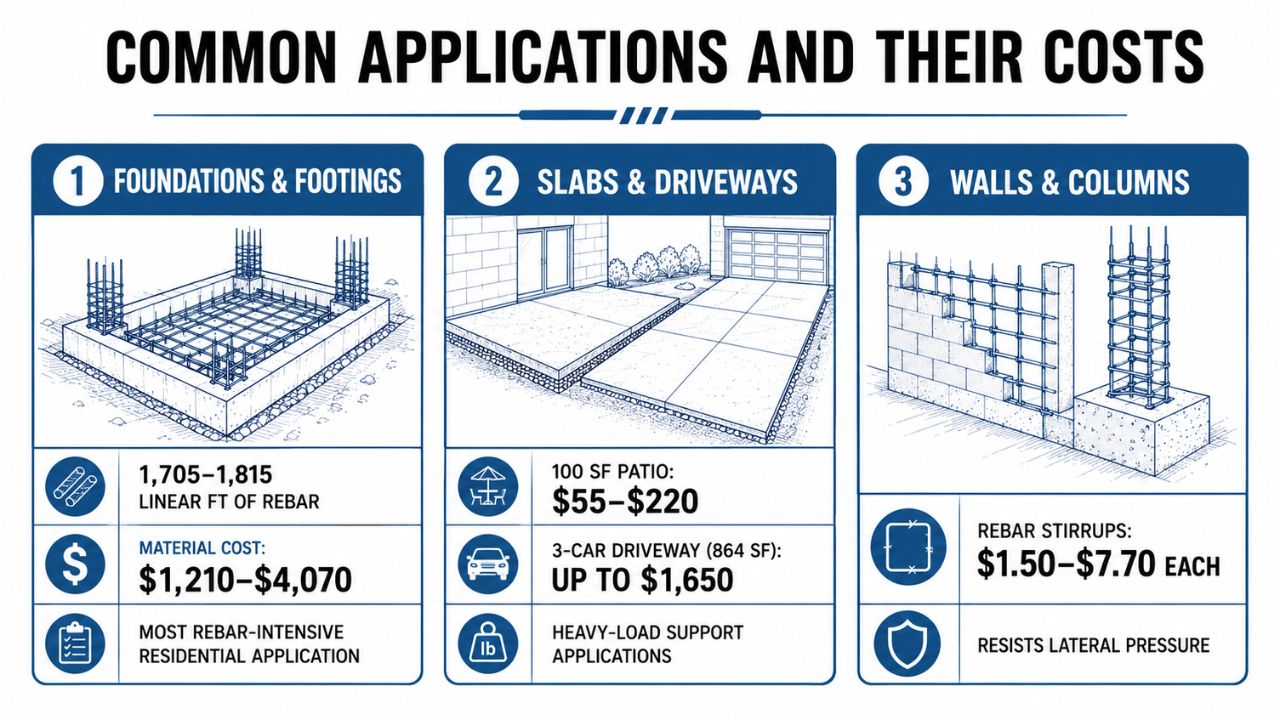
Common Applications and Their Costs
The application dictates the amount of steel and the labor intensity.
Foundations and Footings
Foundations are the most rebar-intensive part of residential construction. A standard 30′ x 40′ foundation (1,200 SF) in Florida might require 1,705 – 1,815 linear feet of rebar, with material costs alone ranging from $1,210 to $4,070.
Slabs and Driveways
For slabs supporting heavy vehicles or those thicker than 4 inches, rebar is mandatory for structural integrity. A typical 100 SF patio may only cost $55 – $220 in materials, whereas a large 3-car driveway (864 SF) can reach $1,650 for materials.
Walls and Columns
Retaining walls and structural columns require vertical reinforcement and “stirrups” to resist lateral pressure. Rebar stirrups can cost between $1.50 and $7.70 each, depending on their length and shape (U-shape, rectangle, etc.).
Additional Costs to Consider
When answering the question, “how much does rebar installation cost?” many contractors forget to account for the “small” items that add up:
- Tying and Supports: Tie wire costs $11 – $50 per reel, and accessories like rebar chairs or spacers cost about $0.06 – $0.18 per foot of rebar.
- Waste Factor: You must account for cutting losses and lap splices (where two bars overlap to maintain continuity). A standard waste factor of 5% to 12% should be added to every takeoff.
- Transportation: Delivery fees in Florida can range from $120 to $1,200 per trip, depending on the distance from the fabrication shop and the weight of the load.
- Inspections: In Florida, a pre-pour inspection is required to ensure rebar is placed and tied correctly. Delays in inspections can lead to increased labor costs for crews standing by.
📞 Ready to know your exact rebar installation costs? Request your detailed estimate today.
How Professional Estimating Helps Control Rebar Costs
In a market where input prices are “surging” and labor is scarce, you cannot afford to guess on your rebar quantities. Professional structural rebar estimating services, like those provided by Estimate Florida Consulting, offer several advantages:
- Precision Takeoffs: We analyze your blueprints to calculate exact linear footage and weight, reducing material waste.
- Accuracy in Bidding: Detailed reports include everything from the main bars to the smallest stirrups and chairs, ensuring your bid is neither too high (losing the job) nor too low (losing money).
- Time Savings: Professional estimators allow project managers to focus on the job site rather than spending hours on manual calculations.
- Cost Control: By identifying opportunities for optimization (like using different grades for residential vs. commercial), we help you maintain your margins.
Plan Reinforcing Steel Scope Before Comparing Rebar Prices
Rebar budgets are most dependable when drawings are converted into a measurable reinforcing schedule rather than priced by a broad slab or foundation area. Bar size, grade, coating, spacing, lengths, laps, hooks, bends, stirrups, dowels, chairs, tie wire, waste, fabrication, delivery, equipment, placement access, and inspection requirements should be defined by element and pour sequence.
Florida wind loading, coastal exposure, concrete cover, corrosion resistance, footing and tie-beam geometry, slab loading, site logistics, and delivery timing can change the appropriate reinforcing package. A detailed quantity takeoff using current steel and labor pricing helps contractors, owners, and design teams compare complete reinforcement scopes and locate omissions before a concrete schedule is committed.
Related estimating support: concrete estimating services, concrete cost estimator, freelance concrete estimator service, and construction cost estimator in Florida.
Frequently Asked Questions (FAQs)
Why is rebar more expensive in coastal Florida areas?
Coastal projects often require epoxy-coated or stainless steel rebar to resist corrosion from salt air. These materials can cost 2x to 5x more than standard carbon steel.
Is rebar necessary for a standard 4-inch concrete slab?
For slabs less than 4 inches thick, rebar is often not required. However, for anything 4 inches or thicker—especially if it will support vehicles—rebar is essential to prevent cracking.
What is the average labor cost for rebar installation per square foot?
In 2026, expect to pay between $1.10 and $1.93 per square foot for labor alone.
How much extra rebar should I order for waste?
A standard contingency is 5% to 12% of the total material cost to cover cutting waste, errors, and lap splices.
What is the difference between Grade 40 and Grade 60 rebar?
Grade 60 is stronger (60,000 PSI yield strength) and is used for heavy commercial and infrastructure work. Grade 40 is common in residential projects and typically costs about 40% less than Grade 60.
Do I need professional rebar stirrups for a retaining wall?
Yes. Stirrups are essential for reinforcing columns and beams, providing the lateral strength needed to hold the main rebar poles in place during the pour.
How do steel market rates affect my project in 2026?
Steel prices fluctuate based on global demand and tariffs. Heading into 2026, prices have shown an upward trend, making it critical to have current market data when bidding.
Get Your Accurate Rebar & Concrete Estimate Today
Don’t let fluctuating steel prices and complex Florida building codes sink your project’s budget. Estimate Florida Consulting provides the expert material takeoffs and cost estimates you need to bid with confidence and build with precision.
Whether you are working on a high-rise in Miami, a custom home in Palm Beach, or a commercial development in Orlando, we are your partners in accurate structural estimating.
Contact Estimate Florida Consulting today:
- Email: info@estimatorflorida.com
- Phone: 561-530-2845