
Building in Florida’s rapidly expanding multi-family market requires trade-by-trade financial planning supported by current local pricing. Whether you are developing a luxury condominium in Miami or a garden-style apartment complex in Orlando, the electrical system represents one of the most complex and variable cost centers in your budget. As we move through 2026, developers face a landscape defined by volatile material prices, a shortage of skilled master electricians, and increasingly stringent building codes focused on energy efficiency and hurricane resilience.
⚡ Get an Accurate Multi-Family Electrical Wiring Cost Estimate.
At Estimate Florida Consulting, we have spent over 12 years refining our methodology. Having delivered more than 1,000 professional estimates, we understand that a “multi-family-building-electrical-wiring-cost-estimator” is not just a tool, but a strategic asset. Accurate cost estimation is the backbone of any successful construction project, ensuring that resources are allocated efficiently and that stakeholders avoid the “money pits” that often arise from poor initial takeoffs. This guide provides an in-depth analysis of current Florida market rates, system components, and regional factors that will influence your 2026 multi-family projects.
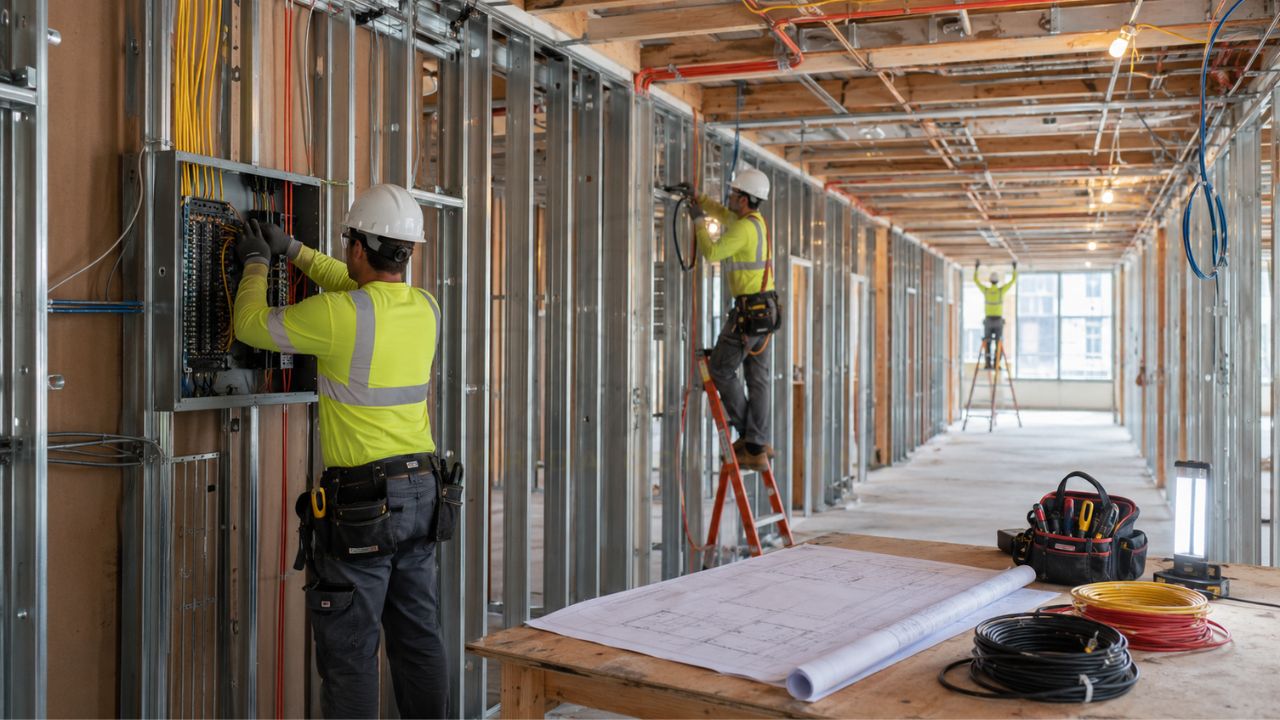
The Role of a Multi-Family Building Electrical Wiring Cost Estimator
In the context of multi-family construction, an estimator must look beyond the individual unit. Unlike single-family homes, multi-family projects involve shared infrastructure, complex distribution networks, and sophisticated life-safety systems.
The Aggregate Variable Model
When calculating costs, professional estimators use an aggregate model that accounts for:
- System Scale: The transition from a 4-plex to a 100-unit complex introduces economies of scale in materials but exponentially increases the complexity of service entrances and distribution panels.
- Labor Burdens: In Florida, labor productivity can drop by 10-15% during summer months due to heat, a factor often missed by generic national estimators.
- Regulatory Compliance: Costs must account for local Central Florida or South Florida building codes, which often mandate specific conduit types or surge protection.
💰 Receive a Detailed Electrical Cost Breakdown for Multi-Family Buildings.
Florida-Specific Pricing Benchmarks for 2026
The following tables represent current benchmarks for the Florida market. These figures are derived from real-world data and professional takeoffs delivered by Estimate Florida Consulting.
Electrical Wiring Costs by Project Size (Florida 2026)
| Project Size (Total Sq. Ft.) | Average Cost Range | Typical Build Type |
|---|---|---|
| 10,000 sq. ft. | $80,000 – $150,000 | 8-12 Unit Low-Rise |
| 20,000 sq. ft. | $160,000 – $300,000 | Garden-Style Apartments |
| 50,000 sq. ft. | $400,000 – $750,000 | Mid-Rise Multi-Family |
| 100,000 sq. ft. | $800,000 – $1,500,000 | Luxury High-Rise Complex |
Data source: Estimate Florida Consulting proprietary market analysis.
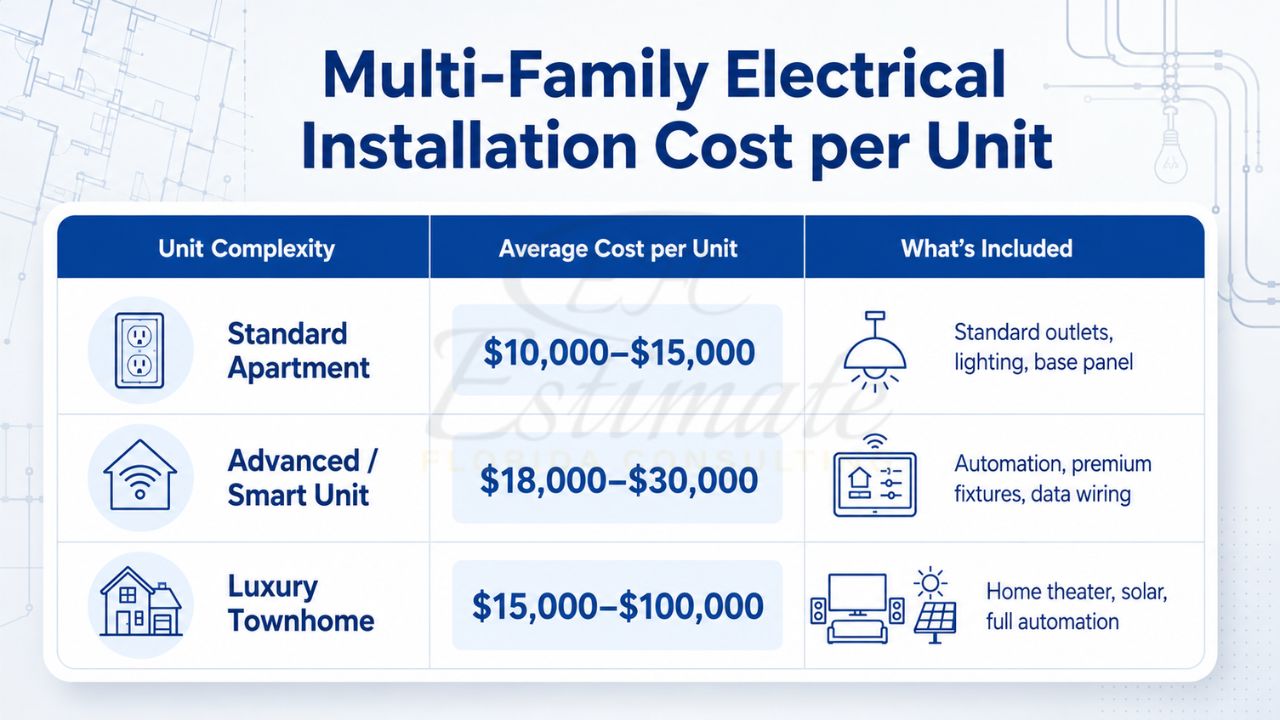
Multi-Family Electrical Installation Cost per Unit
| Unit Complexity | Average Cost per Unit | What’s Included |
|---|---|---|
| Standard Apartment | $10,000 – $15,000 | Standard outlets, lighting, base panel. |
| Advanced/Smart Unit | $18,000 – $30,000 | Automation, high-end fixtures, data. |
| Luxury Townhome | $15,000 – $100,000 | Theaters, solar, full automation. |
Detailed Cost Component Breakdown
To provide an accurate “multi-family-building-electrical-wiring-cost-estimator” experience, we must break down the “total cost” into its constituent parts.
1. Service Entrance and Power Distribution (15–20% of Budget)
The “heart” of a multi-family building is the main service entrance. For large complexes, this involves high-capacity transformers, multi-tenant metering stacks, and massive sub-panels.
- Main Panels: Costs range from $1,500 to $5,000 depending on amperage and smart monitoring features.
- Panel Upgrades: For renovations, upgrading to 400 Amps can cost between $11,000 and $16,500.
2. Rough-In Materials: Wiring and Cabling (30–35% of Budget)
The choice of wire is a major cost driver. While copper is preferred for its durability and conductivity, its price volatility requires constant market monitoring.
- Non-Metallic Sheathed (Romex): $0.95 – $5.70 per foot.
- Metallic Sheathed (BX/AC): $1.27 – $2.24 per linear foot (often required in commercial-style multi-family units).
- Structured/Low-Voltage Wiring: Adds an average of $2.00 per linear foot for high-speed data and communication.
3. Lighting Systems and Fixtures (20–30% of Budget)
Energy-efficient LED lighting is now the standard under Florida’s Energy Conservation Code.
- Standard Lighting Packages: $1,000 – $3,000 per unit.
- Advanced Smart Lighting: Can exceed $15,000 per unit for high-end developments.
📋 Get Customized Estimates for Apartment and Condo Electrical Systems.
Project Type Variations: Duplexes to High-Rise Apartments
The physical layout of the building significantly impacts the electrical wiring strategy and cost.
Single-Story Multi-Family (Duplex/Fourplex)
These are the simplest to wire, with costs ranging from $4 to $7 per square foot. The absence of vertical wiring and simpler distribution needs keeps labor costs manageable.
Multi-Story Residential Buildings
Multi-story projects involve intricate vertical wiring and additional distribution panels for every floor. Costs typically rise to $5–$9 per square foot due to the planning required for conduits and power flow between levels.
Multi-Unit Apartments and Condominiums
These projects demand the most extensive coordination. Shared areas—lobbies, parking garages, and corridors—require dedicated circuits for emergency systems, fire alarms, and security. The square foot cost here typically sits between $6 and $10.
The Florida Factor: Hurricane Codes, Humidity, and Corrosion
In Florida, “average” national pricing is often dangerously inaccurate because it ignores our unique environmental challenges.
Hurricane & Wind Load Requirements
Any external electrical components, such as generator transfer switches or main service disconnects, must be rated for high-velocity hurricane zones (HVHZ). This requires reinforced enclosures and specialized mounting hardware that carries a price premium.
Salt-Air Corrosion
For multi-family projects within five miles of the Florida coast, standard galvanized materials will not last. Professional estimators must account for stainless steel or PVC-coated components, which can increase material costs by 25–40%.
Florida Energy Code (R406) Compliance
Florida’s strict energy codes mandate high-efficiency lighting and, in many commercial-scale multi-family buildings, occupancy sensors and “daylight harvesting” controls that automatically adjust lighting based on natural light levels.
New Construction vs. Renovation: The Financial Gap
One of the most critical distinctions in electrical estimating is the difference between a “new build” and a “full rewire” of an existing apartment building.
New Construction vs. Full Rewire (Residential Multi-Family)
| Project Type | Cost Per Square Foot | Why the Difference? |
|---|---|---|
| New Construction | $4.80 – $8.40 | Open walls, fast install, easy access. |
| Full Rewire/Retrofit | $8.64 – $17.28 | Demolition, fishing wires, debris removal. |

In a renovation, labor intensity is the primary driver of cost. An electrician may spend hours “fishing” a single circuit through 1960s-era plaster walls, whereas that same circuit would take minutes to install in an open-stud new build.
Common Pitfalls in Multi-Family Electrical Budgeting
Even experienced developers can be caught off guard by these common estimating errors:
- Underestimating Labor Hours: Florida’s humidity and heat can reduce labor productivity by up to 15% for outdoor or unconditioned workspace.
- Ignoring Code Changes: Using outdated National Electrical Code (NEC) standards leads to failed inspections and expensive rework.
- Omitting Temporary Power: Many developers forget to budget for the temporary power poles required for the construction crew before the main service is connected.
- Poor Takeoff Accuracy: Missing even 500 feet of specialized data cable in a large multi-family building can erase a contractor’s profit margin.
🔌 Budget Your Electrical Installation with Professional Estimating Services.
Strategic Benefits of Professional Estimating Services
In an industry where margins are thin, an accurate estimate is your most valuable risk-mitigation tool. Partnering with a professional firm like Estimate Florida Consulting offers:
- Risk Mitigation: We identify potential “money pits”—like hidden code requirements or material shortages—before the first wire is pulled.
- Competitive Bidding: Contractors can bid with confidence, knowing their numbers are grounded in current 2026 Florida market data.
- Efficiency: Professional estimators use advanced digital takeoff software, saving dozens of hours of manual counting and reducing human error.
Price Electrical Scope Within the Full Multi-Family Budget
Electrical pricing should be reviewed alongside the building layout, unit count, service capacity, common areas, fire and life-safety coordination, low-voltage systems, site lighting, temporary power, and the local utility requirements that apply to the project. A scope-based electrical takeoff helps a developer or construction team distinguish unit wiring from the larger distribution and infrastructure budget before comparing bids.
For full-project quantity takeoffs and current trade-pricing support, review our Construction Estimating service. Income-property and larger facility scopes can also use Commercial Estimating. For a related plan-based example, see 3-Story 24-Unit Apartment Building Plans & Cost Estimator, and use Construction Cost Estimator in Florida for preliminary statewide budget framing.
FAQs
- What is the average electrical wiring cost per square foot for apartments in Florida?
For 2026, expect between $6.00 and $10.00 per square foot for standard apartment buildings. - Does the per-unit cost include light fixtures?
Standard estimates usually include basic fixtures, but high-end chandeliers or specialized recessed lighting are typically treated as extra line items. - Why are labor rates higher in Florida?
Labor rates for master electricians in Florida range from $100 to $140 per hour, reflecting the high demand for skilled labor and the complexity of state-specific codes. - How does hurricane rating affect electrical costs?
Exterior equipment must meet wind-load and moisture-resistance ratings defined by the Florida Building Code, which often requires more expensive, reinforced enclosures. - Is copper wiring mandatory?
While not always mandatory, copper is preferred for its durability and conductivity. However, it is significantly more expensive than aluminum. - What is “structured wiring”?
It is a system of cabling and hardware that provides the infrastructure for data, telephone, and video signals, usually adding about $2 per linear foot to the estimate. - Can a professional estimate help with bank financing?
Yes. Lenders require detailed, professional cost projections to verify project feasibility and secure construction loans. - How much does a backup generator add to the cost?
Installing a whole-building backup generator for a multi-family complex can range from $10,000 to $100,000+ depending on the size and capacity. - How often do electrical codes change in Florida?
Florida typically adopts updated versions of the National Electrical Code (NEC) every three years. - What is the cost of a 200-amp panel upgrade?
Upgrading to a 200-amp panel in a Florida home or multi-family unit typically costs between $1,650 and $3,850 including labor.
Conclusion
The “multi-family-building-electrical-wiring-cost-estimator” is more than just a calculation; it is a roadmap for project success. In Florida’s unique 2026 construction environment, success depends on understanding the intersection of local climate, strict building codes, and evolving labor markets.
At Estimate Florida Consulting, we specialize in turning complex blueprints into clear, actionable financial roadmaps. Whether you are a developer planning a new multi-family project or a contractor preparing a bid, our precision is your protection.
Ready for a detailed electrical takeoff?
Contact Estimate Florida Consulting today to ensure your project stays on budget and on schedule.
- Phone: 561-530-2845
- Website: estimatorflorida.com