
The Florida real estate landscape in 2026 continues to be a magnet for growth, driven by an influx of over 300,000 new residents annually. For developers and investors, the demand for mid-range, multi-family housing has never been higher. Among the various development models, the 3-story 24-unit apartment building has emerged as a premier choice for maximizing profitability on smaller urban and suburban lots.
However, success in the “Sunshine State” requires more than just a standard blueprint. Florida’s unique environmental challenges—ranging from corrosive coastal air and high humidity to the stringent requirements of High-Velocity Hurricane Zones (HVHZ)—demand a localized approach to architectural planning and cost estimation. Navigating these complexities requires deep regional expertise.
🏢 Get an accurate estimate for your 3-Story 24-Unit Apartment Building before construction begins.
At Estimate Florida Consulting, we bring over 12 years of specialized experience and a portfolio of 1,000+ delivered estimates to your project. We understand that a 3-story 24-unit apartment building plan is not just a layout of rooms; it is a financial instrument that must be tuned to Florida’s specific labor rates, material availability, and regulatory landscape. This guide provides the comprehensive technical and financial insights needed to move from conceptual plans to a successful, profitable build.
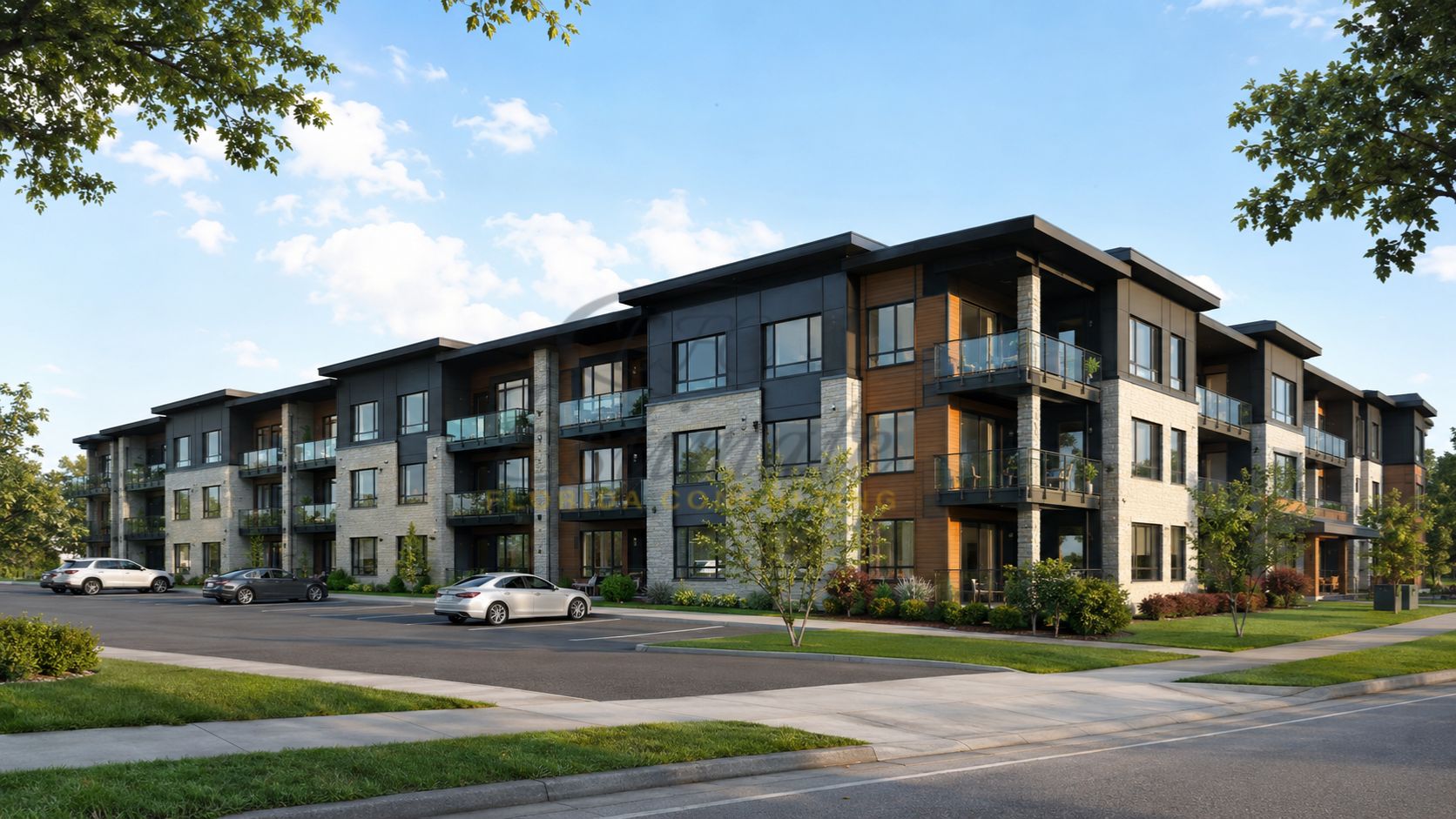
Why the 3-Story 24-Unit Model Dominates the Florida Market
The 24-unit configuration, typically spread across three floors with eight units per floor, is widely regarded as a “sweet spot” in multi-family development for several strategic reasons.
1. Construction Type Efficiency
In Florida, 3-story buildings are often constructed using Type V (Wood Frame) or Type II (Steel/Masonry) methods. Type V is generally the most cost-effective for this height, allowing developers to avoid the significantly higher costs associated with high-rise steel and concrete structures required for buildings over four stories.
2. Elevator Requirements and ADA Compliance
While the Florida Building Code and ADA standards often require elevators in multi-family buildings, 3-story structures are the limit where a single hydraulic elevator can efficiently serve the population without the need for expensive, high-speed traction systems required in taller buildings. This keeps both initial capital expenditure and long-term maintenance costs manageable.
3. Land Use Optimization
A 24-unit building fits comfortably on a 1-to-2-acre lot while leaving adequate space for the parking ratios required by Florida municipalities (typically 1.5 to 2 spaces per unit) and necessary stormwater retention ponds.
4. Operational Scalability
Managing 24 units is an ideal entry point for private investors and a scalable “building block” for larger developers. It provides enough rental income to support professional property management while remaining small enough for easier financing through local Florida lenders.
💰 Avoid costly surprises with a detailed multifamily construction estimate.
Essential Floor Plan Concepts and Layout Options
When selecting or designing 3-story 24-unit apartment building plans, the choice of layout directly impacts construction costs and tenant appeal.
The Double-Loaded Corridor (Hotel Style)
This is the most common layout for modern 24-unit buildings. A central hallway runs the length of the building, with units on either side.
- Pros: Efficient use of climate-controlled space; enhanced security with a single entry point; protected from Florida’s afternoon rain showers.
- Cons: Higher HVAC costs for common areas; potential for noise transfer between units across the hall.
The Garden-Style (Exterior Breezeway)
In this layout, unit entrances are accessed via exterior walkways or breezeways.
- Pros: Lower construction and operational costs (no common area HVAC); popular in coastal Florida for natural ventilation.
- Cons: Residents are exposed to the elements; higher maintenance for exterior-facing doors and finishes due to humidity and salt air.
The “L” or “U” Shape
Ideal for corner lots or sites where a central courtyard is desired for amenities like a pool or fire pit.
- Pros: Maximizes natural light for every unit; creates a premium “community” feel that can command higher rents in markets like Orlando or Tampa.
- Cons: More complex foundation and roofing transitions, which increase the material takeoff requirements and labor costs.
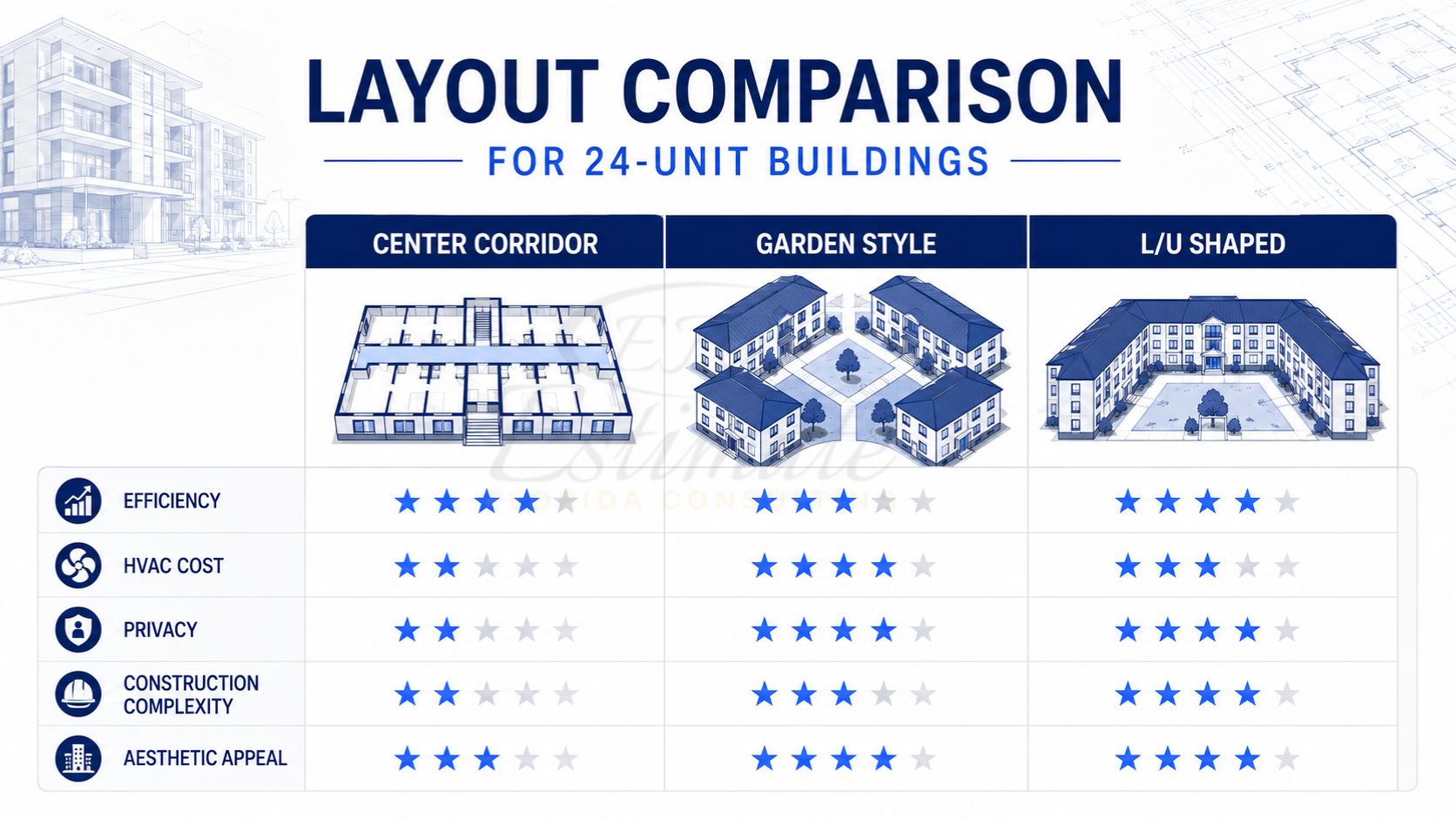
Layout Comparison for 24-Unit Buildings
| Feature | Center Corridor | Garden Style | L/U Shaped |
|---|---|---|---|
| Efficiency | High (Internal) | Medium | Lower |
| HVAC Cost | Highest (Common Areas) | Lowest | Medium |
| Privacy | High | Low/Medium | High |
| Construction Complexity | Low | Medium | High |
| Aesthetic Appeal | Modern/Sleek | Coastal/Relaxed | Premium/Luxury |
🏗️ Build smarter with professional apartment building estimating services.
Optimizing Unit Configurations: Studio vs. 1-Bedroom vs. 2-Bedroom Mix
The “Unit Mix” is the most critical decision for a developer’s ROI. For a 24-unit building in Florida, the mix should reflect the local demographics (e.g., young professionals in Miami vs. retirees in Sarasota).
1. The “Standard Professional” Mix
- Configuration: 4 Studios, 12 One-Bedrooms, 8 Two-Bedrooms.
- Market: Ideal for urban hubs like Tampa or Jacksonville where young professionals seek proximity to work.
- Average SF: 750–950 sq. ft. per unit.
2. The “Family-Centric” Mix
- Configuration: 4 One-Bedrooms, 16 Two-Bedrooms, 4 Three-Bedrooms.
- Market: Suburban Orlando or Lehigh Acres, where families look for affordable multi-family options.
- Average SF: 1,000–1,250 sq. ft. per unit.
3. The “Luxury/Coastal” Mix
- Configuration: 24 High-End Two-Bedroom units.
- Market: Waterfront areas in Boca Raton or Naples where tenants expect spacious layouts and “work-from-home” dens.
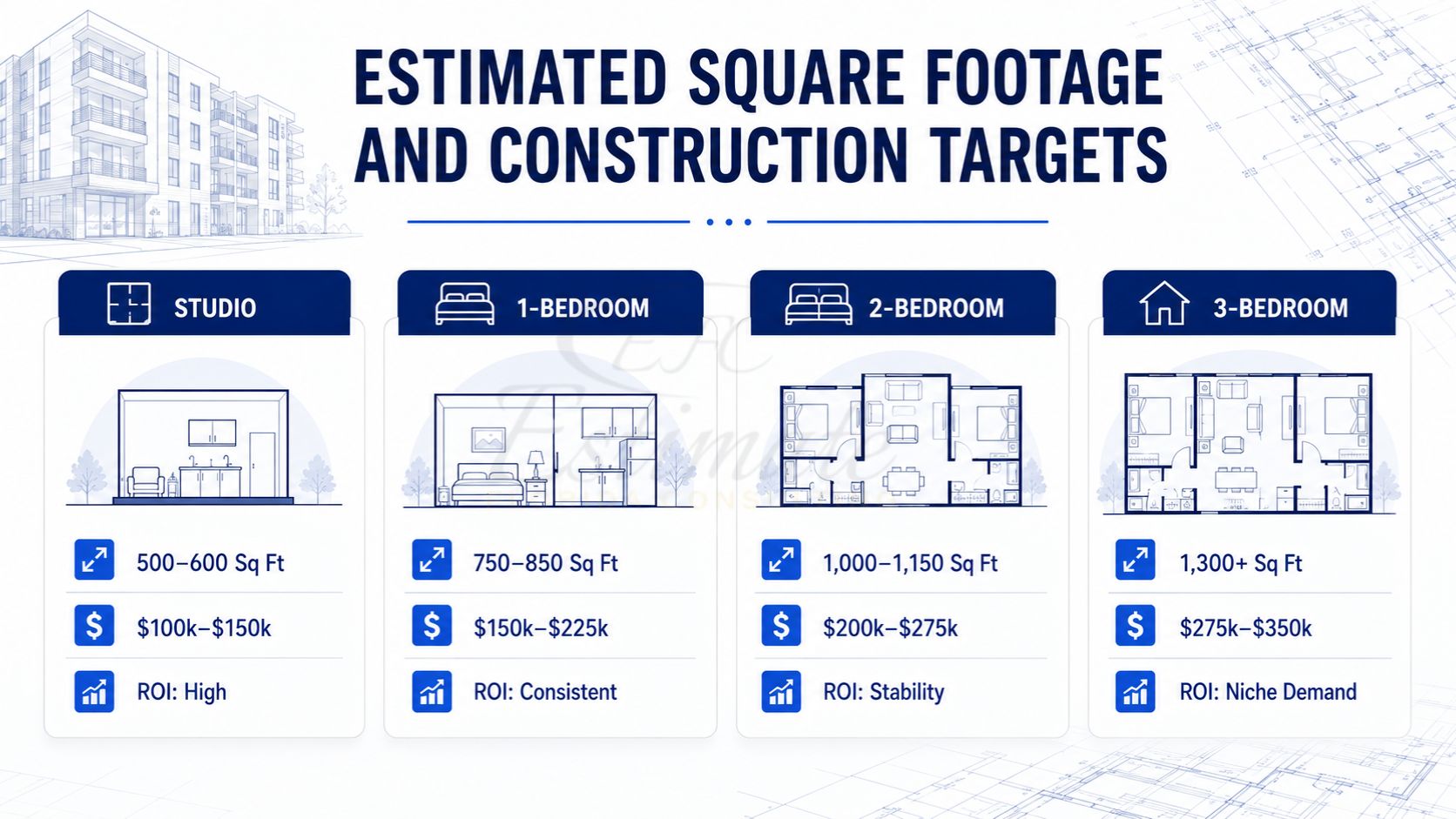
Estimated Square Footage and Construction Targets
| Unit Type | Target Sq. Ft. | Estimated Cost/Unit (Mid-Range) | ROI Potential |
|---|---|---|---|
| Studio | 500 – 600 | $100k – $150k | High (High PSF Rent) |
| 1-Bedroom | 750 – 850 | $150k – $225k | Consistent |
| 2-Bedroom | 1,000 – 1,150 | $200k – $275k | Stability (Lower Turnover) |
| 3-Bedroom | 1,300+ | $275k – $350k | Niche (Family Demand) |
Florida-Specific Design: Hurricane Codes and Wind Load Requirements
Designing a 3-story 24-unit apartment building plan in Florida requires a level of structural engineering far beyond most other states. The Florida Building Code (FBC) is updated regularly to incorporate lessons from recent storm seasons.
High-Velocity Hurricane Zones (HVHZ)
If your project is in Miami-Dade or Broward County, it must meet HVHZ standards. This includes:
- Impact-Resistant Glazing: All windows and glass doors must withstand large missile impacts.
- Reinforced Masonry: Use of “tie-beams” and vertical rebar in CMU (Concrete Masonry Unit) walls to prevent structural failure under extreme wind pressure.
Wind Load and Roof Uplift
Wind loads in Florida can reach 140–180 mph. Plans must include:
- Hurricane Straps: Heavy-duty metal connectors securing the roof trusses to the wall plates.
- Secondary Water Barriers: Specialized underlayments that prevent water intrusion even if the primary roofing material (shingles or tile) is stripped away.
Moisture and Mold Mitigation
Florida’s humidity is a constant threat. High-performance vapor barriers and correctly sized HVAC systems with dehumidification cycles are essential line items in any professional estimate. Failure to account for these can lead to catastrophic remediation costs post-construction.
🏆 Protect your budget with expert multifamily construction estimates.
Site Planning and Feasibility: Parking, Stormwater, and Zoning
A 24-unit building requires significant “unbuilt” space to function and comply with Florida municipal codes.
Parking Ratios and ADA Requirements
Most Florida counties require 1.5 to 2.25 parking spaces per apartment unit. For 24 units, you need roughly 40–54 parking spaces.
- Tip: Incorporating some “tuck-under” parking (parking on the ground floor beneath the units) can save land but increases the structural cost as the first floor must be reinforced concrete or steel.
Stormwater Management
Florida’s flat topography and heavy rainfall mean that stormwater retention ponds are often mandatory. Developers must dedicate 10–20% of the lot to water management, which can impact the number of units feasible on a site.
Energy Efficiency Standards
The Florida Energy Code requires specific R-values for insulation and high-efficiency mechanical systems. Integrating solar-ready infrastructure or EV charging stations is increasingly popular and can offer tax incentives.
Construction Cost Breakdown: Trade-by-Trade Analysis
Understanding where the money goes is vital for maintaining a healthy profit margin. Based on our 1,000+ estimates at Estimate Florida Consulting, here is how a typical 3-story 24-unit build breaks down by CSI division.
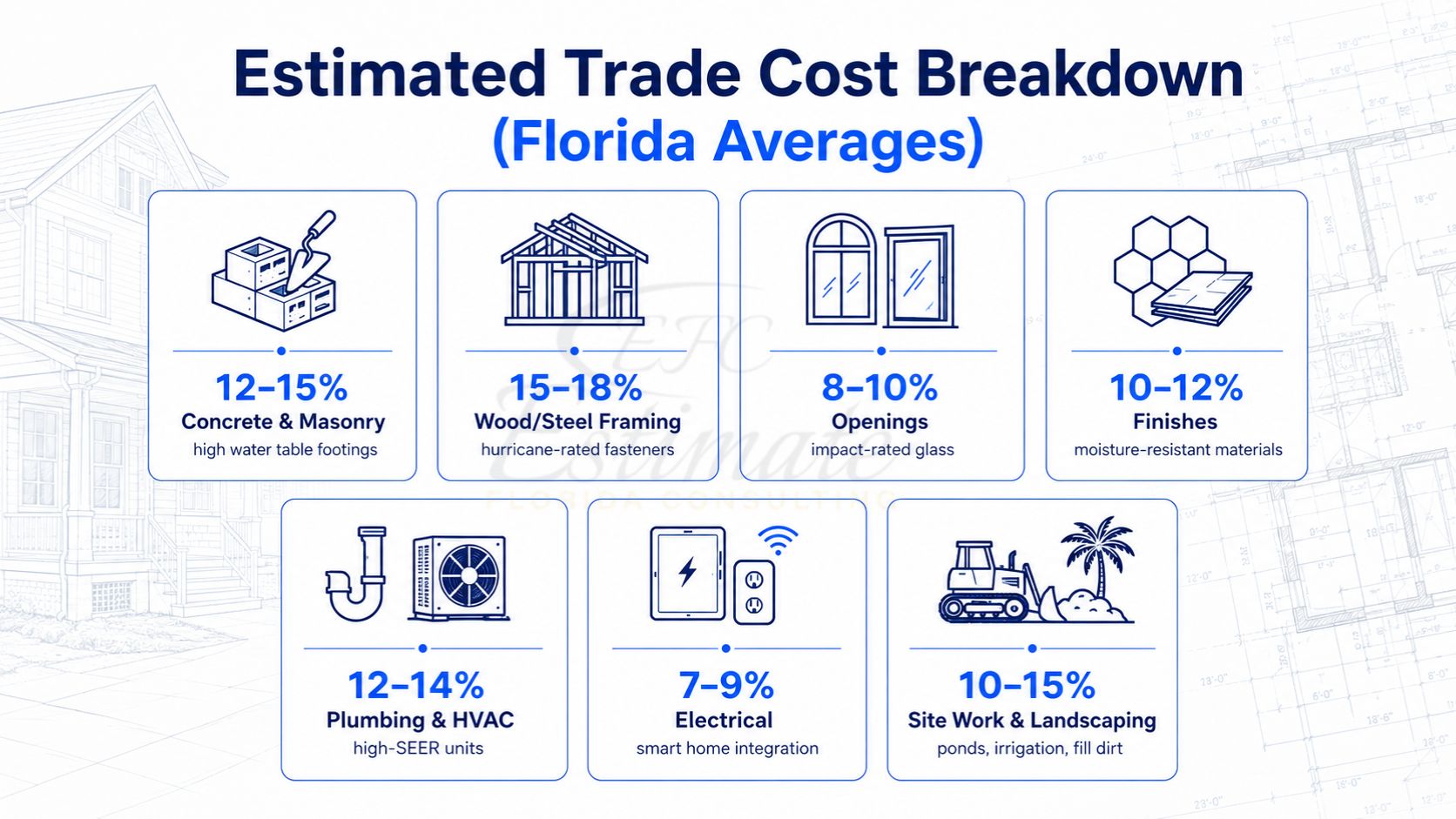
Estimated Trade Cost Breakdown (Florida Averages)
| CSI Division | Description | % of Total Budget | Florida-Specific Factor |
|---|---|---|---|
| Div 03 | Concrete & Masonry | 12% – 15% | Heavy footings for high water table. |
| Div 06 | Wood/Steel Framing | 15% – 18% | Hurricane-rated fasteners/straps. |
| Div 08 | Openings (Windows/Doors) | 8% – 10% | Impact-rated glass (High cost). |
| Div 09 | Finishes (Drywall/Paint) | 10% – 12% | Moisture-resistant materials. |
| Div 22/23 | Plumbing & HVAC | 12% – 14% | High-SEER units for humidity. |
| Div 26 | Electrical | 7% – 9% | Smart home/Security integrations. |
| Div 31/32 | Site Work & Landscaping | 10% – 15% | Ponds, irrigation, and fill dirt. |
The Role of Professional Estimating in Controlling Budgets
Many developers attempt to use generic “cost per square foot” calculators. In the volatile Florida market of 2026, this is a dangerous gamble.
Why Generic Estimates Fail in Florida
- Labor Volatility: Labor rates in Miami can be 20% higher than in Jacksonville.
- Material Spikes: The cost of lumber and concrete fluctuates monthly.
- Code Nuances: A plan designed for Georgia will fail a Florida building inspection, leading to costly redesigns and “change order” nightmares.
The Estimate Florida Consulting Advantage
We provide Detailed Quantity Takeoffs using industry-leading software like PlanSwift and Bluebeam. This means we don’t just guess; we count every linear foot of rebar and every square foot of impact glass.
- Winning Bids: Our estimates allow contractors to bid aggressively without losing their shirts.
- Securing Financing: Banks and lenders require professional, itemized reports to verify the financial feasibility of a project.
📞 Request your 3-Story 24-Unit Apartment Building estimate today.
Strategic Tips for Developers and Investors
- Think “Vertical”: In high-land-value areas like Fort Lauderdale, consider a “Podium” design where the first floor is parking and the 24 units are on the three floors above.
- Focus on “The Core”: Group plumbing stacks (kitchens and baths) back-to-back between units to save thousands on piping and labor.
- Pre-Construction Feasibility: Always perform a Preliminary Estimate before purchasing land. If the site requires $200k in “fill dirt” to reach flood-plane requirements, your ROI could vanish.
- Value Engineering: Work with your estimator to identify “alternates”—such as choosing luxury vinyl plank (LVP) over tile to save on labor while maintaining high aesthetic appeal.
Use the Plan Set to Test the 24-Unit Apartment Budget
Conceptual cost ranges are only a starting point. Before land acquisition, financing, or bid submission, a 24-unit apartment estimate should separate the building shell, unit mix, common corridors, elevators, life-safety systems, MEP distribution, sitework, parking, stormwater, utility connections, amenities, and project-specific code requirements. A measured trade-by-trade scope helps a development team compare options without confusing a headline cost range for a complete project budget.
For plan-based quantity takeoffs and current trade-pricing support, use our Construction Estimating service. Multi-family and other income-property scopes can also be supported through Commercial Estimating. For early statewide cost framing, see Construction Cost Estimator in Florida, and review Multi-Family Building Electrical Wiring Cost Estimator when electrical scope is being evaluated independently.
FAQ: Everything You Need to Know About 3-Story 24-Unit Plans
- How much does it cost to build a 24-unit apartment building in Florida?
Costs typically range from $4 million to $8.5 million depending on the city, finishes, and current material prices. - Do 3-story apartments in Florida require an elevator?
While the FBC has specific thresholds, most modern 24-unit developments include at least one elevator to maximize marketability and comply with Fair Housing Act guidelines. - What is the typical construction timeline?
A 3-story 24-unit building generally takes 12 to 18 months from ground-breaking to certificate of occupancy. - How many acres do I need for a 24-unit building?
Depending on zoning and parking requirements, you typically need 1.25 to 2 acres. - Can I use wood framing for a 3-story building in Florida?
Yes, Type V wood framing is common and cost-effective, provided it meets all wind-load and fire-rating codes. - What are “soft costs”?
Soft costs include architectural fees, permits, and legal work, usually totaling 15–20% of the overall budget. - How do I choose between a center-corridor or garden-style layout?
Choose garden-style for lower costs and a coastal feel; choose center-corridor for higher security and a more “premium” urban aesthetic. - Is an 8-unit-per-floor layout the most efficient?
Yes, it creates a balanced “double-loaded” corridor that minimizes the ratio of hallway space to rentable unit space. - How does flood zone status affect my plans?
Building in a flood zone requires elevated “finished floor” heights and potentially specialized foundations, which can add 10–30% to site costs. - Why is impact glass so expensive in Florida?
It is a specialized multi-layered product designed to prevent pressure changes during a storm that can lead to roof failure. - Does Estimate Florida Consulting provide trade-specific estimates?
Yes, we provide detailed takeoffs for all trades including MEP, framing, and finishes. - Can a professional estimate help me get a bank loan?
Absolutely. Most lenders require an itemized, third-party cost estimation to approve construction financing.
Conclusion
Building a 3-story 24-unit apartment complex is one of the most reliable ways to build wealth in the Florida real estate market. However, with high stakes come high risks—primarily the risk of budget overruns and code non-compliance.
In a market where material costs fluctuate and hurricane codes are uncompromising, you cannot afford to “guesstimate.” Partner with the experts who have spent over a decade analyzing the Florida construction landscape. At Estimate Florida Consulting, we provide the precision you need to bid with confidence and build for profit.
Ready to see the real numbers for your 24-unit project?
Contact us today for a comprehensive, data-backed estimate tailored to your specific Florida location.
- Phone: 561-530-2845
- Email: info@estimatorflorida.com
- Website: estimatorflorida.com