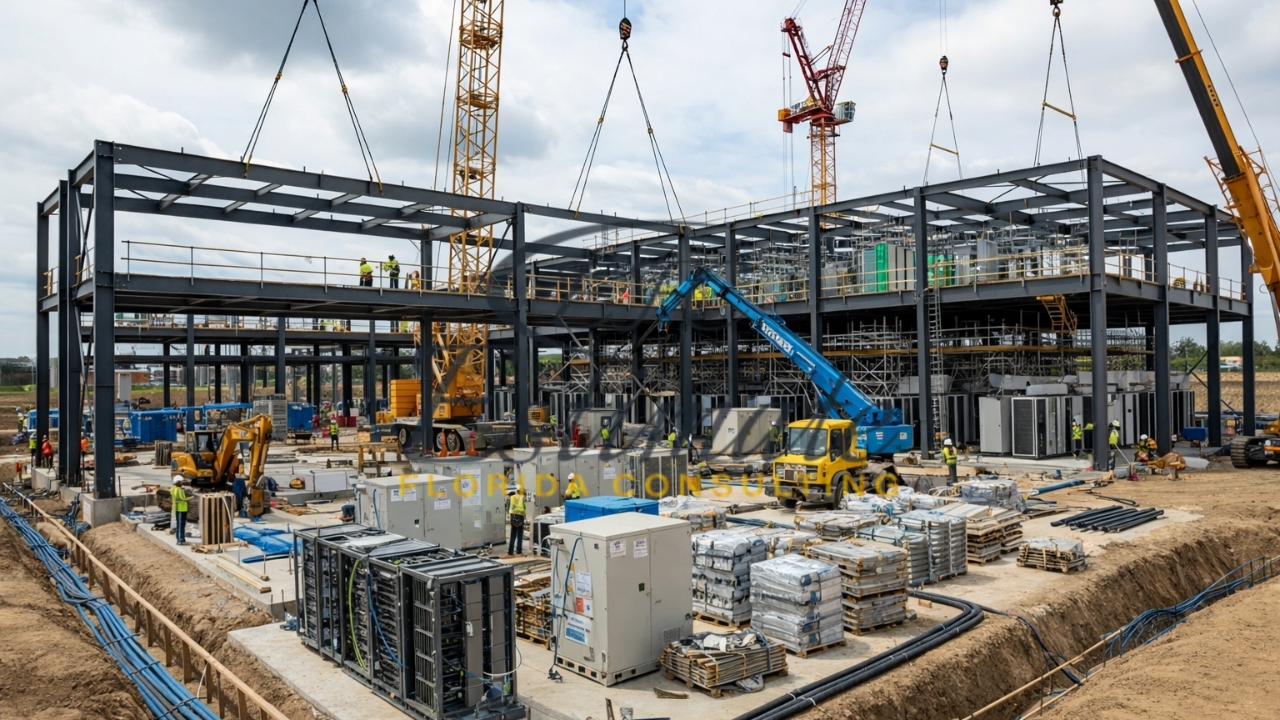
Data center construction in Florida is experiencing rapid growth as demand for cloud computing infrastructure, colocation data centers, enterprise IT facilities, and AI-driven workloads continues to rise. Florida’s strategic geographic location, expanding population, favorable tax environment, and strong connectivity to domestic and international fiber networks make it an increasingly attractive market for hyperscale data center development. However, building a data center in Florida presents unique challenges related to hurricane exposure, power availability, cooling system efficiency, and strict Florida Building Code compliance.
Understanding the complexities of Florida data center construction is essential for developers, operators, and investors seeking high availability, cost-effective design, and long-term operational efficiency across mission-critical facilities.
Why Florida Is a Growing Market for Data Centers?
Florida offers several advantages for data center development, including access to major fiber optic routes, proximity to Latin American and Caribbean markets, and a business-friendly regulatory environment. Cities such as Miami, Orlando, Tampa, and Jacksonville are emerging as key hubs for colocation facilities, enterprise data centers, and cloud service providers.
At the same time, Florida’s climate and regulatory environment require careful planning. High humidity, hurricane risk, and energy resilience requirements significantly influence both data center construction cost and facility design strategy, making early planning essential for successful projects.
Average Cost of Data Center Construction in Florida
The cost to build a data center in Florida varies widely based on facility size, tier classification, redundancy levels, and power density requirements. Unlike traditional commercial buildings, data centers are highly specialized facilities where mechanical systems, electrical infrastructure, and structural hardening represent a significant portion of total project cost.
On average, data center construction costs in Florida typically range from:
- $800 to $1,500+ per square foot
- $7 million to $15 million per megawatt (MW) of IT load
High-density facilities or Tier III and Tier IV data centers often exceed these ranges due to N+1 or 2N redundancy, hardened construction, and advanced cooling technologies.
Site Selection and Location Planning in Florida
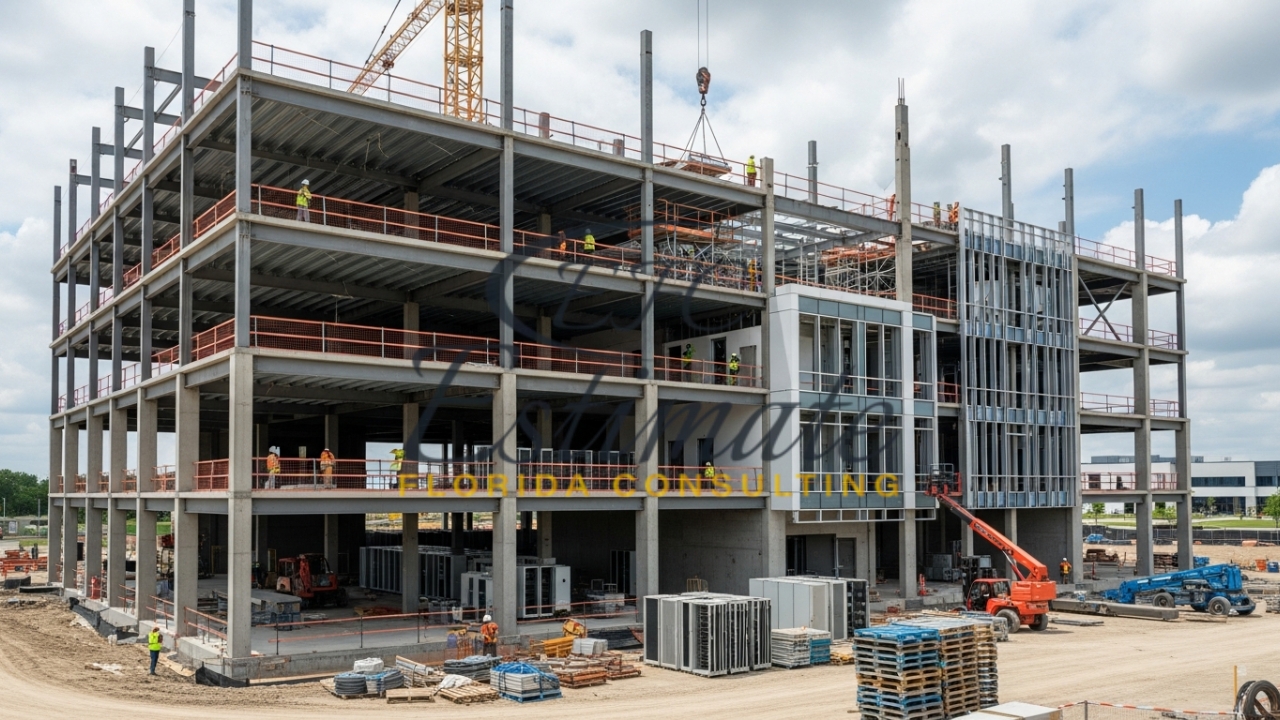
Site selection is one of the most critical decisions in Florida data center construction planning. Developers must evaluate floodplain zones, soil bearing capacity, elevation, and proximity to electrical substations and fiber infrastructure.
Hurricane risk and storm surge exposure often require elevated building pads, reinforced foundations, and advanced drainage systems. Selecting the right site early helps reduce construction risk, insurance premiums, and long-term operational disruptions.
Structural Design and Hurricane-Resistant Construction
Florida Building Code requirements significantly influence data center structural design. Facilities must be engineered to withstand high wind loads, impact forces, and extreme weather events associated with hurricanes.
Reinforced concrete structures, impact-resistant wall assemblies, hardened roofing systems, and protected equipment zones are common features in Florida data center facilities. While these requirements increase upfront data center construction costs, they are essential for business continuity, asset protection, and insurance compliance.
Power Infrastructure and Electrical Systems
Power availability and reliability are central to mission-critical data center construction. Florida data centers require robust electrical infrastructure, including dual utility feeds, on-site substations, switchgear, UPS systems, diesel generators, and extended fuel storage capacity.
Electrical systems often account for the largest share of data center construction cost per square foot. Redundancy planning, backup duration, and load growth capacity must be carefully designed to meet uptime SLAs and regulatory requirements.
Cooling Systems and Mechanical Design
Cooling is one of the most complex aspects of data center construction in Florida due to high ambient temperatures and elevated humidity levels. Mechanical systems must efficiently manage heat rejection, airflow containment, and moisture control to protect sensitive IT equipment.
Common cooling strategies include chilled water systems, air-cooled chillers, CRAH units, hot aisle/cold aisle containment, and advanced thermal management solutions. High-efficiency cooling design directly impacts both construction cost and long-term energy efficiency.
Water Usage and Sustainability Considerations
Water availability and conservation are increasingly important in Florida data center projects, particularly for large hyperscale facilities. Many developments incorporate water-efficient cooling technologies, closed-loop systems, and real-time monitoring controls to reduce water usage.
Sustainable design strategies help lower operating expenses, support environmental compliance, and improve long-term facility resilience while aligning with corporate sustainability goals.
Fire Protection, Life Safety, and Code Compliance
Data centers must meet strict fire protection, life safety, and emergency response standards. Clean agent fire suppression systems, VESDA early smoke detection, fire-rated compartmentalization, and redundant alarm systems are essential components of compliant facilities.
Florida code compliance, including local authority requirements, can significantly affect design coordination, permitting timelines, and construction sequencing. Early integration of life safety planning reduces approval delays and costly redesigns.
Construction Timeline and Phasing Strategy
Data center construction schedules are often aggressive due to market demand and tenant requirements. Depending on facility size, tier level, and equipment lead times, construction timelines in Florida typically range from 12 to 30 months.
Many projects are delivered using phased construction, allowing operators to bring initial capacity online while future data halls are built. Accurate cost forecasting, schedule planning, and phasing strategies are critical for successful delivery.
Operating Costs and Long-Term Performance
Beyond construction, data center operating costs play a major role in financial performance. Energy consumption, cooling efficiency, maintenance, staffing, and physical security all contribute to total cost of ownership.
Design decisions made during construction—such as redundancy level, equipment selection, and layout efficiency—directly influence long-term operating expenses, scalability, and asset value.
Utility Coordination and Power Availability in Florida
Early coordination with utility providers is a critical step in Florida data center preconstruction planning. Data centers require large and reliable electrical loads, often necessitating dedicated substations, dual feeds, or infrastructure upgrades.
Confirming power capacity, utility lead times, and grid resilience during early planning helps avoid delays that could affect commissioning schedules and tenant commitments.
Redundancy Levels and Tier Classification Impact on Cost
Redundancy planning is a major driver of data center construction cost in Florida. Tier I and Tier II facilities require lower capital investment but offer limited redundancy, while Tier III and Tier IV data centers require extensive system duplication.
Higher-tier facilities increase construction costs due to additional equipment, expanded mechanical rooms, and complex system integration, but provide higher reliability and uptime assurance.
Security Design and Controlled Access Systems
Physical security is essential in Florida data center facilities, often exceeding standard commercial requirements. Typical features include perimeter fencing, controlled access points, mantraps, surveillance systems, and secure loading zones.
Security systems must be coordinated with architectural layouts, MEP design, and site circulation. While security features add to construction cost, they are vital for risk mitigation and tenant confidence.
Modular Construction and Scalability Planning
Many Florida data center developments incorporate modular construction strategies to support scalable growth. Modular infrastructure allows capacity to be added incrementally, reducing initial capital expenditure.
Scalability planning affects structural layout, power distribution, cooling capacity, and site utilization, providing long-term flexibility and cost control.
Insurance, Risk Mitigation, and Resilience Planning
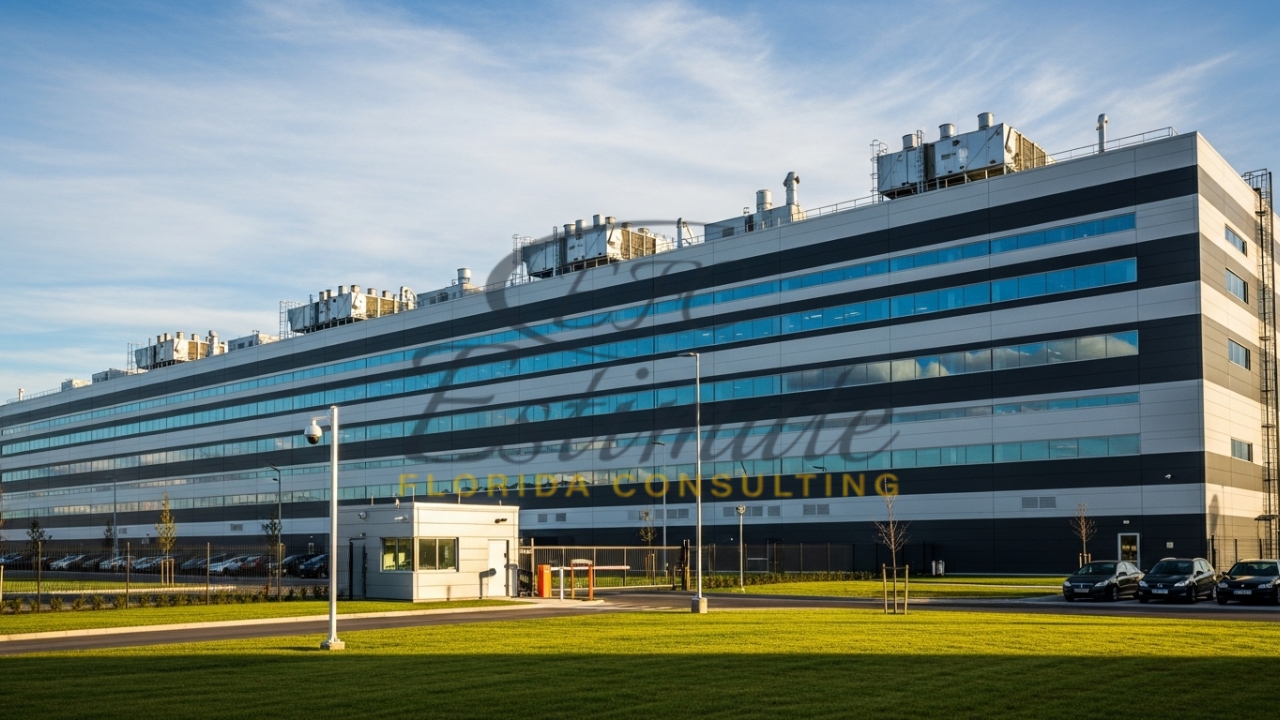
Insurance considerations play a major role in Florida data center construction due to hurricane risk, flood exposure, and weather-related hazards. Structural hardening and redundancy planning directly influence insurance premiums and coverage terms.
Investing in resilient construction methods may increase upfront cost but significantly reduces long-term financial risk and operational disruption.
Long-Term Expansion and Technology Adaptability
Technology evolves rapidly, making adaptability a key factor in data center design. Floor loading capacity, ceiling heights, electrical pathways, and cooling flexibility must support future upgrades.
Planning for adaptability during initial construction helps extend facility lifespan, support higher power densities, and protect long-term investment value.
Why Choose Us – Estimate Florida Consulting?
At Estimate Florida Consulting, we provide specialized construction estimating and preconstruction services for data center construction in Florida. Our team understands the unique cost drivers related to power infrastructure, cooling systems, hurricane-resistant construction, and code compliance.
We deliver detailed quantity takeoffs, accurate cost models, and feasibility analysis tailored to Florida data center projects. From early planning through contractor bidding, our estimates help developers and operators control costs, reduce risk, and move forward with confidence.
Conclusion
Data center construction in Florida presents strong opportunities, but success depends on informed planning and disciplined cost control. Florida’s growing demand for cloud services, colocation facilities, and AI-driven infrastructure makes it an attractive market, while climate conditions, power availability, and strict building codes add layers of complexity to every project. From site selection and hurricane-resistant structural design to power redundancy, cooling efficiency, and long-term scalability, each decision directly impacts both construction cost and operational performance.
Successful Florida data center projects begin with accurate preconstruction planning, realistic budgeting, and a clear understanding of lifecycle costs. At Estimate Florida Consulting, we help developers, operators, and investors navigate these challenges with detailed cost estimating and feasibility analysis. With the right planning strategy and professional cost intelligence, data centers in Florida can achieve resilience, efficiency, and long-term financial sustainability in a highly competitive digital infrastructure market.
Frequently Asked Questions (FAQs)
- How much does it cost to build a data center in Florida?
Data center construction costs in Florida typically range from $800 to $1,500+ per square foot, or $7 million to $15 million per megawatt (MW) of IT load, depending on facility size, tier level, redundancy, and cooling requirements.
- Why is Florida a popular location for data center construction?
Florida offers strong fiber connectivity, proximity to Latin American and Caribbean markets, population growth, and a business-friendly environment. These factors make it attractive for colocation, enterprise, and hyperscale data center development.
- How do hurricanes affect data center construction in Florida?
Hurricane exposure significantly influences design and cost. Florida data centers often require reinforced concrete structures, impact-resistant materials, elevated building pads, hardened roofing systems, and enhanced drainage to meet Florida Building Code requirements.
- What tier level is most common for Florida data centers?
Tier III data centers are common in Florida because they offer N+1 redundancy and high availability without the extreme cost of Tier IV facilities. The ideal tier depends on uptime requirements, risk tolerance, and budget.
- How long does it take to build a data center in Florida?
Construction timelines typically range from 12 to 30 months, depending on facility size, tier classification, permitting requirements, equipment lead times, and whether the project is delivered in phases.
- What are the biggest cost drivers in Florida data center construction?
The largest cost drivers include electrical infrastructure, power redundancy, cooling systems, structural hardening, fire protection systems, and compliance with local and state building codes.
- How important is utility coordination in Florida data center projects?
Utility coordination is critical. Data centers often require dedicated substations, dual utility feeds, and infrastructure upgrades. Early coordination helps prevent delays that could impact commissioning and tenant occupancy.
- How can Estimate Florida Consulting help with data center construction?
Estimate Florida Consulting provides data center cost estimating, quantity takeoffs, feasibility studies, and preconstruction planning tailored to Florida-specific conditions. Our services help control budgets, reduce risk, and support confident decision-making before construction begins.