
Navigating the financial landscape of building in the Sunshine State requires more than just a general understanding of construction—it requires precision. The electrical construction cost per square foot is a pivotal metric that determines the viability of a project, whether it is a luxury beachfront estate in Naples or a high-tech distribution center in Orlando. As we move through 2026, market fluctuations, evolving energy codes, and labor shortages continue to shift the baseline for these costs.
🔌 Receive Customized Estimates for Residential and Commercial Electrical Work.
At Estimate Florida Consulting, we bring over 12 years of specialized experience to the table. Having delivered more than 1,000 professional estimates across the state, we understand that “average” pricing rarely tells the whole story. A project’s success hinges on an accurate “takeoff”—a detailed accounting of every circuit, outlet, and panel. In Florida, the stakes are even higher. Our unique climate and geographic vulnerabilities necessitate specialized materials and installation techniques that can drive costs upward. This guide serves as a comprehensive resource for contractors, developers, and homeowners to understand the current benchmarks and variables of Florida’s electrical construction market.
What Defines Electrical Construction Cost Per Square Foot?
The “cost per square foot” is a shorthand used by professionals to provide quick budget assessments. However, it is an aggregate of several distinct variables:
- Material Costs: The literal price of wire, conduit, boxes, and panels. For example, metallic sheathed (BX/AC) wiring can range from $1.27 to $2.24 per linear foot.
- Labor Burdens: The hourly rate of licensed journeymen and apprentices in specific Florida regions (e.g., Miami-Dade labor is typically higher than in Ocala).
- Permitting and Inspections: Florida’s rigorous inspection process, particularly for fire alarms and life safety systems.
- System Complexity: A standard residential home requires significantly less infrastructure than a commercial “smart” building or a surgical suite.
Residential Electrical Pricing in Florida (2026)
Residential projects in Florida are currently seeing a stabilization in material costs, though labor remains a premium. For new construction, the complexity is lower because wiring is installed before the drywall is hung, allowing for faster “rough-in” phases.
Estimated Cost of Wiring a New Home (Florida 2026)
| House Size (sq.ft.) | Average Cost Range |
|---|---|
| 1,000 sq.ft. | $5,760 – $10,080 |
| 1,500 sq.ft. | $8,640 – $15,120 |
| 2,000 sq.ft. | $11,520 – $20,160 |
| 2,500 sq.ft. | $14,400 – $25,200 |
| 3,000 sq.ft. | $17,280 – $30,240 |
| 4,000 sq.ft. | $23,040 – $40,320 |
The “High-End” Variable: These averages reflect standard builds. In Florida’s luxury market, the inclusion of whole-home automation, landscape lighting, and dedicated home theater circuits can push these figures well beyond the $10.00 per square foot mark.
⚡ Get an Accurate Electrical Construction Cost Estimate.
Commercial & Industrial Cost Projections
Commercial electrical construction is a different beast entirely. Unlike residential homes where non-metallic sheathed (Romex) cable is common, commercial codes in Florida often mandate the use of conduit (EMT) or armored cable (MC).
Commercial Tiers of Complexity:
- Tier 1: Shell & Core / Warehouse ($8–$14/sq.ft.): Basic lighting, exit signs, and power for HVAC units. High-bay LED lighting is a major cost factor here.
- Tier 2: Retail & Office ($15–$25/sq.ft.): Includes data drops, floor outlets, and sophisticated lighting controls to meet Florida’s energy conservation codes.
- Tier 3: Healthcare & High-Tech ($30–$60+/sq.ft.): Redundant power systems (UPS), medical-grade outlets, and complex fire suppression integration.
Detailed Cost Component Breakdown
Understanding where your money goes is the first step in controlling the budget. We break down the electrical construction cost per square foot into its primary material and system components.
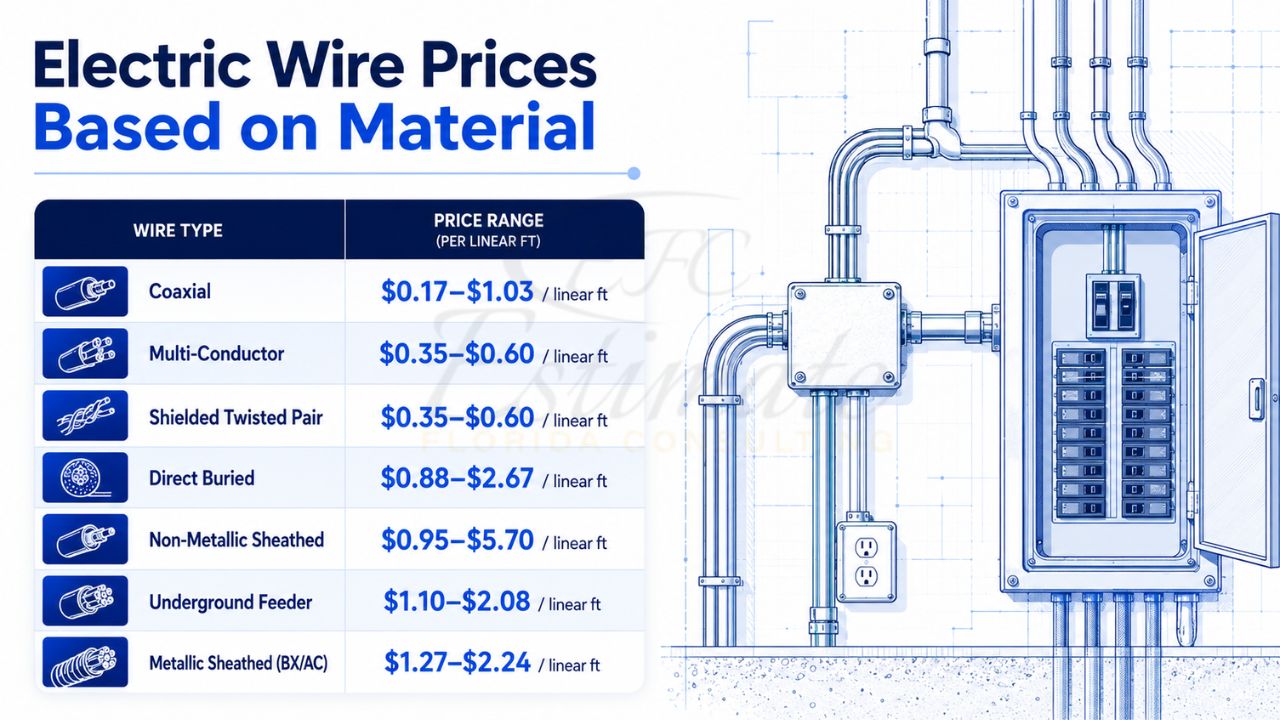
Electric Wire Prices Based on Material
| Type of Wiring | Cost per Linear Foot |
|---|---|
| Coaxial | $0.17 – $1.03 |
| Multi-Conductor | $0.35 – $0.60 |
| Shielded Twisted Pair | $0.35 – $0.60 |
| Direct Buried | $0.88 – $2.67 |
| Non-Metallic Sheathed | $0.95 – $5.70 |
| Underground Feeder | $1.10 – $2.08 |
| Metallic Sheathed (BX/AC) | $1.27 – $2.24 |
System Components Cost Distribution:
- Service Entrance & Panels (15-20%): The “heart” of the system. In Florida, exterior panels must be NEMA 3R rated for weather resistance.
- Rough-In Materials (30-35%): Wire, conduit, boxes, and fasteners.
- Lighting Fixtures (20-30%): A major variable depending on the designer’s specifications.
- Trim & Devices (10-15%): Outlets, switches, and smart dimmers.
- Low Voltage & Data (10%): Essential for modern connectivity and security.
🏗️ Get Reliable Electrical Estimating Services for New Construction.
Florida-Specific Factors Influencing Estimates
Construction in Florida is unique due to our environment. These factors must be included in any accurate Florida electrical wiring cost per square foot calculation.
1. Hurricane & Wind Load Requirements
Electrical equipment mounted on the exterior—such as generator transfer switches and main service disconnects—must be rated to withstand Florida’s high-velocity hurricane zones (HVHZ). This often requires specialized mounting hardware and reinforced enclosures.
2. Salt-Air Corrosion
For projects within 5 miles of the coast (from Miami Beach to Pensacola), standard galvanized materials will corrode within years. Estimates must account for stainless steel or PVC-coated components, which can carry a 25-40% price premium.
3. Lightning Protection
Florida is the lightning capital of the U.S. Professional estimates now frequently include whole-home or whole-building surge protection devices (SPDs) as a standard line item rather than an optional add-on to protect sensitive electronics and smart home systems.
4. Energy Code Compliance (R406)
Florida’s Energy Conservation Code is strict. Lighting must be high-efficiency (LED), and many commercial spaces require occupancy sensors and “daylight harvesting” controls that automatically dim lights near windows.
New Construction vs. Renovation: The Price Gap
One of the most common questions we receive at Estimate Florida Consulting is why rewiring an old home costs so much more than wiring a new one.
Rewiring vs. New Construction (Residential)
| Project Type | Cost Per Square Foot | Why the Difference? |
|---|---|---|
| New Construction | $4.80 – $8.40 | Open walls, easy access, fast install. |
| Full Rewire | $8.64 – $17.28 | Wall demolition, fishing wires, debris removal. |
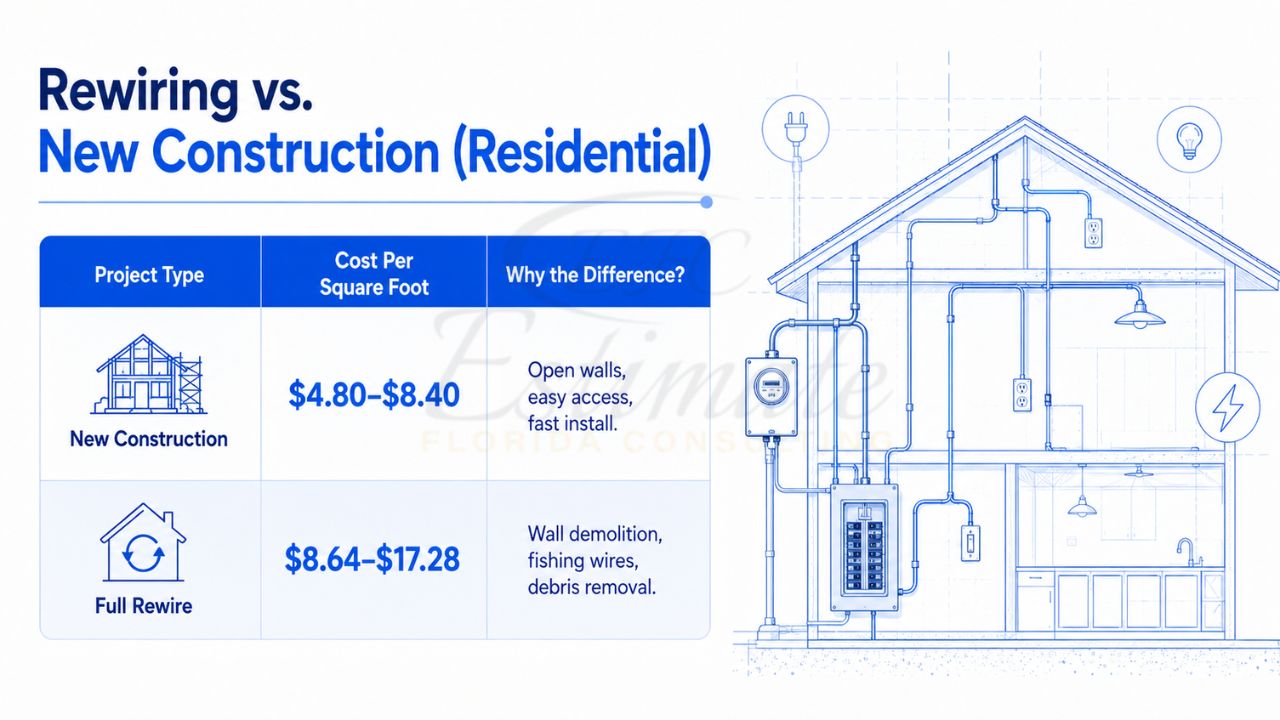
In a rewire, an electrician might spend four hours “fishing” a single wire through a 1950s plaster wall that would have taken ten minutes to install in an open-stud new build. This labor intensity is the primary driver of the nearly 100% cost increase.
Mistakes to Avoid in Electrical Estimating
Even experienced contractors can fail if their estimates are flawed. Common pitfalls include:
- Underestimating Labor Hours: Florida’s heat can reduce labor productivity by 10-15% during summer months for outdoor or unconditioned work.
- Ignoring Code Changes: Using outdated NEC (National Electrical Code) standards can lead to failed inspections and costly “re-dos.”
- Poor “Takeoff” Accuracy: Missing a single sub-panel or 500 feet of specialized data cable can erase a project’s profit margin.
- Omitting Temporary Power: Forgetting the cost of setting up temporary poles for the construction crew.
📞 Request Your Electrical Construction Estimate Today.
The Value of Professional Estimating Services
In an industry where margins are thin, an accurate estimate is your most valuable tool. Using professional services like Estimate Florida Consulting offers several strategic advantages:
- Risk Mitigation: We identify potential “money pits” before the first wire is pulled.
- Competitive Bidding: Contractors can bid with confidence, knowing their numbers are backed by current Florida market data.
- Efficiency: Professional estimators use advanced software for precise “digital takeoffs,” saving you dozens of hours of manual counting.
- Compliance: We ensure your project budget accounts for the latest Florida building and energy codes.
Florida Electrical Pricing Scope Planning
A useful Division 26 electrical budget separates service and distribution equipment, feeders, branch circuits, conduit and cable pathways, devices, lighting and controls, low-voltage coordination, exterior equipment, temporary power, testing, permits, and current Florida trade-pricing data. Defined scope assumptions help clients compare electrical quantities and per-square-foot benchmarks with greater clarity.
Explore related planning resources for electrical estimating services, the multi-family electrical cost estimator, commercial estimating, and our construction estimating service.
FAQs
- What is the average electrical cost per square foot for a new home in Florida in 2026?
Typically, it ranges from $4.80 to $8.40 per square foot, covering everything from the panel to the outlets. - Why is rewiring an existing home so much more expensive?
Rewiring costs $8.64 to $17.28 per square foot because it involves labor-intensive tasks like opening and repairing walls and removing old wiring. - Does the cost include light fixtures?
Usually, “standard” light fixtures are included in the $4.80–$8.40 range, but high-end chandeliers or specialized recessed lighting are considered “extra”. - How does the type of wire affect my budget?
Material choice is huge. Non-metallic sheathed wire is roughly $0.95–$5.70/ft, whereas metallic sheathed (BX/AC) starts at $1.27/ft and up. - Are commercial electrical costs per square foot higher than residential?
Yes. Due to the requirement for conduit (pipes) and higher voltage systems, commercial costs often start at $12–$15 per square foot. - Does Florida have specific electrical requirements for hurricanes?
Yes, exterior equipment must meet specific wind-load and moisture-resistance ratings defined by the Florida Building Code. - Can a professional estimate help me get a bank loan?
Absolutely. Lenders require detailed, professional cost projections to verify project feasibility and secure funding. - How do smart home systems impact the square foot cost?
Adding full-home automation can add $2.00 to $5.00 per square foot to your estimate. - What is “Service Entrance” and why is it a separate cost?
The service entrance is where power enters the building. Upgrading a service (e.g., from 100 amps to 200 amps) is a common expense in renovations. - How often do electrical codes change in Florida?
Florida typically adopts updated versions of the National Electrical Code (NEC) every three years. - Why should I use Estimate Florida Consulting?
With 1,000+ estimates and 12+ years in the Florida market, we provide the localized expertise needed to ensure your project stays on budget. - How do accurate estimates improve project success?
They minimize financial risks, prevent mid-project funding gaps, and ensure all regulatory standards are met from the start.
Conclusion
The electrical construction cost per square foot in Florida is a dynamic figure, shaped by geography, code, and complexity. For a successful build in 2026, you cannot rely on “guesstimates.” You need a data-driven approach that accounts for everything from the price of copper to the humidity in Miami.
At Estimate Florida Consulting, we specialize in turning complex blueprints into clear, actionable financial roadmaps. Whether you are a general contractor bidding on a government contract or a homeowner planning a dream renovation, our precision is your protection.
Ready to get an accurate takeoff for your next project?
Contact Estimate Florida Consulting today:
- Phone: 561-530-2845
- Website: estimatorflorida.com