








How to Bid Hospital Exterior Painting Projects Accurately?

Leading provider of painting estimating services.

Bidding hospital exterior painting projects accurately requires more than standard commercial takeoff; it demands precise quantities, strict compliance with healthcare standards, and detailed documentation that satisfies facility managers and infection‑control teams. A structured approach helps you price every element—from access and safety to coatings and schedules—so you can win hospital work without sacrificing profit.​

How to Bid Hospital Exterior Painting Projects Accurately

Get a Quick
Estimate For Projects

Understand Hospital-Specific Requirements

Hospitals are critical facilities that operate 24/7, so exterior painting must be planned around patient safety, staff operations, and regulatory expectations. Even though the work is outdoors, many owners apply the same risk‑management mindset used for clinical interiors: they expect low‑odor systems, minimal disruption, and documented safety procedures.​

  • Healthcare facility painting guidelines emphasize durability, cleanability, and contamination control, which directly influence the types of exterior coatings you can specify and how you stage the work.​
  • Many systems and standards used for healthcare design (FGI Guidelines, internal infection‑control policies, and environmental requirements) drive decisions about surfaces, logistics, and access—even on facades.​

Before pricing, request the hospital’s painting standards, preferred manufacturers, and any existing facility guidelines; this avoids change orders caused by spec conflicts later.​

Step 1: Scope Review and Site Assessment

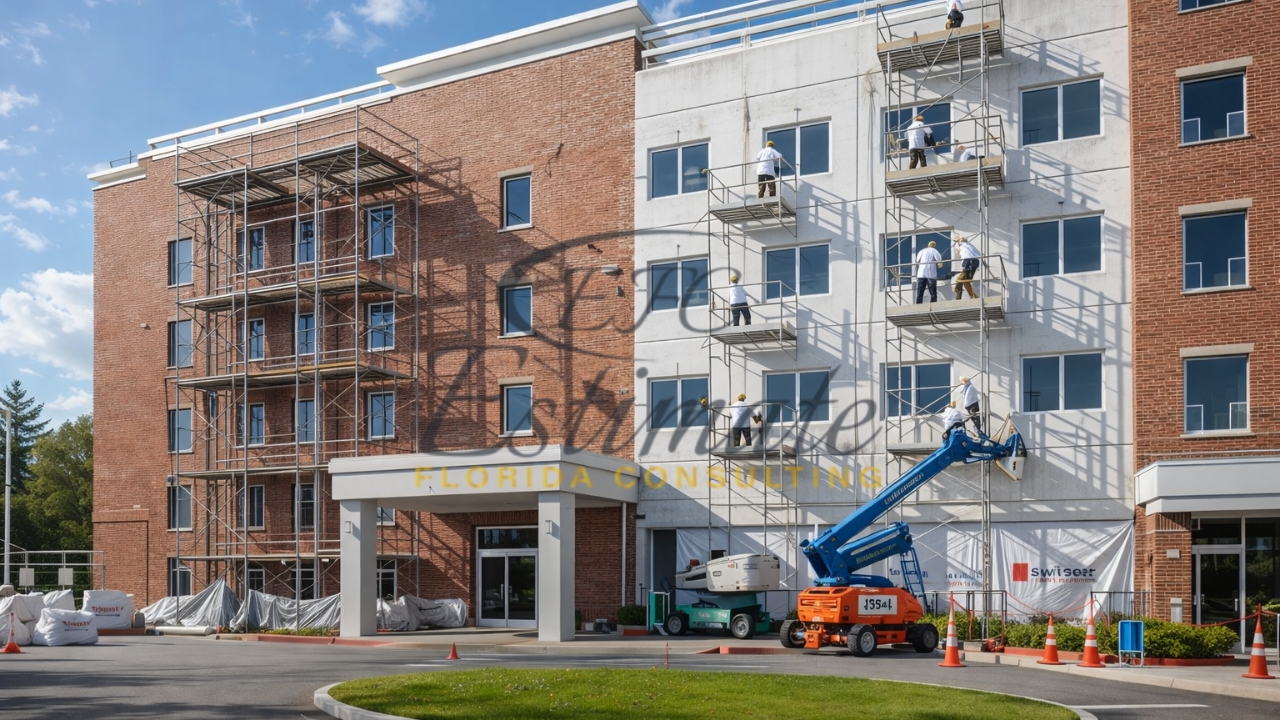
Accurate hospital exterior bids start with a thorough scope review and a structured site visit. Hospitals often have complex envelopes—multiple wings, canopies, mechanical penthouses, helipads, and service yards—that must be carefully quantified.​

During the site assessment, focus on:

  • Building geometry: Count wings, courtyards, towers, covered entries, and skybridges that affect access and square footage.​
  • Sensitive zones: ED entrances, ambulance bays, loading docks, oxygen tank areas, and air intakes where dust and fumes must be tightly controlled.​
  • Existing conditions: Chalked coatings, hairline cracks, delamination, efflorescence, rust at steel, failed sealants, and prior “band‑aid” repairs all impact prep quantities and labor.​

Take high‑resolution photos and mark up drawings; owners and facility managers expect visual documentation to support your quantities and recommendations.​

Get High-Quality 3D Rendering Services Today!

Transform your space with stunning 3D Rendering that blends style, comfort, and functionality.

We Specialize in Both Residential and Commercial 3D Rendering Projects.

Step 2: Measure and Quantify Exterior Surfaces

Hospitals can be very large, so you need a repeatable method for surface area calculations. Combine digital takeoff with on‑site checks for best accuracy.​

  • Use digital tools to calculate wall areas: length × height per elevation, then subtract doors, windows, and non‑painted cladding elements.​
  • Include parapets, stair towers, elevator overruns, soffits, canopy undersides, and columns—items commonly missed on quick takeoffs.​

For example, a hospital tower with four elevations at 120 ft long and 60 ft high gives 28,800 sq ft of gross wall area; a 15–20% deduction for glazing yields around 23,000–24,000 sq ft of paintable surface.​

Also quantify:

  • Linear footage for expansion joints, control joints, and caulked perimeters.​
  • Special substrates such as exposed concrete, EIFS, metal panels, or louvers that may require different systems, primers, and production rates.​

Step 3: Evaluate Substrates and Surface Preparation

Hospitals demand long service life and minimal future disruption, so surface preparation is a major part of the estimate. Prep often consumes 25–40% of total labor on institutional exteriors.​

Key preparation tasks to quantify:

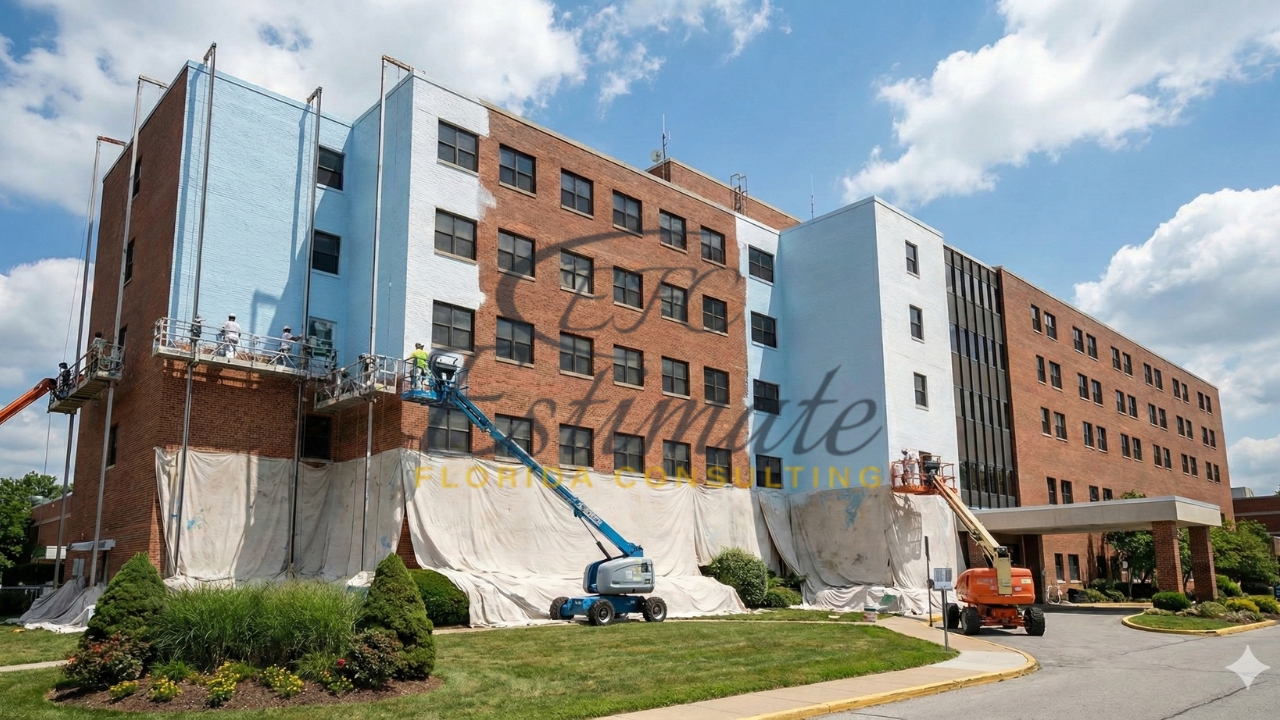
  • Cleaning: Pressure washing or soft‑washing for dirt, mildew, algae, and pollutants; note areas requiring chemical cleaners or biocides.​
  • Repairs: Crack routing and patching on masonry/stucco, spall repairs on concrete, rust treatment on metals, and replacement of damaged sealant or caulk.​
  • Priming: Different primers for chalky surfaces, high‑pH concrete, corroded steel, or previously coated substrates.​

Exterior hospital coatings must withstand intense UV, heavy rain, and pollution, so skipping or underpricing prep can shorten life cycles dramatically and undermine your relationship with the facility.​

Step 4: Select Healthcare-Appropriate Coating Systems

While infection‑control standards focus on interiors, hospital owners are increasingly conscious of exterior coating performance and air quality. Many specify low‑VOC, low‑odor, and high‑durability products even outdoors.​

When choosing systems:

  • Favor high‑performance 100% acrylic or elastomeric coatings for stucco and masonry to bridge hairline cracks and enhance weather resistance.​
  • Use corrosion‑resistant systems for steel, railings, and rooftop equipment enclosures, as rust can lead to both structural and aesthetic concerns.​
  • Coordinate color and sheen with the hospital’s branding and maintenance standards; facility guidelines often call for specific palettes and light‑reflectance values for wayfinding and patient comfort.​
How to Bid Hospital Exterior Painting Projects Accurately

Even though antimicrobial formulations are more critical indoors, some healthcare owners may extend antimicrobial or easy‑clean technologies to exterior doors, entry canopies, and high‑touch surfaces; clarify if this is required because it will affect material pricing.​

Step 5: Plan for Safety, Infection Control, and Logistics

Hospitals enforce strict safety and infection‑control expectations for any construction activity near patients or staff. Even exterior work may intersect with air intakes, operable windows, or entrances.​

Key elements you must include in your bid:

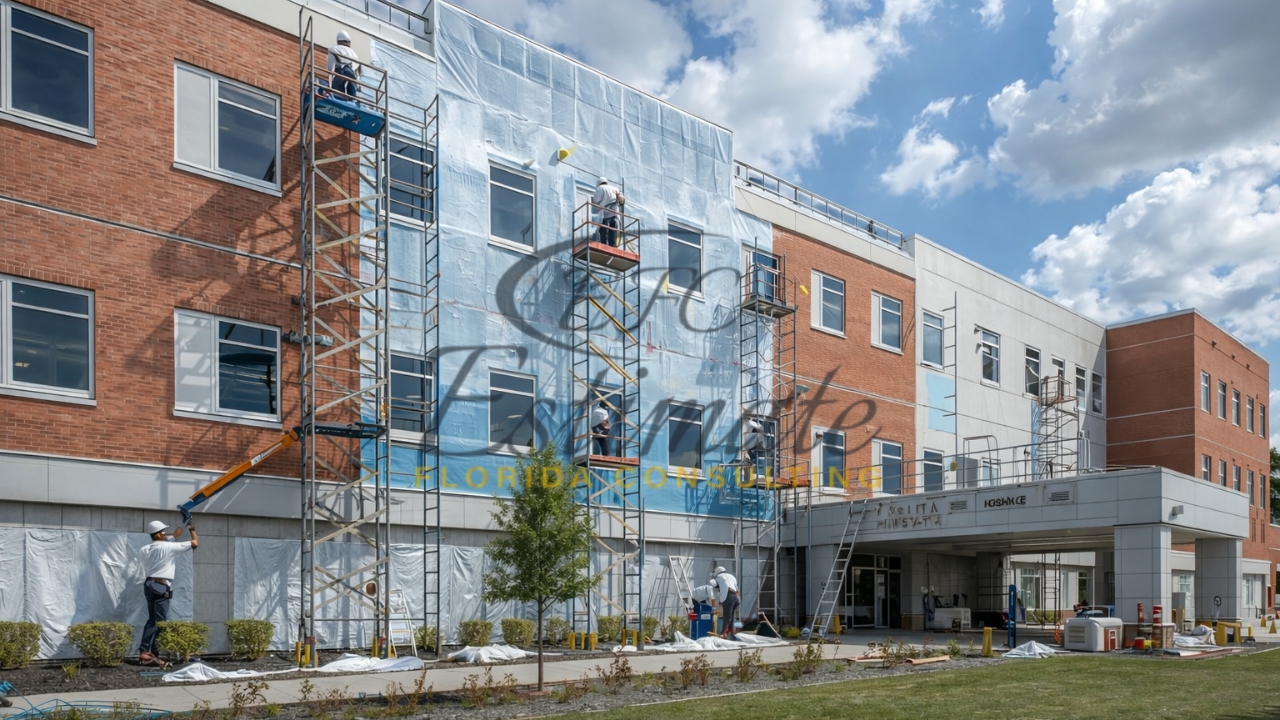
  • Work‑zone containment: Barriers, signage, and traffic control around entrances, ambulance routes, and pedestrian walkways.​
  • Ventilation and air‑intake protection: Coordination with facility staff to temporarily adjust or protect nearby intakes when pressure washing or spraying.​
  • Noise and vibration: Limits during certain hours near patient rooms, ICUs, or administrative zones.​

Many hospitals require an Infection Control Risk Assessment (ICRA) or similar planning process for construction work; even for exterior painting, they may ask to see your methods for controlling dust, overspray, and fumes. This should be built into your general conditions and schedule allowances.​

Step 6: Build a Detailed, Transparent Cost Breakdown

Hospital administrators and procurement teams expect clear, itemized proposals that explain how you arrived at your number. A vague lump‑sum price can hurt your credibility and make it harder to negotiate scope changes later.​

Your estimate should clearly break out:

  • Surface preparation (cleaning, repairs, priming) by substrate or elevation.​
  • Coating application (by system and area), with notes on number of coats and application method (brush/roll/spray).​
  • Access and safety: Lifts, scaffolding, swing stages, harness systems, and any night/weekend premiums.​
  • General conditions: Project management, supervision, mobilization/demobilization, protection, and cleanup.​
  • Allowances: Weather delays, minor additional repairs discovered after washing, and color‑matching or mockups.​

Good‑quality commercial exterior paint typically runs in the mid‑tier cost range per gallon, but in your bid you should show quantities of primer and topcoat separately rather than hiding them in a single line.​

90% More Chances to Win Bids with
Our Estimate!

Step 7: Account for Hospital-Specific Scheduling Constraints

Hospital work is rarely performed on a simple Monday–Friday, 8–5 schedule. To bid accurately, quantify the productivity impact of restricted hours, phasing, and coordination with clinical operations.​

Important scheduling factors:

  • Night and weekend work around emergency departments, entrances, and drop‑off zones.​
  • Seasonal considerations (e.g., avoiding peak flu season or local surge periods) that the hospital may specify.​
  • Weather windows for exterior work, especially in Florida’s rainy and hurricane seasons, which may require longer durations and contingency days.​

Your estimate should reflect lower production rates for off‑hours or constrained access zones, and include premiums for extended supervision and lighting if needed.​

Step 8: Incorporate Risk, Contingency, and Compliance Costs

Hospital exterior projects have unique risks: hidden façade damage, stricter reviews, and higher expectations for appearance and durability. A realistic contingency protects your margin if conditions are worse than they appear.​

Common risk allowances include:

  • Extra repairs after washing exposes hairline cracks, spalls, or delamination not visible during the initial walkthrough.​
  • Added protection or rework if weather changes rapidly, causing wash‑offs or extended curing times.​
  • Compliance and administration time for background checks, badges, training, and documentation required by hospital security and facility departments.​

Instead of a single “miscellaneous” line, describe your contingency approach in the proposal so owners understand you are planning responsibly rather than inflating the number arbitrarily.​

Step 9: Present a Professional, Healthcare-Focused Proposal

Hospitals often use formal RFP processes and evaluation criteria that score safety, past performance, and understanding of healthcare environments—not just price. Your bid should read like a solution for a sensitive facility, not a generic commercial job.​

Strong proposals typically include:

  • A brief methodology describing prep, coatings, safety, infection‑control measures, and communication with hospital staff.​
  • Relevant experience with healthcare or other critical facilities, highlighting low disruption and on‑time delivery.​
  • An outline of your quality‑assurance steps and final inspection/touch‑up process tailored to the hospital’s expectations.​

Clarity and professionalism can often justify a higher price if the owner believes you understand their environment and risk profile better than competitors.​

How to Bid Hospital Exterior Painting Projects Accurately

Common Estimating Mistakes to Avoid

Even experienced commercial painters make errors when they treat hospitals like standard offices or schools. Avoid these pitfalls to keep your bids profitable and competitive.​

  • Underestimating prep: Hospitals often have older facades with deferred maintenance; assuming “light prep” can devastate margins.​
  • Ignoring logistics: Not pricing lifts, staging moves, or work‑zone changes around ambulance routes and main entries leads to costly change orders.​
  • Overlooking soft costs: Background checks, orientation, added PPE, and infection‑control documentation all take time and must be budgeted.​

Review your estimates against a checklist specific to healthcare exteriors to catch these issues before submitting.​

How Professional Estimating Support Helps You Win Hospital Work?

Hospital exterior painting projects are high‑visibility, high‑expectation jobs where a sloppy bid can cost far more than just one project. Accurate takeoffs, realistic production rates, and healthcare‑aware scope definitions are essential to win and deliver successfully.​

Estimate Florida Consulting helps contractors bid hospital exterior painting projects accurately with detailed quantity takeoffs, healthcare‑focused scopes, and clear, owner‑ready cost breakdowns. With years of experience supporting Florida contractors, the team helps you bid more confidently on complex facilities—simply upload your plans to 

info@estimatorflorida.com

 or call 561‑530‑2845 to elevate your next hospital proposal.

Want to Start Your Project with the Best Contractors?

Let’s Take Your Projects to the Next Level.

EMAIL info@estimatorflorida.com
PHONE 561-530-2845

& What's you will get:

  • Connecting You to Top Local Contractors
  • Professional Consulting, Contractors Near You
  • From Expert Advice to Local Contractor Connections 
We’re Here for You – Reach Out Today!

Contact Now

Let's discuss with a cup of coffee

Question Answer

Frequently Asked Question

Hospital exterior painting projects involve higher risk, stricter safety expectations, and detailed documentation. Unlike standard commercial buildings, hospitals operate 24/7 and require careful planning around patient safety, air quality, infection control, and uninterrupted operations, all of which must be priced into the bid.

Before pricing, contractors must review:

  • Hospital facility standards and preferred paint systems

  • Infection Control Risk Assessment (ICRA) expectations

  • Low-VOC and low-odor coating requirements

  • Safety, access, and security protocols
    Ignoring these requirements can lead to rejected bids or costly change orders.

Use a combination of:

  • Digital takeoff software

  • On-site verification

  • Elevation-by-elevation calculations

Include walls, parapets, stair towers, elevator overruns, soffits, canopies, columns, and mechanical penthouses. Deduct glazing and non-painted cladding to arrive at net paintable square footage.

Frequently missed items include:

  • Underside of entry canopies

  • Service yard walls

  • Courtyard elevations

  • Parapet interiors

  • Rooftop equipment screens
    Missing these areas can reduce margins by thousands of dollars.

Surface preparation is critical and often represents 25–40% of total labor. Hospitals expect long-lasting finishes, so prep must include washing, crack repairs, rust treatment, sealant replacement, and proper priming. Underestimating prep is one of the biggest causes of losses on hospital projects.

Comprehensive Trade-Specific Estimates

At Estimate Florida Consulting, we offer detailed cost estimates across all major trades, ensuring no part of your project is overlooked. From the foundation to the finishing touches, our trade-specific estimates provide you with a complete and accurate breakdown of costs for any type of construction project.

Construction Cost Estimator
Client Trust Us

Our Clients & Partners

We pride ourselves on building strong, lasting relationships with our clients and partners across the construction industry.

Testimonials

What Our Clients Say?

We take pride in delivering accurate, timely, and reliable estimates that help contractors and builders win more projects. Our clients consistently praise our attention to detail, fast turnaround times, and the positive impact our estimates have on their businesses.

Estimate Florida Consulting has helped us win more bids with their fast and accurate estimates. We trust them for every project!
Marvelous Marble
Marvelous Marble Manager

Their estimates are always on time and on point, making budgeting much easier. We've saved time and money thanks to their services.

6 Star Contractors
6 Star Painting Contractor

Since using their services, we’ve secured more projects. Their attention to detail is second to none.

Patio Pools Driveways
Patio Pools and Driveway Contractor

Our Simple Process to Get Your Estimate

01

Upload Plans

Submit your project plans, blueprints, or relevant documents through our online form or via email.

02

Receive Quotation

We’ll review your project details and send you a quote based on your scope and requirements.

03

Confirmation

Confirm the details and finalize any adjustments to ensure the estimate meets your project needs.

04

Get Estimate

Receive your detailed, trade-specific estimate within 1-2 business days, ready for your project execution.

Get Started

Upload Plans Here