



- Homepage
- How Many Sq Ft Does Quikrete 60 lb Cover?
How Many Sq Ft Does Quikrete 60 lb Cover?
Leading provider of estimate services.
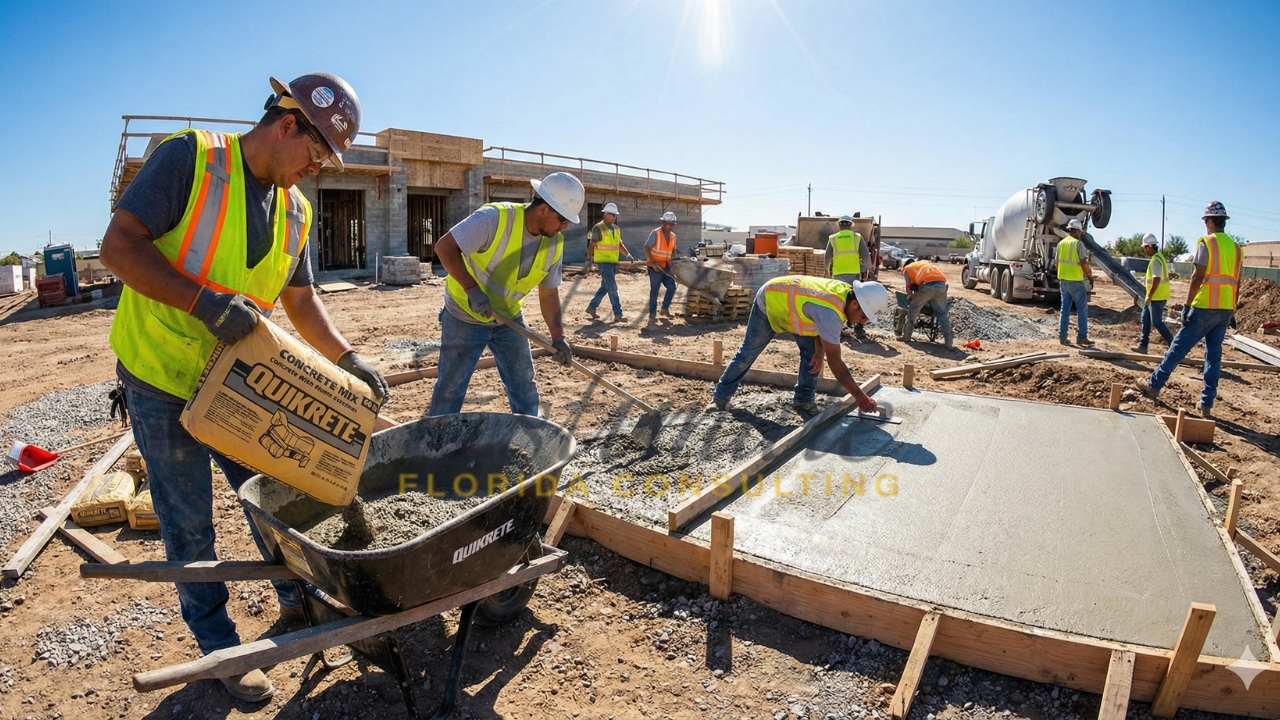
Quikrete is one of the most commonly used ready-mix concrete products in residential and small-scale construction projects. Whether you are building a concrete slab, walkway, patio, step footing, mailbox post, or repairing damaged concrete, understanding how much coverage a single 60-lb bag provides is key for estimating material quantity accurately. Too little material leads to delays, inconsistent concrete strength, and cold joints, while ordering too much becomes unnecessary expense. For this reason, knowing how many square feet a 60-lb bag of Quikrete covers at different slab thicknesses is extremely useful during planning.
In Florida, this calculation becomes even more important because slab thickness and reinforcement choices often vary based on soil type, humidity, and intended use.
A concrete slab for a patio may require only a thin layer, while a driveway or structural footing requires a deeper pour. Therefore, estimating coverage correctly depends not just on square footage, but also on the depth of the slab.
What Does a 60-lb Bag of Quikrete Contain?
A standard 60-lb bag of Quikrete contains a dry concrete mix made of cement, sand, and gravel. When properly mixed with water, it produces approximately:
Specification | Amount |
Yield | 0.45 cubic feet of concrete (approximate) |
Compressive Strength | 4,000 PSI after curing (average) |
Intended Use | Small slabs, posts, walkways, repairs |
This volume yield (0.45 cu.ft.) is the key number used to calculate coverage. Because concrete coverage is based on depth, the square footage changes depending on the thickness of the pour.
How Many Sq Ft Does a 60-lb Bag of Quikrete Cover?
Below is the standard coverage chart showing how many square feet one 60-lb bag covers at common slab thickness levels:
Thickness | Coverage per 60-lb Bag (Sq.Ft.) |
1 inch | 5.4 sq. ft. |
1.5 inches | 3.6 sq. ft. |
2 inches | 2.7 sq. ft. |
3 inches | 1.8 sq. ft. |
4 inches | 1.35 sq. ft. |
6 inches | 0.9 sq. ft. |
These values are industry-standard and are used by contractors and estimate software systems nationwide.
Get High-Quality 3D Rendering Services Today!
Transform your space with stunning 3D Rendering that blends style, comfort, and functionality.
We Specialize in Both Residential and Commercial 3D Rendering Projects.
- Luxury Villas
- Apartment Complexes
- Modular Kitchens
- Bathrooms
- Office Buildings
- Shopping Malls
- Hospitals
- Hotels & Resorts
Why Thickness Matters in Florida?
Florida climate conditions affect slab thickness requirements. While thinner slabs may be suitable in some states for walkways or shed pads, Florida’s sandy soils, moisture cycles, and hot weather expansion often require slightly thicker pours — especially for outdoor projects exposed to rain or heavy weight.
Project Type | Typical Florida Slab Thickness |
Small sidewalks & garden edging | 2–3 inches |
Patio slabs | 3–4 inches |
Shed foundations | 4 inches |
Driveways & parking pads | 4–6 inches |
Structural footings or heavy loads | 6+ inches |
Understanding the relationship between thickness and coverage ensures accurate bag quantity calculation.
How Many Bags of Quikrete Do You Need? (Florida Examples)
Once thickness and project size are known, the number of bags required can be calculated.
Example 1 — 4 ft × 4 ft patio slab at 4 inches thick
Step 1: Calculate area:
4 × 4 = 16 sq.ft.
Step 2: Coverage per bag at 4 inches:
1.35 sq.ft. per 60-lb bag
Step 3: Divide:
16 ÷ 1.35 = 11.85 bags → round to 12 bags
Example 2 — 10 ft × 10 ft slab at 3 inches thick
Step 1: Area = 100 sq.ft.
Step 2: 60-lb bag coverage at 3 inches = 1.8 sq.ft.
Step 3: 100 ÷ 1.8 = 55.5 bags → round to 56 bags
Example 3 — Driveway apron: 5 ft × 20 ft at 6 inches
Step 1: Area = 100 sq.ft.
Step 2: Coverage = 0.9 sq.ft.
Step 3: 100 ÷ 0.9 = 111.1 bags → round to 112 bags
Driveway projects often require reinforcement and curing adjustments due to heat and car weight.
Quikrete 60-lb Bag Calculator Table for Common Project Sizes
To make planning easier, the table below provides an estimated number of 60-lb Quikrete bags needed for different slab sizes at common thickness levels. This table is especially useful for homeowners or contractors estimating small-to-medium projects such as patios, shed pads, and walkways.
Reminder: These quantities are based on Quikrete’s yield of 0.45 cubic feet per 60-lb bag. Rounding up is always recommended because partial bags are not practical once mixing begins.
Slab Size | 2-inch Thick | 3-inch Thick | 4-inch Thick | 6-inch Thick |
2×2 (4 sq.ft.) | 2 bags | 3 bags | 4 bags | 6 bags |
3×3 (9 sq.ft.) | 4 bags | 5 bags | 7 bags | 10 bags |
4×4 (16 sq.ft.) | 6 bags | 9 bags | 12 bags | 18 bags |
5×5 (25 sq.ft.) | 10 bags | 14 bags | 19 bags | 28 bags |
6×6 (36 sq.ft.) | 14 bags | 20 bags | 27 bags | 40 bags |
8×8 (64 sq.ft.) | 24 bags | 36 bags | 48 bags | 72 bags |
10×10 (100 sq.ft.) | 37 bags | 56 bags | 74 bags | 112 bags |
12×12 (144 sq.ft.) | 54 bags | 80 bags | 107 bags | 160 bags |
These numbers apply to flat and level slabs. Projects requiring slope correction, deeper load-bearing sections, or edge support may require extra bags.
How Coverage Changes With Type of Concrete Project?
Quikrete coverage varies depending on the purpose of the concrete, because reinforcement, depth, and mix type may change.
Project Type | Recommended Thickness | Approx. Bags per 50 sq.ft. |
Small patio or walkway | 2–3 in. | 19–28 bags |
Shed foundation | 4 in. | 37 bags |
Driveway section / vehicle load | 5–6 in. | 50–74 bags |
Setting fence posts (12″ diameter, 2 ft deep) | — | 1–2 bags per hole |
Mailbox or sign post hole | — | ½ – 1 bag |
These numbers apply to standard concrete. Specialty mixes (fast-setting, crack-resistant, fiber-reinforced, or high-strength) may affect coverage and cost.
90% More Chances to Win Bids with Our Estimate!
Florida-Specific Considerations That Affect Material Quantity
Construction conditions in Florida can change how many bags of Quikrete are needed. Heat, moisture, soil type, and load requirements often require thicker slabs or reinforcement.
Factors that increase material usage:
- Sandy or soft soil: Base material required
- High humidity: Mix adjustments for water ratio
- Driveway and parking loads: Minimum 4–6 inches recommended
- Coastal regions: Rebar or wire mesh for structural stability
- Flood-prone zones: Slab elevation may require additional volume
Because Florida’s climate cycles between heavy rainfall and intense heat, preventing slab cracking requires careful control of thickness, moisture, and reinforcement.
Cost to Use Quikrete (Florida Pricing)
While the question focuses on coverage, estimating cost helps in planning—even for small jobs.
Material | Average Cost in Florida |
Quikrete 60-lb bag | $5.75 – $8.60 |
Rebar (optional) | $0.90 – $1.65 per foot |
Wire mesh | $0.55 – $1.10 per sq.ft. |
Base gravel | $35 – $55 per ton |
Example: 10×10 slab at 4 inches thick:
- Required bags: 74 bags (from table)
- Cost per bag: $6.90 average
Total material cost for mix only:
74 × $6.90 = $510.60
Adding gravel base, reinforcement, tools, and tools may increase total material cost to $900–$1,450.
Labor Cost if Professionally Installed in Florida
If the concrete slab is professionally installed rather than DIY:
Type of Project | Installed Price (Material + Labor) |
Basic slab (walkway) | $6.60 – $10.45 per sq.ft. |
Patio slab | $8.80 – $15.40 per sq.ft. |
Driveway slab | $11 – $22 per sq.ft. |
Decorative/stamped slab | $13.75 – $27.50 per sq.ft. |
Understanding material coverage helps determine whether DIY or professional installation is more cost-effective.
Final Summary
A 60-lb bag of Quikrete provides approximately 0.45 cubic feet of concrete, which means it covers between 0.9 and 5.4 square feet, depending on slab thickness. The thinner the slab, the more coverage per bag; the thicker the slab, the fewer square feet one bag can cover. In Florida, slab thickness tends to be slightly higher than national averages because sandy soil, humidity, and vehicle loads require additional reinforcement and structural reliability.
By understanding thickness, yield, reinforcement needs, and local climate considerations, homeowners, contractors, and builders can calculate the correct number of Quikrete bags with confidence — helping avoid delays, shortages, or unexpected expenses.
Frequently Asked Question
Approximately 0.45 cubic feet.
There are 27 cubic feet in 1 cubic yard.
27 ÷ 0.45 = 60 bags (approximate).
Both have similar yield-to-price ratios; 60-lb bags are easier to handle.
Both matter — thickness changes total volume dramatically.
Yes — typically 5–10% more for cutting, leveling, or waste.
Comprehensive Trade-Specific Estimates
At Estimate Florida Consulting, we offer detailed cost estimates across all major trades, ensuring no part of your project is overlooked. From the foundation to the finishing touches, our trade-specific estimates provide you with a complete and accurate breakdown of costs for any type of construction project.
Our Simple Process to Get Your Estimate
Upload Plans
Submit your project plans, blueprints, or relevant documents through our online form or via email.
Receive Quotation
We’ll review your project details and send you a quote based on your scope and requirements.
Confirmation
Confirm the details and finalize any adjustments to ensure the estimate meets your project needs.
Get Estimate
Receive your detailed, trade-specific estimate within 1-2 business days, ready for your project execution.
Our Clients & Partners
We pride ourselves on building strong, lasting relationships with our clients and partners across the construction industry.
What Our Clients Say?
We take pride in delivering accurate, timely, and reliable estimates that help contractors and builders win more projects. Our clients consistently praise our attention to detail, fast turnaround times, and the positive impact our estimates have on their businesses.
Estimate Florida Consulting has helped us win more bids with their fast and accurate estimates. We trust them for every project!