
Navigating the construction landscape in South Florida requires more than just general knowledge; it demands a deep understanding of unique environmental stressors, stringent building codes, and fluctuating material markets. As we move through 2026, the demand for a reliable roofing-cost-estimator-in-miami-dade-county has never been higher. Whether you are a homeowner in Coral Gables looking to preserve historical aesthetics or a developer in Downtown Miami building modern multifamily units, the roof is your first line of defense against the elements.
🏠 Get an Accurate Roofing Cost Estimate in Miami-Dade County.
At Estimate Florida Consulting, we have spent over 12 years perfecting the art and science of construction estimating. We understand that in Miami-Dade, a roof is not just a structural necessity—it is a critical investment in safety and property value. This guide provides an exhaustive look at current market rates, material comparisons, and the regulatory nuances that define South Florida roofing. By leveraging our database of over 1,000 delivered estimates, we aim to provide you with the transparency and accuracy needed to make informed financial decisions.
The 2026 Miami-Dade Roofing Market Overview
The Miami-Dade roofing market in 2026 is defined by a “resilient building focus”. Following the stabilization of material costs post-2024, the market has seen a steady but manageable inflation rate of approximately 5–12% year-over-year for critical materials like concrete and lumber. However, the most significant driver of cost this year is the transition to the 9th Edition Florida Building Code.
The Impact of the 9th Edition Building Code
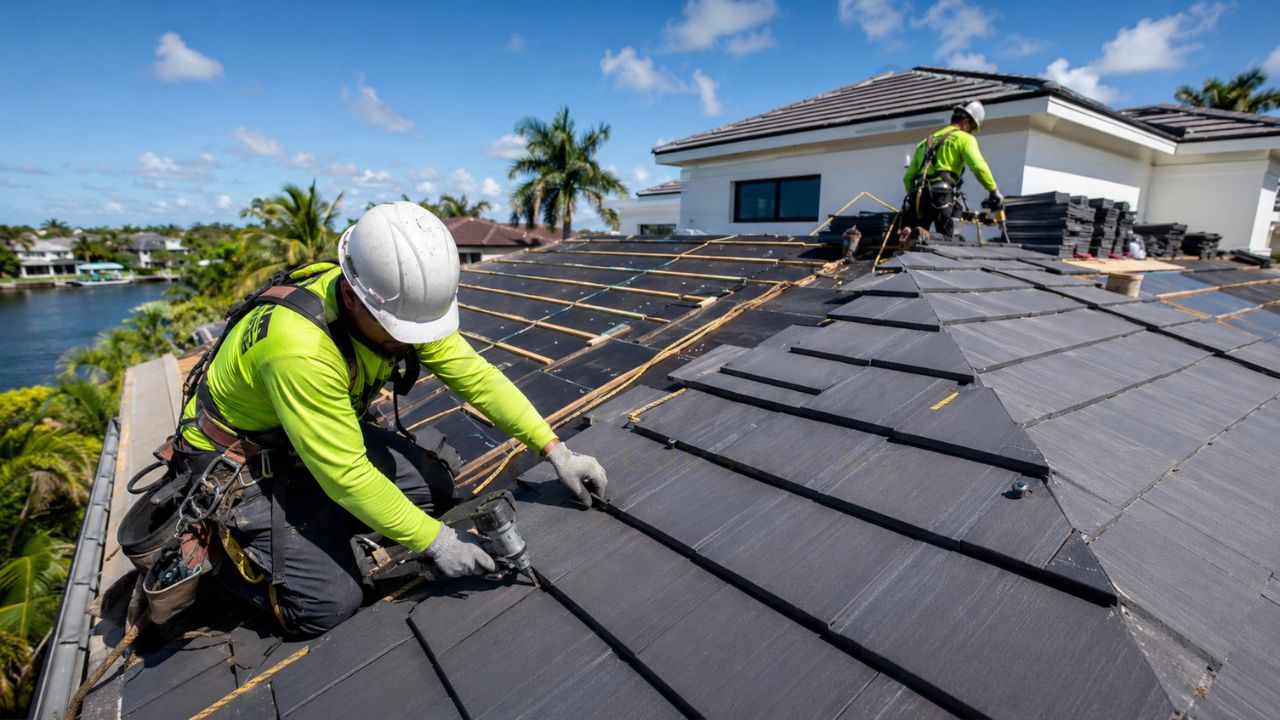
Effective December 31, 2026, the updated building code mandates even stricter wind load requirements. In coastal areas of Miami-Dade, roofs must now be engineered to withstand winds of up to 160 mph. This requires specialized attachment methods, reinforced underlayments, and high-impact materials that add approximately 10-20% to the total project cost compared to non-coastal regions.
| Factor | 2026 Market Trend | Impact on Cost |
|---|---|---|
| Material Inflation | 5% – 12% YoY | Moderate Increase |
| Labor Rates | 3.4% Increase for Remodels | Slight Increase |
| Wind Load Requirements | Up to 160 mph | High Increase (10-20%) |
| Permit Wait Times | 1–3 Weeks (Typical) | Indirect Cost (Timeline) |
| Insurance Incentives | Discounts for Resilience | Long-term ROI |
Primary Roofing Materials: Costs, Pros, and Cons
Choosing the right material is the most significant variable in your estimate. In Miami-Dade, the “Big Three” remain asphalt shingles, metal, and tile, each serving different budgetary and aesthetic needs.
📋 Receive a Customized Roofing Cost Breakdown for Your Property.
Asphalt Shingles: The Budget-Friendly Standard
Asphalt shingles are the most common residential choice in Miami due to their affordability and ease of installation.
- Average Cost: $5 to $8 per square foot.
- Lifespan: 15 to 30 years, depending on maintenance.
- Best For: Residential homeowners looking for cost-effective protection and a wide variety of style options.
Metal Roofing: The Modern Powerhouse
Increasingly popular in Miami for its energy efficiency, metal roofing reflects solar heat, significantly reducing cooling costs in our tropical climate.
- Average Cost: $8 to $12 per square foot.
- Lifespan: 50+ years with minimal maintenance.
- Key Advantage: Exceptional wind resistance and durability against heavy rain and hail.
Tile Roofing (Clay & Concrete): The South Florida Signature
Tile roofs are iconic in Miami-Dade, offering a Mediterranean aesthetic that boosts curb appeal and resale value.
- Average Cost: $10 to $15 per square foot (can go higher for luxury custom tiles).
- Lifespan: 50 years or more.
- Consideration: Heavy weight may require reinforcing the roof frame, which can increase structural costs.
Flat Roofs: The Modern & Commercial Solution
Common on modern residential designs and commercial properties, flat roofs provide functional surfaces for solar panels or rooftop gardens.
- Average Cost: $6 to $10 per square foot.
- Maintenance: Requires regular checks to prevent water pooling and debris buildup.
Detailed Cost Breakdown by Component
A professional roofing-cost-estimator-in-miami-dade-county does not just look at the surface; it breaks down every “nut and bolt.” Below is a breakdown of how your investment is distributed across a typical project.
1. Labor Costs
Labor in Miami-Dade is highly specialized due to the technical requirements of the HVHZ codes. You can expect labor to account for $2 to $5 per square foot of the total estimate. Skilled contractors are essential for ensuring that hurricane straps and impact-resistant materials are installed to code.
2. Materials and Takeoffs
Material costs are the largest variable. In 2026, framing lumber has seen a 10% increase, while concrete is up 7%
- Asphalt Shingle Bundles: Typically $37 to $360 per bundle, with each bundle covering approximately 33.3 sq. ft..
- Aluminum Roofing: Material alone ranges from $6 to $16 per square foot.
3. Tear-Off and Disposal
In many Miami-Dade municipalities, you cannot layer a new roof over an old one if there are already two layers present. A full tear-off includes removing old materials and disposing of them at local facilities, which can add $1,500 to $4,000 to the project cost depending on the roof size and material weight.
4. Secondary Water Barrier (Underlayment)
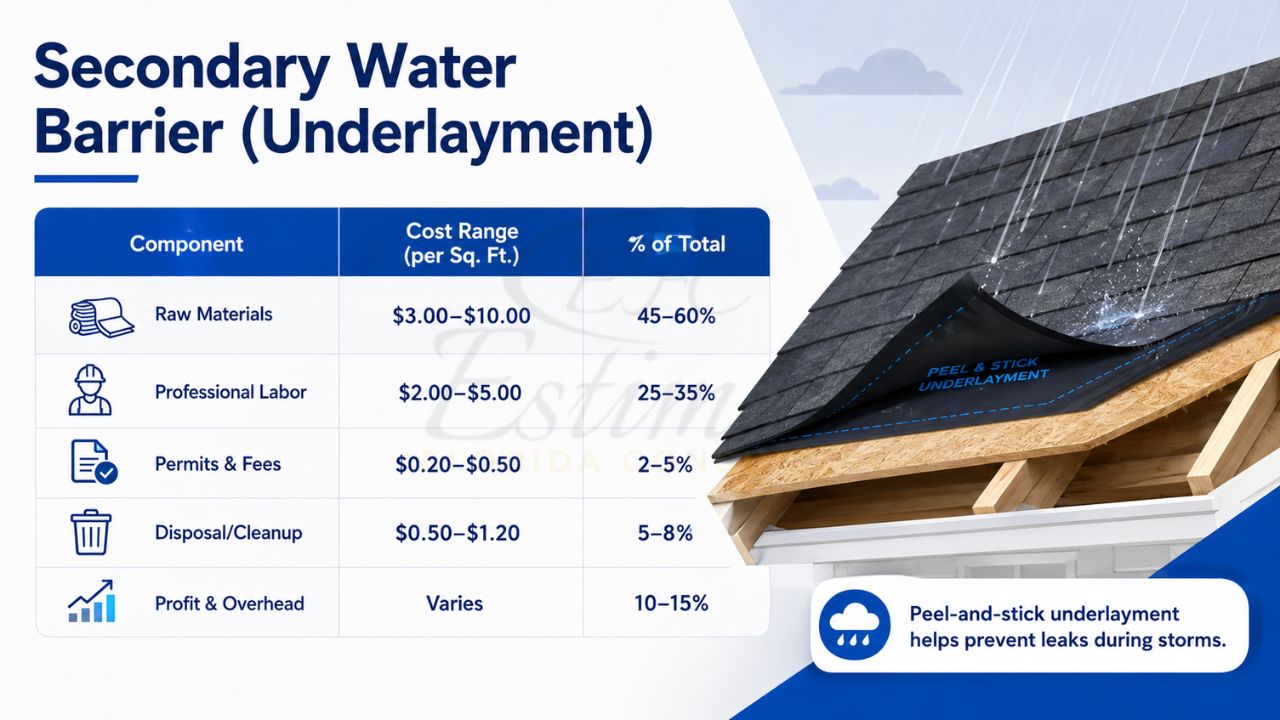
In South Florida, the underlayment is arguably more important than the top layer. Most codes now require a “peel-and-stick” secondary water barrier that prevents leaks even if the primary roof tiles or shingles are blown off during a storm.
| Component | Cost Range (per Sq. Ft.) | Percentage of Total |
|---|---|---|
| Raw Materials | $3.00 – $10.00 | 45% – 60% |
| Professional Labor | $2.00 – $5.00 | 25% – 35% |
| Permits & Fees | $0.20 – $0.50 | 2% – 5% |
| Disposal/Cleanup | $0.50 – $1.20 | 5% – 8% |
| Profit & Overhead | Varies | 10% – 15% |
Hurricane Resilience and High-Velocity Hurricane Zones (HVHZ)
Miami-Dade County is entirely within a High-Velocity Hurricane Zone (HVHZ), the most stringent classification in the Florida Building Code. This means every roofing project must adhere to specialized standards:
- ASCE 7-22 Wind Calculations: Estimates must now include these specific calculations to prove the roof can handle the uplift pressures of 160 mph winds.
- Impact-Rated Materials: Tiles and shingles must be tested to withstand flying debris.
- Missile-Resistant Glass: While technically part of the windows, if a roof includes skylights, they must meet the same “large missile” impact standards.
Cost Impact of Resilience Mandates
While these requirements add 10-20% to initial costs, they are non-negotiable for passing inspections and securing homeowners’ insurance. Insurers in 2026 are increasingly “slashing premiums” for homes that can provide proof of code-compliant, resilient roofing systems in their estimates.
🏗️ Get Reliable Residential and Commercial Roofing Estimates.
Permitting, Inspections, and Regulatory Fees
Securing a roofing permit in Miami-Dade is a multi-step process that varies slightly between the county and specific cities like Miami Beach or Coral Gables.
- Permit Costs: Generally range from $200 to $1,000 depending on the project scope and property value.
- Mandatory Inspections: These are required at various stages:
- In-Progress Inspection: To verify the dry-in (underlayment) and flashing.
- Final Inspection: To ensure the finished product meets the approved plans and wind load requirements.
Regional Pricing Variations Across Miami-Dade
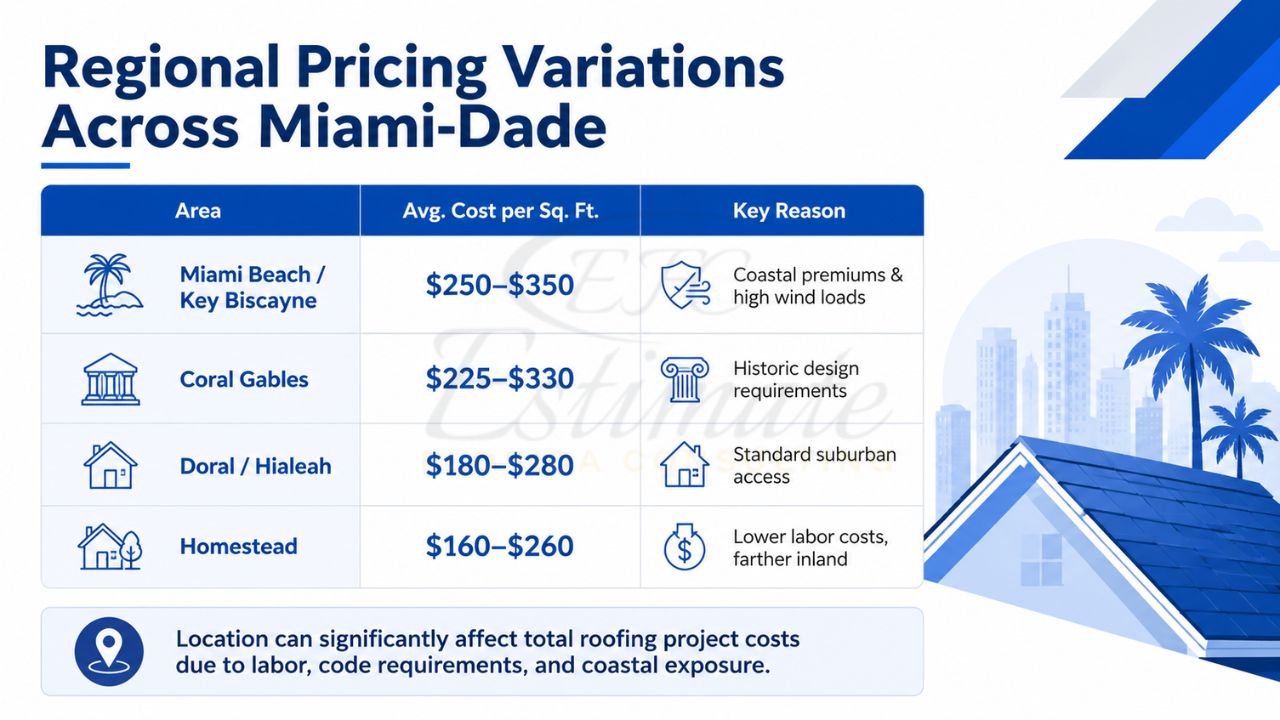
Where you live in the county significantly impacts the “soft costs” of your project.
| Area | Avg. Cost per Sq. Ft. | Reason for Variation |
|---|---|---|
| Miami Beach / Key Biscayne | $250 – $350 | Coastal premiums, high wind loads. |
| Coral Gables | $225 – $330 | Historical board requirements, specific tile types. |
| Doral / Hialeah | $180 – $280 | Standard suburban requirements, easier access. |
| Homestead | $160 – $260 | Slightly lower labor rates, further from coastal surge. |
The ROI of Professional Roofing Estimating
Why should a contractor or homeowner pay for a professional estimate from Estimate Florida Consulting?
- Avoid Bid Fails: Inaccurate estimates lead to bids that fail code checks or balloon later with expensive change orders.
- Protect Profit Margins: For contractors, precise quantity takeoffs allow you to bid aggressively without risking your bottom line.
- Lender Confidence: Professional, data-backed reports increase the likelihood of securing construction loans or investment.
- Speed: We offer 1-2 day delivery for residential estimates, ensuring you don’t lose time in a fast-paced market.
📞 Request Your Miami-Dade County Roofing Estimate Today.
Strategic Tips for Homeowners and Contractors
- Check for Structural Integrity: If switching from shingles to tile, always have a professional check if your rafters can handle the weight (approx. 800-1,000 lbs per square).
- Use Real-Time Pricing: Don’t rely on 2024 data. Use 2026-specific Florida adjustments like RSMeans to ensure your budget is realistic.
- Factor in Ventilation: Proper attic ventilation can extend the life of your Miami roof by 10 years by reducing heat buildup.
- Don’t Skip the Cleanup: Ensure your estimate includes a magnetic sweep for nails and debris disposal to avoid post-construction hazards.
Miami-Dade Roofing Scope Planning
A useful Division 07 budget identifies roof area and geometry, existing-condition and tear-off assumptions, assembly and underlayment selection, flashings, drainage, penetrations, equipment coordination, access, and current Miami-Dade trade-pricing data. Defined scope assumptions help project teams organize quantities and compare roofing proposals with greater clarity.
Explore related planning resources for roofing estimating services, Miami construction estimating, Miami construction cost estimates, and our construction estimating service.
Frequently Asked Questions (FAQ)
- What is the average cost of a new roof in Miami-Dade for 2026?
On average, a full replacement ranges from $10,000 to $30,000, but material choice and house size can push this much higher. - Is a permit required for minor roof repairs?
Yes, in Miami-Dade, most roofing work requires a permit to ensure hurricane standards are met. - How much more does a tile roof cost compared to shingles?
Tile typically costs $10-$15/sq. ft., whereas shingles are $5-$8/sq. ft.. - Are metal roofs noisy during Miami’s heavy rain?
When installed with proper underlayment and insulation, metal roofs are no noisier than other materials. - How long does a roofing project take in Miami?
A typical residential project takes 3 to 7 days of actual labor, though permitting can take weeks. - What are the wind requirements for 2026?
Up to 160 mph in coastal zones per the 9th Edition Building Code. - Can I install solar panels on a flat roof?
Yes, flat roofs are ideal for solar but require professional sealing at the mounting points. - What is a “square” in roofing terms?
A square is a 10′ x 10′ area, or 100 square feet. - Why is copper roofing more expensive?
Copper is a premium material with an extremely long lifespan and high aesthetic value, often exceeding $20/sq. ft.. - Do I need an inspection after the roof is finished?
Yes, a final inspection by the county or city is mandatory to close the permit. - How often should I inspect my roof for repairs?
At least once a year, preferably before the start of hurricane season (June 1st). - Does Estimate Florida Consulting provide free revisions?
Yes, we offer consultations and revisions as part of our professional service model.
Conclusion
A roof in Miami-Dade County is more than just a cover—it is a sophisticated engineering system designed to protect life and property from some of the most extreme weather conditions in the country. By using a precise roofing-cost-estimator-in-miami-dade-county, you eliminate the guesswork that leads to financial stress and legal non-compliance.
Whether you are budgeting for a sleek metal roof in Coconut Grove or a durable flat roof for a commercial warehouse in Medley, accuracy is your greatest asset. At Estimate Florida Consulting, we provide the data-driven clarity you need to build with confidence.