
For Florida property owners, the foundation of a safe and durable waterfront structure begins below the water line. If you are planning a new build or a major renovation, one of the most critical questions you will ask is: how much does it cost to install dock pilings in 2026?
In the current Florida market, the total cost to drive dock pilings typically ranges from $37,500 to $198,000 for a full project, or roughly $75 to $200 per square foot. On a per-unit basis, individual piling installation can range from $330 to $1,760 per piling depending on material and depth.
⚓ Get an Accurate Dock Piling Installation Cost Estimate.
At Estimate Florida Consulting, we understand that these wide ranges can make budgeting difficult. Whether you are building a private residential dock in Coral Gables or a commercial pier in Fort Lauderdale, having a precise waterfront construction piling estimate is essential to avoid the 20-30% overruns commonly seen in unmanaged marine projects.
Average Cost to Install Dock Pilings in 2026
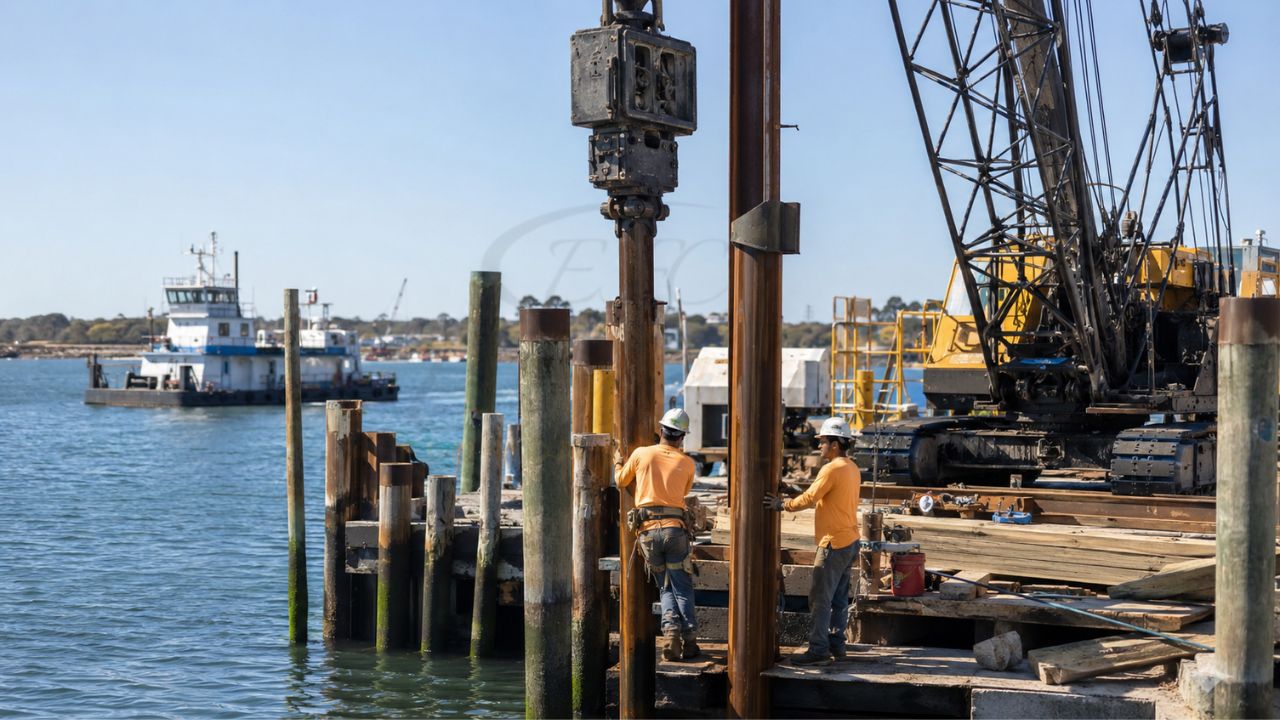
The marine piling installation price you receive will be influenced by global material trends and local Florida labor conditions. For 2026, costs have stabilized somewhat, but High-Velocity Hurricane Zone (HVHZ) requirements and saltwater-resistant upgrades keep Florida prices higher than the national average.
2026 Cost Breakdown by Piling Type
| Piling Material | Cost Per Linear Foot | Estimated Lifespan | Best Use Case |
|---|---|---|---|
| Wood (Pressure-Treated) | $13 – $52 | 15 – 30 Years | Light-duty residential |
| Steel | $39 – $78 | 50 – 100 Years | Heavy industrial/Commercial |
| Concrete (Pre-stressed) | $26 – $65 | 50 – 100 Years | Residential & Commercial |
| Composite/Fiberglass | $52 – $104 | 50 – 100+ Years | Harsh saltwater environments |
Cost Per Piling vs. Cost Per Linear Foot
When requesting a quote, it is important to understand the difference between these two pricing models.
- Cost Per Piling: This is often used for repairs or small-scale replacements. For example, replacing a single dock piling in Florida typically averages between $330 and $1,760. This price includes the material, the mobilization of a barge or pile driver, and the labor to secure it.
- Cost Per Linear Foot: This is the industry standard for new construction. It accounts for the total length of the piling, including the portion driven deep into the seabed to reach a load-bearing strata. In Florida, where you may need to drive pilings 40 feet deep to reach stable soil, the boat dock piling cost per foot becomes the primary driver of your budget.
💰 Plan Your Waterfront Project with a Detailed Cost Estimate.
Types of Dock Pilings and Their Costs
The material you choose will dictate both your upfront dock piling installation cost per piling and your long-term maintenance expenses.
Wood Pilings
Wood remains the most cost-effective initial option, typically ranging from $20 to $40 per linear foot. While popular for their aesthetic, wood pilings in Florida are susceptible to marine borers and rot. Even with heavy pressure treatment, they rarely exceed a 30-year lifespan in saltwater.
Concrete Pilings
Concrete is the “gold standard” for many Florida homeowners. At $50 to $80 per linear foot, concrete pilings offer extreme durability and resistance to the harsh Florida sun and saltwater. They are especially favored in South Florida due to their ability to meet strict HVHZ wind and wave load requirements.
Steel Pilings
Mainly used for commercial piers or heavy yacht docks, steel pilings cost between $40 and $60 per linear foot. While incredibly strong, they require specialized coatings or cathodic protection to prevent corrosion in saltwater, which can add 25% to the total cost.
Composite Pilings
Composite pilings are the premium choice, often exceeding $100 per linear foot. Made from fiberglass or advanced polymers, they are immune to rot and corrosion. For property owners looking to minimize maintenance over 50+ years, composites offer the best lifecycle value.
Key Factors That Affect Dock Piling Installation Cost
Understanding the variables behind your waterfront construction piling estimate can help you optimize your project budget.
- Piling Depth and Length: Deeper pilings provide more stability but increase costs. In soft, silty areas of the Intracoastal Waterway, pilings may need to be driven 30-50 feet to find a solid foundation, significantly increasing material and labor costs.
- Site Accessibility: If a contractor can reach your site with a land-based pile driver, costs will be lower. However, most Florida projects require a barge-mounted rig. Equipment rental for pile drivers and cranes can range from $5,000 to $20,000 for a standard project.
- Soil Composition: Driving a piling into sandy soil is relatively straightforward. However, encountering the limestone shelf common in parts of Florida requires “rock cutting” or pre-drilling. Rock-cut deep-dredging or drilling can run $40 to $80 per cubic yard or add thousands to your piling bid.
- Labor Rates: Specialized marine construction labor in Florida is in high demand. Skilled crews typically charge $60 to $120 per hour. In high-cost areas like Miami or the Keys, labor can be 20% above the state average.
🔍 Get Reliable Dock Piling Installation Pricing for Your Project.
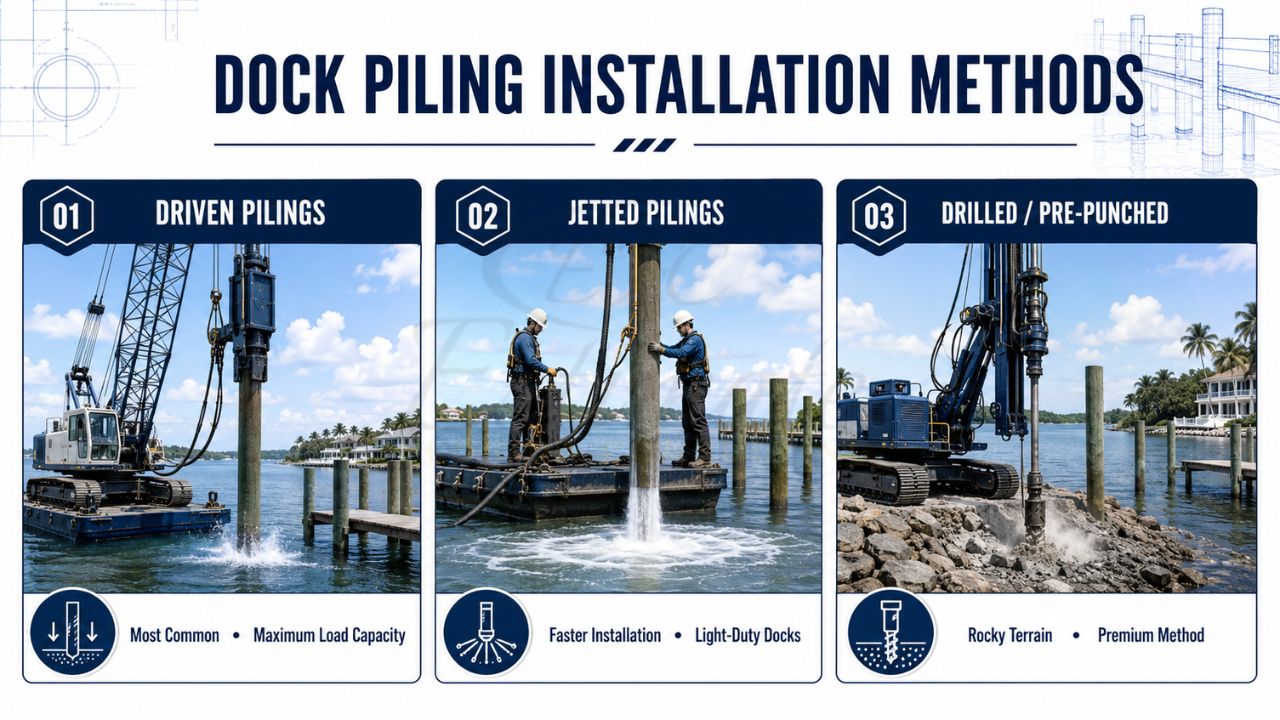
Installation Methods: Driven, Jetted, and Drilled
The method used to install your pilings will also impact the cost to drive dock pilings Florida contractors provide.
- Driven Pilings: Using a traditional pile driver (drop hammer or vibratory), this method is the most common for permanent structures. It ensures the piling reaches the necessary “refusal” point for maximum load-bearing capacity.
- Jetted Pilings: This involves using high-pressure water to liquefy the soil so the piling can sink. While faster and often cheaper for light-duty docks, jetted pilings may not provide the stability required for heavy boat lifts or hurricane-force winds.
- Drilled/Pre-punched: Essential for rocky terrain, a drill or “punch” is used to create a pilot hole before the piling is inserted. This is the most expensive method due to the specialized machinery required.
Additional Costs to Consider
A realistic estimate must look beyond just the pilings themselves.
- Permits and Engineering: Florida marine projects require a “stack” of permits. You may need approvals from the Florida Department of Environmental Protection (FDEP), the U.S. Army Corps of Engineers, and your local county. Permitting fees and environmental compliance can range from $2,000 to $10,000+.
- Environmental Mitigation: If your project impacts seagrass or mangroves, you may be required to pay into a mitigation bank. For large projects, environmental mitigation can account for 30-50% of the total project cost.
- Mobilization: This is the cost to move heavy equipment and barges to your site. For remote locations, mobilization fees can start at $2,100 to $8,400.
- Corrosion Protection: For steel or concrete with rebar, specialized coatings and sacrificial anodes are necessary to prevent saltwater damage, adding 10-20% to structure costs.
Florida-Specific Considerations for Dock Pilings
Building on the water in Florida is unique due to several environmental and regulatory factors.
HVHZ and Hurricane Resilience
South Florida’s High-Velocity Hurricane Zone codes require structures to withstand wind speeds of 175-180+ mph. This necessitates deeper piling penetration and heavy-duty hardware, which typically adds a 20-35% premium to your construction costs compared to inland or non-HVHZ areas.
Saltwater Corrosion and Marine Borers
Florida’s warm saltwater is a breeding ground for marine borers that can tunnel through wood pilings in a few years. For this reason, many Florida municipalities now recommend or require concrete or composite pilings for permanent residential structures.
Sea-Level Rise (SLR) Adaptation
Modern Florida codes often require “elevated slabs” and higher bulkhead caps to account for projected sea-level rise. Elevating your dock foundation by just 2-3 feet can increase the required piling length and, consequently, your total budget by 10-15%.
📞 Request Your Dock Piling Installation Estimate Today.
How Professional Estimating Helps with Marine Projects
Marine construction is inherently volatile. At Estimate Florida Consulting, we provide high-precision cost takeoffs that eliminate the “guesswork” that leads to budget overruns. By using advanced software like PlanSwift and local RSMeans data calibrated for the Florida market, we ensure your bids are competitive and accurate.
Professional estimating helps you:
- Verify Material Quantities: Avoid over-ordering expensive composite or steel materials.
- Account for HVHZ Uplift: Ensure your budget reflects mandatory hurricane-resistance hardware.
- Plan for Mitigation: Identify potential environmental “hidden costs” before you break ground.
Plan Dock Piling Scope Before Comparing Construction Costs
A dock-piling budget is more dependable when the waterfront work is organized into measurable scopes instead of a broad per-piling allowance. Survey and existing-condition review, access and mobilization, waterway and substrate conditions, piling material and length, installation method, pile caps and connections, corrosion protection, deck interface, hardware, utility coordination, cleanup, testing, and closeout should be identified separately.
Water depth, soil or rock conditions, wind and wave exposure, tidal access, equipment needs, selected piling material, corrosion environment, adjacent structures, local requirements, environmental coordination, material lead times, and construction sequencing can change the appropriate scope and pricing. A plan-based quantity takeoff supported by current trade-pricing data helps project teams compare complete marine construction packages while their design, environmental, and code professionals confirm project-specific requirements.
Related estimating support: industrial construction estimating, underground utilities cost guide, concrete estimating services, and construction estimating services.
Frequently Asked Questions
- How many pilings do I need for a standard boat dock?
A typical 600-square-foot piling dock usually requires between 12 and 20 pilings, depending on the load and deck layout. - Is it cheaper to repair or replace a dock piling?
Repairing a piling (e.g., wrapping or patching) averages $200 to $700, while a full replacement can cost $330 to $1,760. If the structural integrity is compromised, replacement is usually the safer long-term investment. - How deep do dock pilings need to be driven in Florida?
The depth varies by soil, but most Florida pilings are driven 10 to 40 feet deep. A professional soil test or “penetrometer” test is the only way to determine the exact depth needed for your site. - Can I install my own dock pilings?
While small “pipe docks” can sometimes be a DIY project, driving structural pilings requires heavy machinery, specialized permits, and engineering expertise. Errors can lead to structural failure or heavy fines from the DEP. - How long does the installation process take?
For a residential project, the actual piling installation usually takes 10 to 20 days once the equipment is on-site. However, the permitting process can take 4 to 12 weeks. - What is the best piling material for Florida saltwater?
Concrete and composite/fiberglass are the best for saltwater. They resist both corrosion and marine borer attacks, offering the longest lifespan in Florida’s climate.
Contact Estimate Florida Consulting Today
Don’t leave your waterfront foundation to chance. For an accurate, professional cost estimate for your 2026 dock piling project, contact the experts at Estimate Florida Consulting. We provide detailed material takeoffs and budget breakdowns that help you build with confidence.
Email: info@estimatorflorida.com
Phone: 561-530-2845