
Building a performing arts theater is far more than a standard commercial construction project; it is the creation of a high-performance “instrument” designed to manipulate light and sound with surgical precision. For Florida developers, municipalities, and educational institutions, this endeavor is further complicated by a unique set of environmental demands. From the corrosive salt air of coastal regions to the extreme humidity and the rigorous requirements of High-Velocity Hurricane Zones (HVHZ), Florida projects demand a level of engineering excellence that few other regions require.
At Estimate Florida Consulting, we bring over 12 years of specialized experience and a portfolio of over 1,000 professional estimates to every project. Having managed cost projections for complex commercial developments reaching up to $65 million, we understand that “how much does it cost to build a performing arts theater” depends on a thousand interconnected variables. In the 2026 market, characterized by material volatility and a premium on skilled labor, precision in the pre-construction phase is the difference between a successful cultural landmark and a budgetary crisis.
🏛️ Get an accurate Performing Arts Theater construction estimate before you build in Florida.
High-Level Cost Overview: The 2026 Florida Reality
Nationally, theater construction can vary widely, but Florida’s stringent building codes and climate needs often push costs toward the higher end of the spectrum. A standard 30,000 sq ft facility in Florida generally ranges from $10.5 million to over $22.3 million.
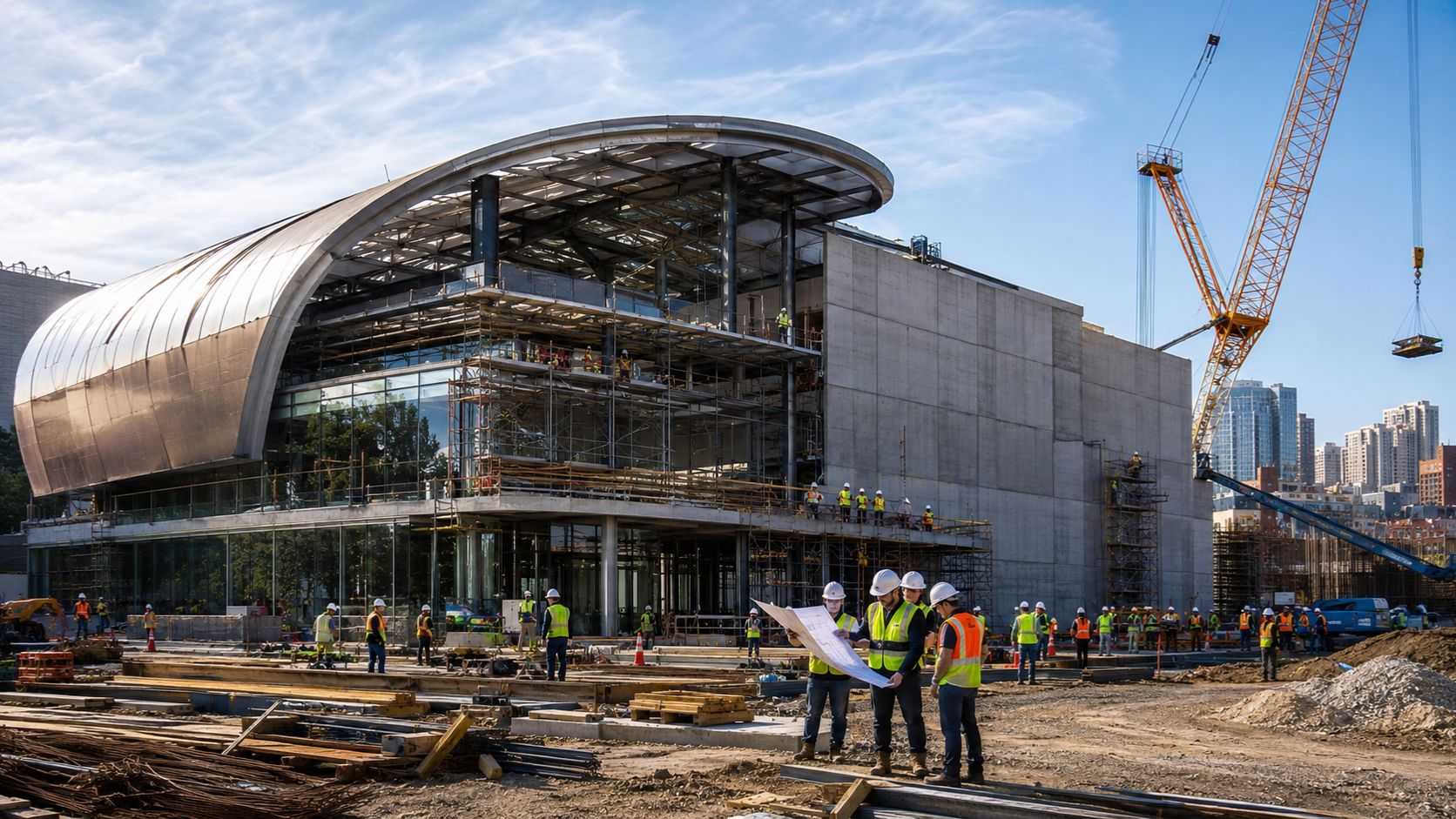
2026 Estimated Construction Cost per Square Foot (Florida)
| Facility Type | Basic/Community Theater | Mid-Range/Standard | Premium/Professional Center |
|---|---|---|---|
| Indoor Performing Arts Theater | $350 – $500 | $500 – $750 | $750 – $1,100+ |
| Covered Amphitheater | $250 – $350 | $350 – $550 | $550 – $750+ |
| Multipurpose Auditorium | $270 – $400 | $400 – $550 | $550 – $700 |
Note: These ranges include hard construction costs, specialized systems, and materials. Soft costs like architectural fees and permits typically add another 15-20% to the total budget.
The Florida Factor: Environmental and Regulatory Drivers
Florida’s construction landscape is governed by the Florida Building Code (FBC), one of the most rigorous in the United States.
1. Hurricane Resilience and Wind Loads
In coastal Florida, structures must withstand winds of 150-180 mph. For theaters, which often feature massive, vertical “fly towers” for stage scenery, this creates a significant “sail area.” Wind-load engineering requires reinforced masonry, massive structural steel, and impact-resistant glazing, all of which drive up the building shell’s cost.
2. High-Volume, Quiet HVAC Systems
Theaters must house hundreds—if not thousands—of people in Florida’s 90%+ humidity. The HVAC system must work overtime to manage moisture while remaining nearly silent to avoid interfering with acoustic performance. This necessitates Dedicated Outside Air Systems (DOAS) and specialized ductwork treatments.
3. Humidity Control for Instruments and Materials
The interior of a theater often features expensive wood finishes and sensitive musical instruments (like grand pianos). Constant, precise humidity control is essential to prevent warping and mold, requiring high-end automation systems.
💰 Avoid costly surprises with a detailed theater cost estimate.
Phase-by-Phase Construction Cost Breakdown
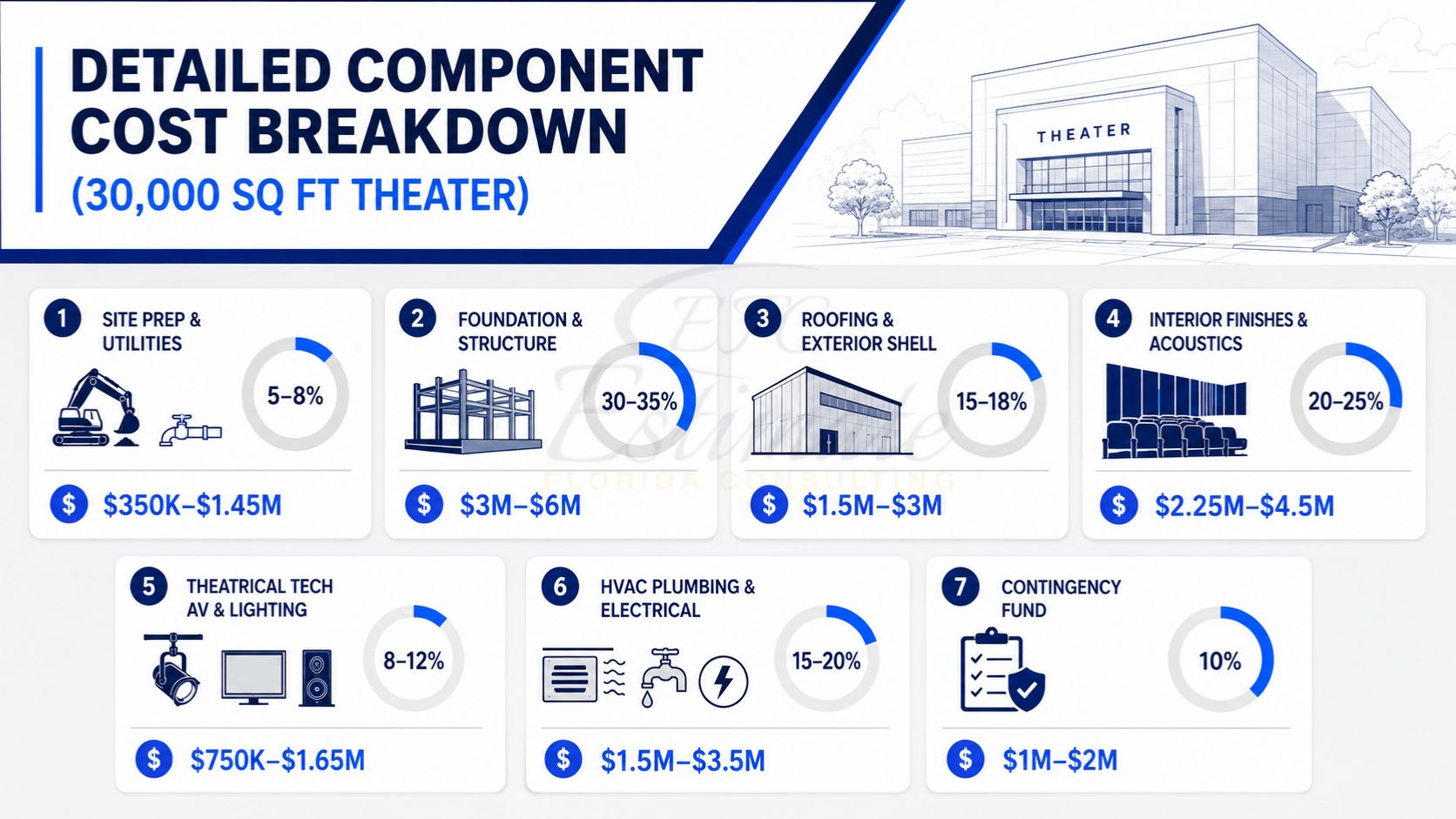
To understand the budget, one must analyze the project through individual trades. For a typical 30,000 sq ft professional-grade facility, the costs are distributed across several critical phases.
Detailed Component Cost Breakdown (30,000 Sq Ft Theater)
| Phase/Component | Estimated Cost Range | Percentage of Total Budget |
|---|---|---|
| Site Prep & Utilities | $350,000 – $1,450,000 | 5% – 8% |
| Foundation & Structure | $3,000,000 – $6,000,000 | 30% – 35% |
| Roofing & Exterior Shell | $1,500,000 – $3,000,000 | 15% – 18% |
| Interior Finishes & Acoustics | $2,250,000 – $4,500,000 | 20% – 25% |
| Theatrical Tech, AV & Lighting | $750,000 – $1,650,000 | 8% – 12% |
| HVAC, Plumbing & Electrical | $1,500,000 – $3,500,000 | 15% – 20% |
| Contingency Fund (10%) | $1,000,000 – $2,000,000 | 10% |
Technological Infrastructure: The Heart of the Performance
A theater’s value is defined by its ability to support world-class performances. The “tech package” is a major investment area.
Advanced Sound Reinforcement
Professional acoustics involve more than speakers. They require sound-isolated mixing booths, digital signal processing, and assistive listening systems. A professional sound system for a mid-sized theater typically costs between $200,000 and $500,000.
Stage Rigging and Automation
The rigging system allows for the movement of heavy scenery and curtains. While manual counterweight systems are more affordable, modern Florida theaters are increasingly opting for motorized automation, which increases safety but raises costs into the $150,000 – $300,000 range.
🎭 Turn your vision into reality with expert theater estimating services.
Structural Engineering: Managing Long Spans and Wind Loads
The “Clear Span” requirement—the need for a vast, column-free auditorium—is the single greatest structural challenge.
- Custom Steel Trusses: These often span 60 to 100 feet and must support the weight of the roof plus the massive load of lighting bridges and theatrical rigging.
- Vibration Isolation: Mechanical units (HVAC) must be isolated from the structure to prevent vibrations from traveling into the performance space.
- Fly Tower Construction: The tall structure above the stage (the fly tower) requires additional wind-load reinforcement, as it stands much higher than the rest of the building.
Acoustics and Interior Finishes: Building the “Instrument”
Acoustics are not an “add-on”; they are foundational to the design. Achieving a Noise Criteria (NC) rating of 15-20 requires specialized materials.
- Acoustic Clouds and Diffusers: Suspended panels that manage sound reflections.
- Floating Floors: Essential in urban areas to isolate the auditorium from external traffic or subway noise.
- Theatrical Seating: Seats must be durable and comfortable, but also acoustically neutral—meaning they absorb the same amount of sound whether someone is sitting in them or not. Seating for a 500-seat house can cost $200,000 – $400,000.
Support Spaces: Front-of-House and Backstage Realities
A theater requires roughly 40-50% of its square footage to be dedicated to support spaces, not just the stage and seats.
1. Front-of-House (FOH)
The lobby is the public face. High-end finishes, ticket windows, restrooms (which must handle “intermission surges”), and concessions can cost $200,000 to $500,000.
2. Backstage (BOH)
Performers require dressing rooms ($50k – $150k), green rooms, and administrative offices ($150k – $300k). These spaces must meet strict life-safety and accessibility codes.
Regional Price Variations Across Florida
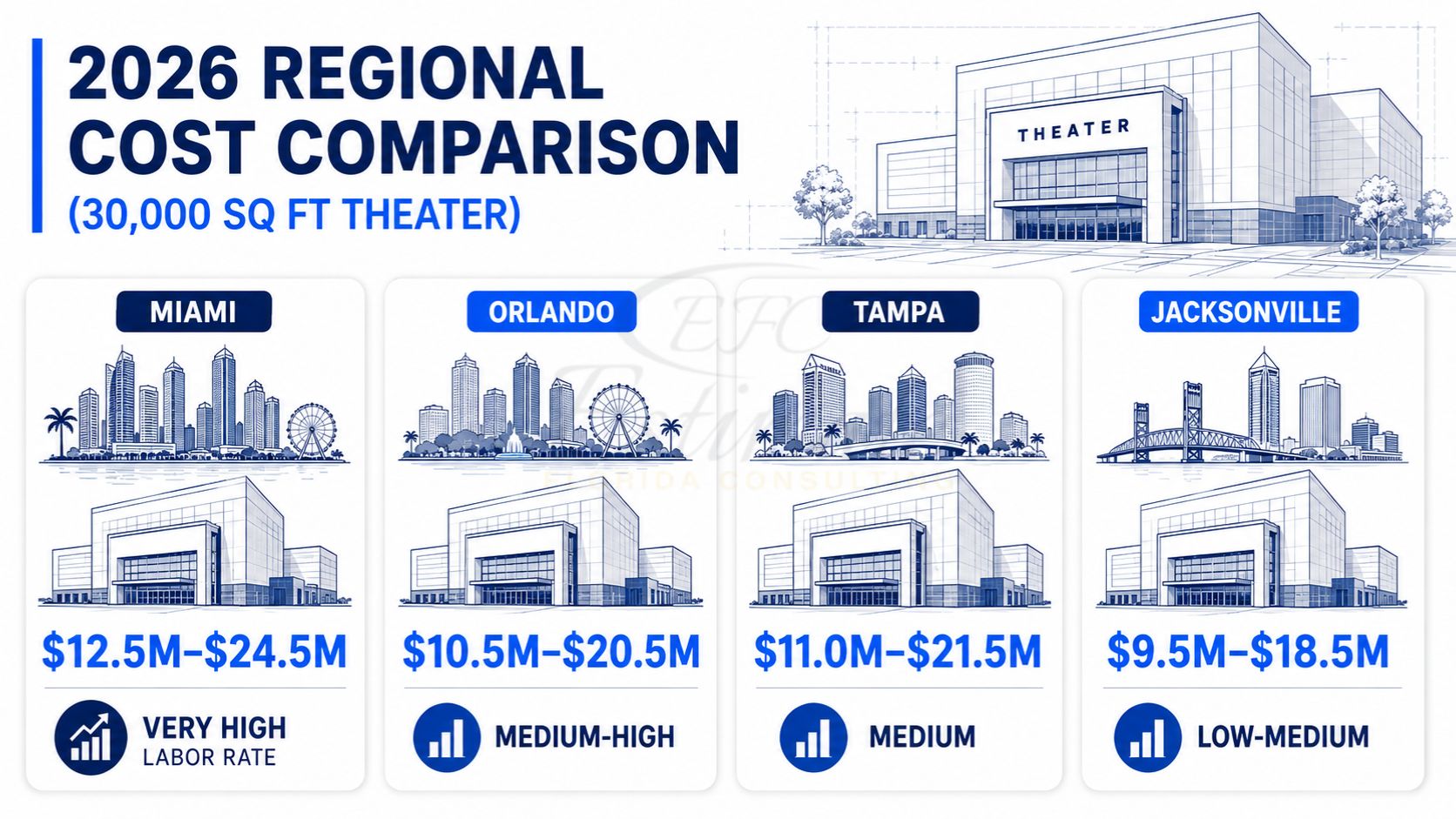
Labor and material availability vary significantly between North and South Florida.
2026 Regional Cost Comparison (30,000 Sq Ft Theater)
| City | Estimated Project Cost | Labor Rate Index |
|---|---|---|
| Miami | $12.5M – $24.5M | Very High |
| Orlando | $10.5M – $20.5M | Medium-High |
| Tampa | $11.0M – $21.5M | Medium |
| Jacksonville | $9.5M – $18.5M | Low-Medium |
Site Planning and Permitting Challenges
In Florida, site selection involves more than just location; it involves environmental feasibility.
- Flood Mitigation: Coastal sites often require elevating the entire structure, adding millions to the foundation costs.
- Public Assembly Permits: Theaters fall under “Public Assembly” codes, which have the strictest requirements for fire suppression, emergency egress, and ADA accessibility.
- Parking Requirements: Florida municipalities often require 1 parking spot per 3-4 seats, which can necessitate expensive parking garage structures in dense urban areas like Miami or Tampa.
🏆 Protect your budget with professional performing arts theater estimates.
Why Professional Multi-Trade Estimating is Non-Negotiable
Given the technical complexity of a performing arts center, “guesstimates” are dangerous. Professional estimating provides:
- Risk Mitigation: Identifying cost overruns before groundbreaking.
- Lender Confidence: Accurate estimates are essential for securing construction loans or municipal bonds.
- Value Engineering: Finding high-quality alternatives for materials without sacrificing the “NC” acoustic rating.
- Trade Coordination: Ensuring that electrical, mechanical, and theatrical trades are synchronized in the budget.
Pre-Construction Budget Checkpoints for a Florida Theater
A reliable theater budget begins with the program, not a single square-foot allowance. Before setting a funding target or comparing proposals, confirm the seat count, fly-tower height, acoustical criteria, stage-rigging approach, lighting and AV package, HVAC noise-control requirements, egress and fire-protection scope, parking, site conditions, and hurricane-resistance assumptions. This keeps specialized performance requirements visible in the estimate rather than buried in a late change order.
For coordinated planning, connect the facility estimate with a commercial construction cost estimate, commercial HVAC duct-installation cost planning, electrical estimating support, and broader construction estimating services. Each scope can then be reviewed as part of one consistent Florida project budget.
Frequently Asked Questions (FAQs)
What is the single biggest cost driver? Structural engineering for long-span roofs and hurricane resistance (30-35% of budget).
How long does construction take? Typically 18-30 months from planning to grand opening.
Is a contingency fund necessary? Absolutely. A 10% contingency is mandatory to cover unforeseen site conditions or material price spikes.
Can we use standard HVAC? No. Standard HVAC is too loud for theaters. You need specialized low-velocity systems.
How much for a professional sound system? Generally $200,000 to $500,000 for a 500+ seat venue.
What is the difference between an auditorium and a theater? Auditoriums are often multipurpose; theaters are specialized for stage productions and high-end acoustics.
Does the Florida Building Code impact theater design? Yes, especially in wind-load requirements for the fly tower.
How much does seating cost per seat? High-quality theater seats range from $400 to $800 each, including installation.
Are there eco-friendly theater options? Yes, LED lighting and high-efficiency HVAC can reduce long-term operational costs.
Why build in Florida? Strong community demand and cultural growth drive high ROI and community engagement.
How much does a lobby cost? A well-appointed lobby typically budgets between $200k and $500k.
What is “Value Engineering” in theater building? It’s the process of maintaining acoustic/visual quality while reducing material costs.
Conclusion
Building a performing arts theater in Florida is a massive financial and cultural undertaking. While costs in 2026 range from $350 to over $1,100 per square foot, the value of a high-functioning, hurricane-resilient venue is immeasurable for the community it serves. Success hinges on precise planning, expert engineering, and, most importantly, accurate financial forecasting.
Don’t leave your project’s budget to chance. Accurate, trade-by-trade estimating is the foundation of every successful commercial build.
Ready to start your project?
Contact Estimate Florida Consulting today for a detailed, professional construction estimate that accounts for the unique realities of the Florida market.