
Your driveway is more than just a place to park your vehicle; it is a critical component of your home’s curb appeal and a significant financial investment. In Florida, where the environmental conditions are among the harshest in the country, maintaining this surface is a matter of proactive preservation. Homeowners frequently ask, “how much does driveway sealing cost?” but the more important question is often what they stand to lose by skipping it.
📋 Receive a Customized Cost Breakdown for Your Driveway Project.
At Estimate Florida Consulting, we have delivered over 1,000 professional estimates across the Sunshine State. With 12+ years of specialized experience in residential repair and maintenance costing, we have seen firsthand how a small investment in sealing can prevent a $15,000 full driveway replacement. In 2026, the landscape of material costs and labor rates continues to shift. This guide provides a comprehensive, expert-backed analysis of driveway sealing costs, ensuring you can make an informed decision for your property in regions from the sandy coasts of Miami to the red clay of Tallahassee.
Key Takeaways
- Average Cost Range: Driveway sealing in Florida typically costs between $176 and $1,100, with a national average of $539.
- Per Square Foot Pricing: Expect to pay $0.18 to $0.60 per square foot depending on the sealant type and driveway material.
- Concrete vs. Asphalt: Concrete sealing is generally more expensive ($0.30–$0.48/sq. ft.) due to the need for premium acrylic or epoxy sealants, while asphalt ranges from $0.24 to $0.36 per sq. ft..
- Florida Factors: High UV exposure and heavy tropical rainfall make high-reflectivity, moisture-resistant sealants essential to prevent structural fatigue and mold.
- Frequency: In Florida’s intense climate, asphalt driveways benefit from resealing every 2 to 3 years, while concrete can last 3 to 5 years.
- Professional Advantage: Estimate Florida Consulting brings 12+ years of experience and 1,000+ professional estimates to ensure your project uses “bankable” numbers tailored to local market conditions.
💰 Plan Your Budget with a Detailed Driveway Sealing Estimate.
Why Sealing is Non-Negotiable in Florida
Florida’s unique geography and tropical climate present challenges that driveways in other states simply don’t face. Sealing isn’t just an aesthetic upgrade; it is a structural necessity for several reasons.
Protection Against Intense UV Degradation
The Florida sun is relentless. UV radiation can degrade building materials in months, drying out asphalt membranes and causing them to become brittle. Without a protective sealant, asphalt undergoes rapid oxidation, losing its dark, flexible oils and turning gray and prone to cracking. High-quality sealants act as a sunscreen for your driveway, reflecting thermal energy and extending the life of the substrate.
Preventing Tropical Water Intrusion
Florida is famous for its torrential downpours. Unsealed concrete and asphalt are porous. During a storm, water can penetrate the surface, reaching the sub-base. In regions with expansive soil, such as North Florida’s red clay, this moisture leads to significant expansion and contraction, which causes structural fatigue and “alligator” cracking. Sealing creates a monolithic (seamless) barrier that keeps moisture out of the foundation.
Combatting Mold and Algae Growth
The high humidity levels in Florida create a breeding ground for biological growth. Unsealed driveways often develop dark streaks of mold or slippery patches of algae. These not only look unsightly but can also eat away at the surface material over time. A proper seal makes the surface non-porous, making it much harder for organic matter to take root and much easier to clean.
Chemical Resistance
Spills from vehicles—such as oil, gasoline, and transmission fluid—are common. On an unsealed driveway, these chemicals penetrate deep into the material, breaking down the chemical bonds that hold the asphalt or concrete together. A sealed surface allows you to simply wipe or wash away these spills before they cause permanent damage.
2026 Driveway Sealing Cost Breakdowns
The total cost to seal a driveway in 2026 is influenced by several variables, ranging from the size of the area to the complexity of the preparation work.
Overall Average Project Costs
On average, a homeowner can expect to spend between $176 and $1,100 for professional sealing, with most projects landing near the $539 mark. However, high-end projects involving decorative stamped concrete or multi-coat systems can exceed these figures.
Average Cost per Square Foot by Material
The specific formula of the sealant you choose is a primary driver of the per-square-foot cost.
| Sealant Type | Average Cost per Square Foot (Materials + Labor) |
|---|---|
| Asphalt Emulsion | $0.18 – $0.30 |
| Coal Tar | $0.24 – $0.36 |
| Acrylic (Concrete/Pavers) | $0.30 – $0.48 |
| Oil-Based | $0.17 – $0.22 |
| Epoxy (High-End Concrete) | $0.36 – $0.60 |
| Fast-Drying Sealcoating | $0.11 (Material only) |
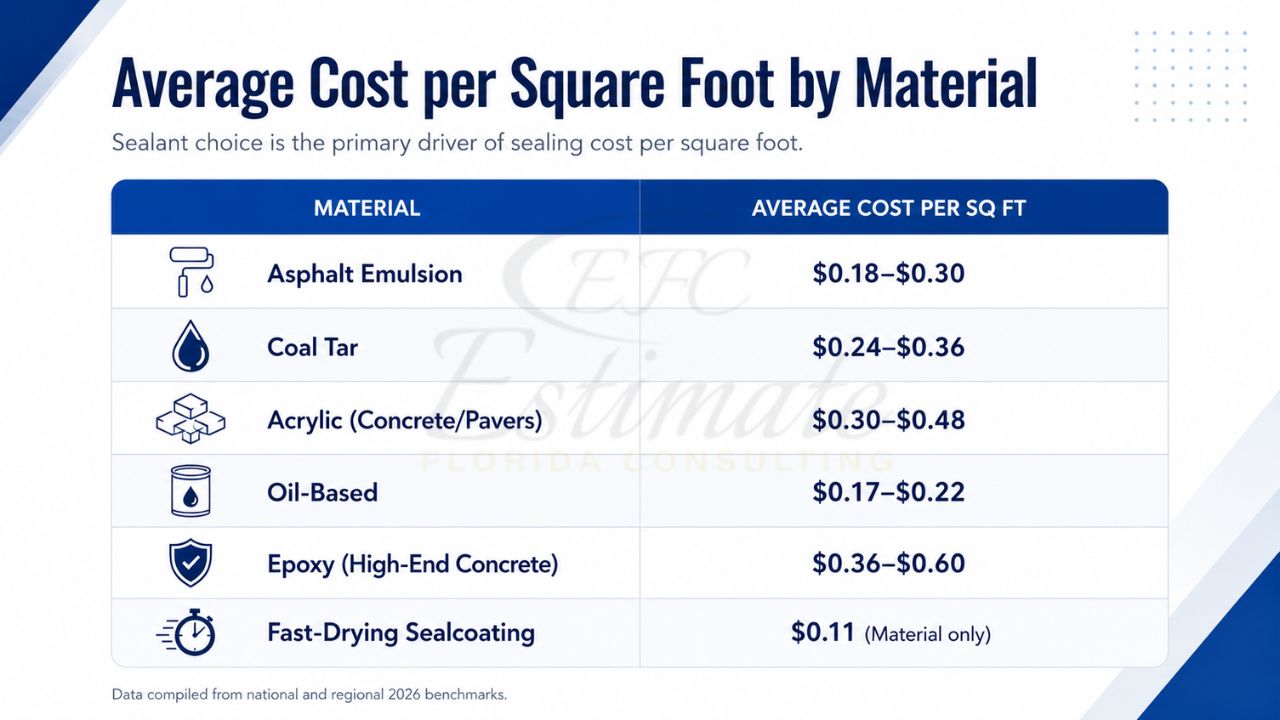
Data compiled from national and regional 2026 benchmarks.
🔍 Estimate Labor, Materials, and Sealcoating Costs with Confidence.
Total Estimated Cost by Driveway Size
The size of your driveway is the most straightforward factor in your estimate. Larger areas require more material and more labor-hours for application.
| Driveway Size (sq. ft.) | DIY Cost Estimate | Professional Cost Estimate |
|---|---|---|
| 500 sq. ft. (Single Car) | $50 – $150 | $250 – $500 |
| 1,000 sq. ft. (Two Car) | $100 – $300 | $500 – $1,000 |
| 1,500 sq. ft. | $150 – $450 | $750 – $1,500 |
| 2,000 sq. ft. | $200 – $600 | $1,000 – $2,000 |
Note: These estimates assume a driveway in “good” condition. Extensive repairs will increase these figures significantly.
Materials Deep Dive: Choosing the Right Shield
Selecting the right material is a balance of performance, durability, and budget. In Florida, the “best” choice is often dictated by UV stability and moisture resistance.
1. Asphalt Emulsion
This is a popular mid-range choice because it has a lower environmental impact than coal tar. It provides a rich, black finish and is fairly durable, typically lasting four years or more. However, it must be installed in warm weather (above 50°F), which is rarely an issue in Florida, but it can be more susceptible to staining from gasoline spills.
2. Coal Tar
Historically the most affordable option at $0.07 to $0.11 per sq. ft. for materials. It is highly durable and resists chemical spills well. However, it contains significant amounts of VOCs and carcinogens, which can lead to environmental runoff issues during Florida’s heavy rain cycles. Many modern homeowners are opting for more eco-friendly alternatives.
3. Latex Acrylic
At $0.22 to $0.28 per sq. ft. for materials, acrylic is a premium option often used for both concrete and asphalt. It offers superior UV protection and stain resistance. In Florida, this is highly valued as it can last 5 to 10 years with basic maintenance. It is also effective for filling small “micro-cracks” before they expand.
4. Oil-Based Sealants
These offer a good balance of cost and durability, lasting around four years. They are excellent for penetrating the surface of older asphalt to restore some flexibility. However, they lack the high-gloss “decorative” finish some homeowners prefer.
5. Epoxy and Specialty Concrete Sealers
For concrete driveways, epoxy is the “gold standard” for strength and longevity. While more expensive ($0.36 – $0.60 per sq. ft.), it creates a virtually indestructible barrier against salt air and moisture.
🏠 Get Reliable Estimates for Residential and Commercial Driveways.
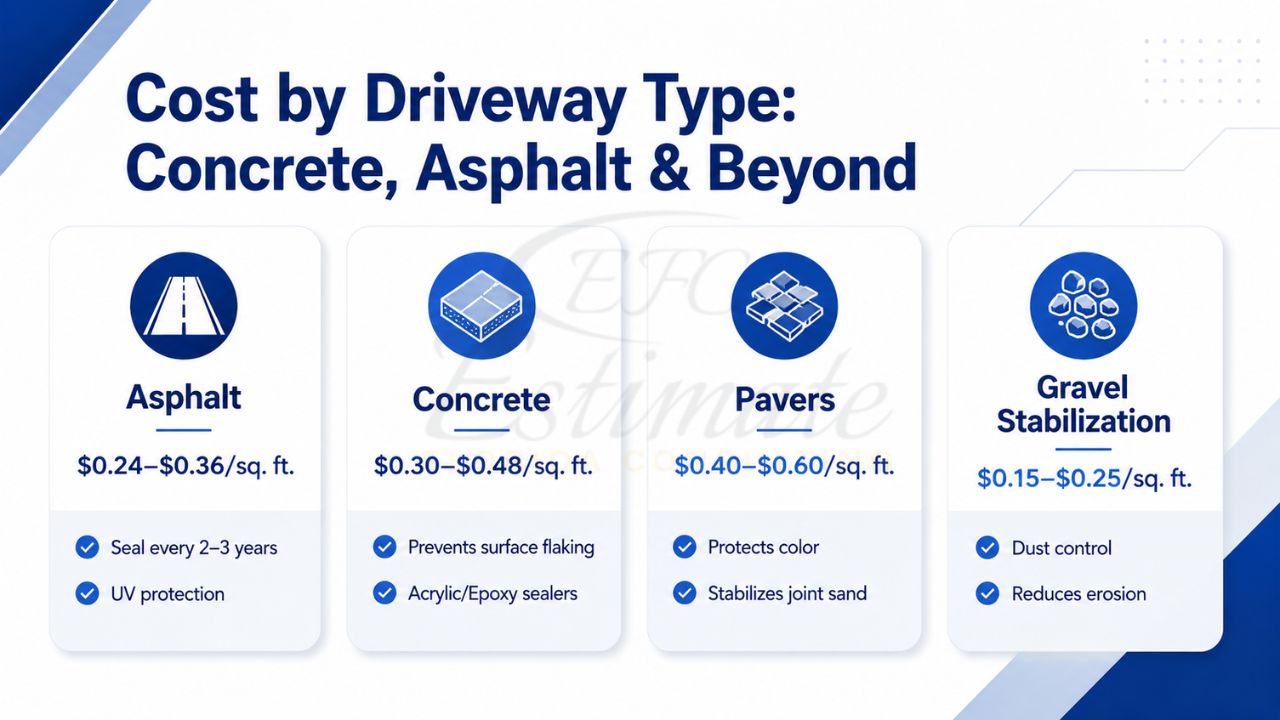
Cost by Driveway Type: Concrete, Asphalt, and Beyond
Not all driveways are created equal. The material your driveway is constructed from determines the sealing process and the associated costs.
Asphalt Driveways
Asphalt is the most common surface for sealing projects. It benefits significantly from regular maintenance because the bitumen binder is so sensitive to UV oxidation. Sealing costs typically range from $0.24 to $0.36 per sq. ft.. Routine sealing every 2-3 years extends the lifespan and maintains a smooth surface.
Concrete Driveways
Concrete requires specialized sealers to prevent “spalling” (surface flaking) caused by moisture and salt exposure. The cost of sealing a concrete driveway is higher, ranging from $0.30 to $0.48 per sq. ft.. Premium epoxy or acrylic sealants are recommended to handle the high vehicle weight and Florida’s heat.
Paver Driveways
For upscale residences, pavers are a top choice for aesthetics. Sealing pavers involves not just the surface but also stabilizing the joint sand. This process helps protect the pavers from fading and prevents weed growth between joints. The average cost for paver sealing is between $0.40 and $0.60 per square foot.
Gravel Driveways (Stabilization)
While gravel driveways do not use traditional film-forming sealants, they can be treated with “stabilizers” or binding agents to control dust and reduce erosion. This application typically costs $0.15 to $0.25 per square foot and is helpful for maintaining the driveway’s integrity during heavy rains.
Factors Influencing the Final Price Tag
When we provide a professional residential estimate, we look at more than just the square footage. Several hidden factors can shift the cost.
1. Driveway Condition and Pre-Sealing Repairs
A sealant is a barrier, not a miracle cure. If your driveway has existing damage, it must be addressed first.
- Small Crack Filling: Included in many packages or added at a low cost.
- Major Repairs: Driveway repairs can range from $2 to $4 per square foot.
- Deep Hole Patching: Using cold or hot-mix asphalt to fill potholes before sealing.
2. Preparation and Professional Cleaning
You cannot apply sealant to a dirty surface. The bond will fail almost immediately.
- Professional Cleaning: Power washing typically costs $0.20 to $0.40 per square foot.
- Oil Stain Treatment: Specialized primers are needed to ensure the sealant adheres to areas with previous oil spills.
3. Labor Rates and Regional Inflation
Labor accounts for 50% to 70% of the total project expense, averaging around $1.21 per square foot. In high-demand Florida markets like Miami or Tampa, labor rates may be 20-30% higher than the state average due to local market conditions and strict hurricane-region building codes.
4. Number of Coats
While one coat is the minimum, we often recommend two coats for better durability in high-traffic areas. However, this essentially doubles the material cost and significantly increases labor time.
5. Aesthetic Enhancements
Adding custom stamps, pigment dyes, or “slip-resistant” additives to the sealant will increase the cost. For example, pigment dyes can add an additional $0.25 to $0.50 per square foot.
📞 Request Your Driveway Sealing Estimate Today.
The Professional Sealing Process Step-by-Step
Understanding the “how” helps explain the “why” of the cost. A professional job ensures the sealant actually bonds.
- Inspection: Checking for soft spots and identifying every crack that needs pre-treatment.
- Cleaning: Removing all debris, dirt, and biological growth via high-pressure washing.
- Mechanical Scraping: Using wire brushes to remove loose aggregate or peeling old sealant.
- Edge Trimming: Clearing grass and dirt from the edges of the driveway to ensure full coverage.
- Crack and Hole Repair: Applying specialized “fill-and-seal” compounds or latex-acrylic fillers to existing damage.
- Oil Spot Priming: Using a chemical primer to seal oil stains so the new coat won’t peel.
- Application: Applying the sealant via squeegee (for a thicker, more durable coat) or airless sprayer (for a uniform, aesthetic finish).
- Curing: Restricting foot traffic for 24 hours and vehicle traffic for 48–72 hours to allow for a full chemical bond.
DIY vs. Professional Sealing: A Risk-Reward Analysis
Many homeowners consider the DIY route to save on labor. However, the “savings” can disappear quickly if the sealant fails.
| Feature | DIY Application | Professional Application |
|---|---|---|
| Initial Cost | Low ($50 – $300) | Higher ($250 – $1,100+) |
| Time Investment | 1 – 2 Full Weekends | 1 Day |
| Equipment | Manual tools (Brooms, squeegees) | Commercial-grade sprayers/mixers |
| Durability | Typically 1 – 2 years | 3 – 5+ years |
| Quality | Prone to streaks and “holidays” | Even, consistent thickness |
| Warranty | None (Material only) | Workmanship + Material Warranty |
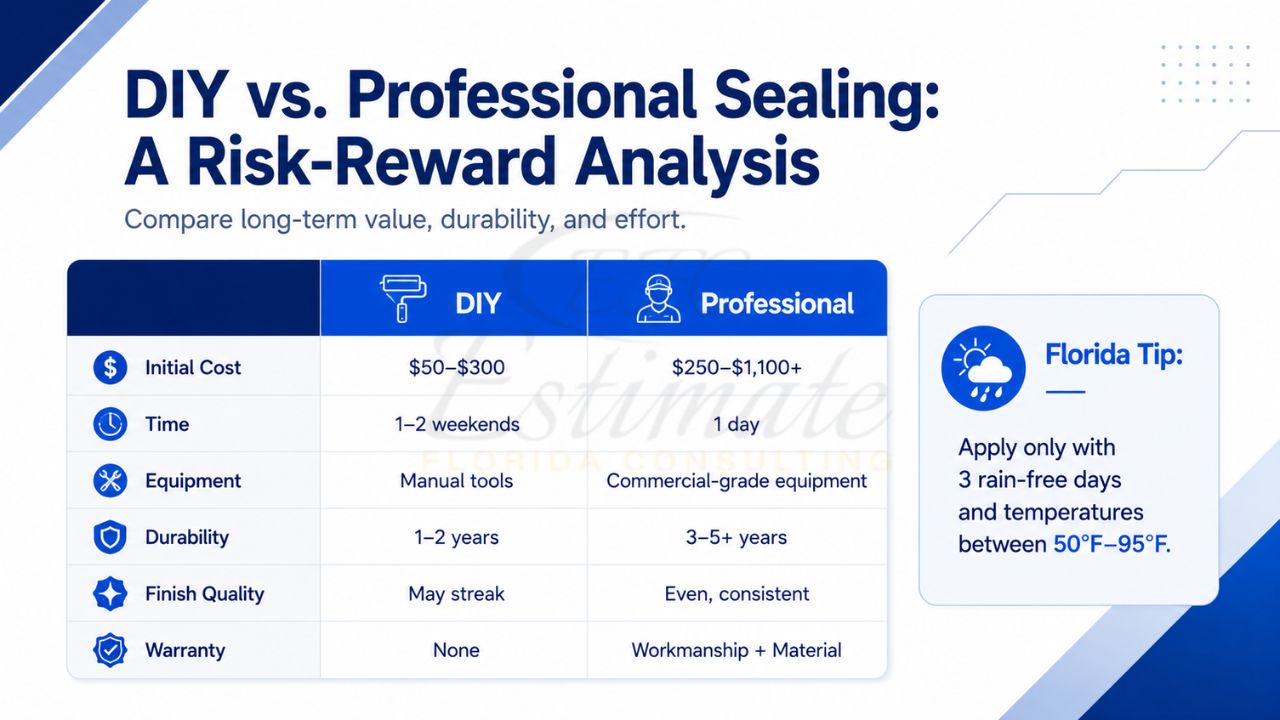
Note: For DIYers, timing is crucial. You need at least three consecutive days without rain—a challenge during Florida’s summer—and temperatures between 50°F and 95°F.
Long-Term Maintenance and Cost Savings
Investing in a seal today can save you from a full driveway replacement tomorrow.
Extending Lifespan
A well-maintained concrete driveway can last 30 to 50 years. Without sealing, that lifespan can be cut in half due to the aggressive Florida environment.
Enhancing Home Value
Curb appeal is a massive factor in property valuation. A freshly sealed, jet-black or polished gray driveway looks well-kept and boosts “resale potential”. Appraisers and lenders consider the quality of the driveway when evaluating property value.
5 Ways to Save Money on Sealing
- Keep Up with Maintenance: Sweep away debris and clean up spills immediately to extend the life of the current seal.
- Gather Multiple Quotes: Compare at least three contractors to evaluate cost and reputation.
- Bundle Projects: If you have pathways or a patio, seal them at the same time to save on initial service fees.
- Look for Off-Season Deals: Schedule your sealing during mid-week appointments or slightly cooler months to secure better rates.
- Do the Prep Work Yourself: Cleaning the driveway and removing debris before the pro arrives can cut down on labor hours.
🚧 Get an Accurate Driveway Sealing Cost Estimate.
Plan Driveway Sealing Scope Before Comparing Maintenance Costs
Driveway sealing allowances are more dependable when the maintenance scope is separated into measurable preparation and application activities. The surface type, measured area, cleaning, vegetation and debris removal, oil-spot treatment, crack routing and filling, patching, joint condition, edging, drainage, primer, sealer system, coat count, texture or slip resistance, protection, curing, access, and cleanup should be identified before comparing prices.
Florida UV exposure, rainfall, humidity, substrate moisture, prior coatings, traffic patterns, site access, weather windows, and existing pavement distress can affect material selection, sequencing, and durability. A plan-based scope supported by current trade-pricing data helps owners and project teams distinguish routine surface maintenance from work that requires repair or replacement planning.
Related estimating support: asphalt driveway cost guide, driveway paving cost guide, landscaping cost calculator, and construction estimating services.
FAQ: Expert Answers to Homeowner Questions
- How much does driveway sealing cost on average?
The average cost is approximately $539, with most homeowners paying between $176 and $1,100. - How often should I seal my driveway in Florida?
Generally, every 2 to 5 years. Asphalt driveways in intense sun benefit from resealing every 2 to 3 years. - Can I seal a driveway that is already cracking?
Yes, but the cracks must be filled first. For major damage, a professional repair is recommended before sealing. - What is the best time of year to seal in Florida?
The “dry season” (November through April) is best to avoid sudden afternoon thunderstorms that can ruin wet sealant. - How long before I can drive on a sealed driveway?
Wait at least 48 to 72 hours for vehicle traffic, though you can usually walk on it after 24 hours. - Does the color of the sealant matter?
In Florida, “Cool White” is popular for roofs to reflect heat, but for driveways, high-reflectivity clear or light-pigment seals on concrete can help reduce surface temperatures. - Is coal tar better than asphalt emulsion?
Coal tar is more durable but contains more pollutants. Asphalt emulsion is the more eco-friendly “mid-range” choice popular today. - How many gallons of sealant do I need for a two-car driveway?
A 1,000 sq. ft. driveway typically requires 10 to 15 gallons of sealant for a two-coat system. - Does professional sealing add value to my home?
Yes. It significantly boosts curb appeal and is a proactive step in preserving your home’s structural integrity. - What is the cost difference between sealing concrete and asphalt?
Concrete is generally 20-40% more expensive to seal due to the specialized nature of the acrylic/epoxy sealers required.
Conclusion: Protecting Your Curb Appeal
Driveway sealing is one of the most cost-effective maintenance steps a Florida homeowner can take. While the initial investment of a few hundred dollars might seem like just another chore, the long-term protection it provides against Florida’s relentless UV rays, humidity, and tropical rains is invaluable. By choosing the right material—be it a budget-friendly asphalt emulsion or a high-end acrylic seal—you are ensuring your driveway remains durable and beautiful for decades to come.
Don’t guess on your maintenance costs. Whether you are budgeting for a single-car upgrade or managing a large residential property, Estimate Florida Consulting provides the precision you need. We deliver detailed, “bankable” estimates that account for every local variable in the Florida market.