
Building a warehouse in the Sunshine State is a complex, multi-million dollar venture that requires more than just a vision; it requires a financial roadmap that lenders can trust. Whether you are developing a massive distribution hub in Orlando or a specialized cold storage facility in Miami, your journey to project funding begins with a precise warehouse construction estimate for bank financing Florida. This document is the cornerstone of your loan application, serving as a comprehensive cost analysis that proves your project’s financial feasibility to underwriters and loan officers.
In Florida’s unique construction landscape—defined by stringent hurricane codes, volatile material costs, and a booming industrial sector—a generic cost guess is often the fastest way to get a loan rejected. Professional estimating ensures your numbers reflect the reality of the local market, helping you build lender confidence and avoid devastating funding shortfalls mid-construction.
📋 Get Professional Warehouse Budget Estimates for Funding Applications.
Why Banks Require Detailed Construction Estimates for Warehouse Projects
Commercial lenders in Florida, ranging from major institutions like Bank of America to local credit unions, use construction estimates as their primary tool for risk management. A professional construction cost estimate for warehouse loan applications ensures the bank that their investment is sound.
Risk Mitigation and Financial Feasibility
Banks must be certain that the requested loan amount covers the total project scope. If an estimate is too low, the borrower may run out of funds before the certificate of occupancy is issued, leaving the bank with a half-finished, non-operational asset. Conversely, over-financing can lead to unsustainable debt-to-income ratios.
Loan-to-Value (LTV) Ratio Accuracy
The LTV ratio is a critical metric for loan approval. Banks need a granular Florida warehouse project cost breakdown to verify that the property’s value upon completion will sufficiently collateralize the loan.
Structuring the Draw Schedule
Loans are not disbursed in one lump sum but through a “draw schedule” tied to construction milestones. A detailed estimate allows the bank to plan these disbursements accurately, ensuring funds are available when specific trades, like foundations or structural steel, are completed.
Key Components of a Bank-Ready Warehouse Construction Estimate
A lender-compliant estimate must go beyond simple square-footage pricing. It requires trade-level precision and clear categorization using CSI (Construction Specifications Institute) divisions.
- Site Development & Preparation: Includes land clearing, grading, drainage systems, and utility connections. Florida’s soil conditions and flood zones make this a scrutinized section.
- Structural Steel & Foundation: The core of any industrial building. Detailed quantities of concrete, rebar, and structural steel are essential.
- Mechanical, Electrical, and Plumbing (MEP): Systems like specialized HVAC for temperature-controlled storage or advanced fire suppression for hazardous materials.
- Enclosure & Roofing: Metal siding or tilt-up concrete panels, along with roofing systems that must meet Florida’s rigorous wind-load standards.
- Soft Costs & Professional Fees: Often overlooked, these include architectural design, engineering, and city permitting fees.
- Contingency Fund: A critical buffer—typically 10% to 20%—to manage price escalations or unforeseen site conditions.
🏭 Get a Bank-Ready Warehouse Construction Cost Estimate in Florida.
Typical Cost Breakdown for Warehouse Construction in Florida
Florida’s costs vary by region and warehouse type. Below is an overview of the bank ready warehouse construction budget Florida investors should anticipate for 2025–2026.
| Warehouse Type | Avg. Cost Per Sq. Ft. | 50,000 Sq. Ft. Project Total |
|---|---|---|
| Basic Storage Warehouse | $110 – $150 | $5.5M – $7.5M |
| Distribution Center | $130 – $180 | $6.5M – $9M |
| Cold Storage Facility | $180 – $260 | $9M – $13M |
| Manufacturing Warehouse | $150 – $220 | $7.5M – $11M |
| High-Tech / Automated | $190 – $250 | $9.5M – $12.5M |
(Note: These figures reflect total turnkey costs including materials, labor, and soft costs.)
Hard Costs vs. Soft Costs in Warehouse Projects
Understanding the distinction between hard and soft costs is vital for accurate commercial construction estimating for financing.
Hard Costs (The “Physical” Build)
These are the tangible expenses directly related to construction.
- Materials: Concrete, steel beams, insulation, and roofing.
- Labor: Trade crews for excavation, electrical, plumbing, and framing.
- Site Improvements: Paving for truck loading bays and parking lots.
Soft Costs (The “Non-Physical” Essentials)
These are administrative and design costs required to move the project forward.
- Design & Engineering: Fees for architects, structural engineers, and civil engineers.
- Permits & Impact Fees: Significant costs that vary drastically by Florida county (e.g., Miami-Dade vs. Jacksonville).
- Insurance & Legal: General liability, builder’s risk, and project management overhead.
How Hurricane Codes Affect Warehouse Construction Costs in Florida
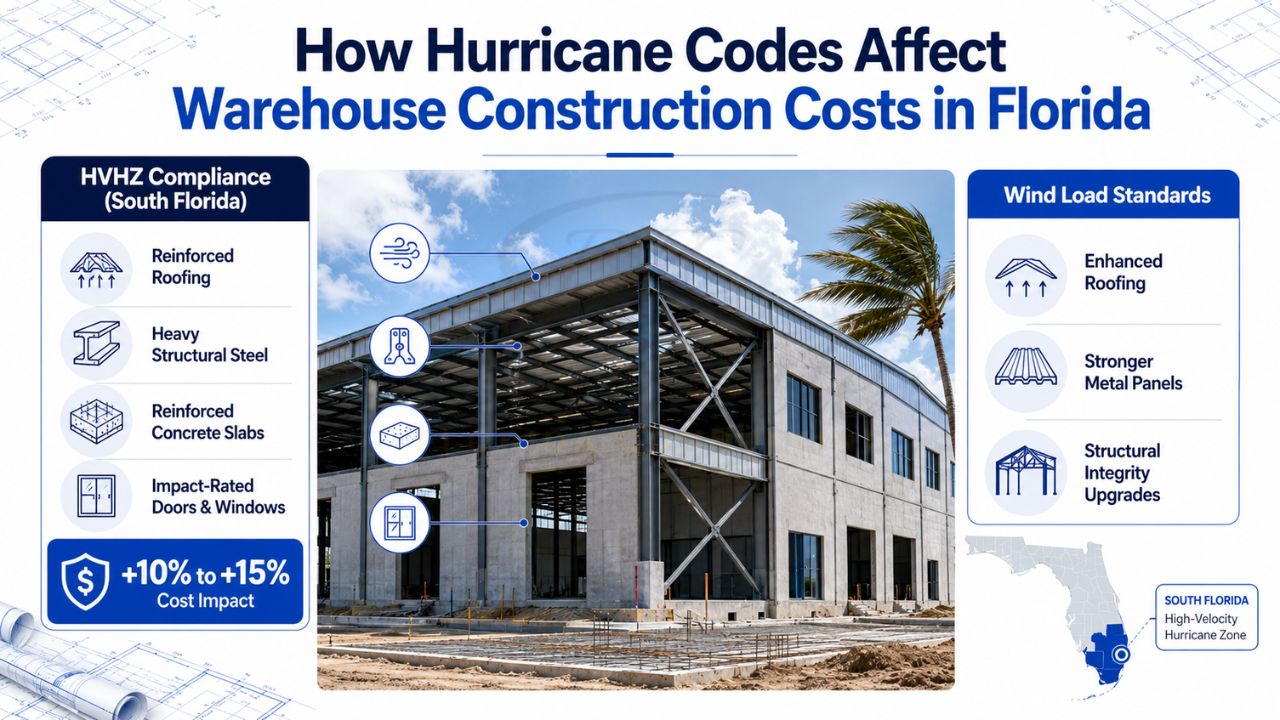
In Florida, “standard” construction doesn’t exist. All industrial buildings must comply with the Florida Building Code, but regional variations—specifically the High-Velocity Hurricane Zone (HVHZ) standards—significantly impact the industrial building cost estimate for bank review.
HVHZ Compliance (South Florida)
Projects in Miami-Dade, Broward, and Palm Beach counties face the strictest codes in the country. This requires:
- Reinforced roofing systems with advanced anchoring.
- Thicker structural steel and reinforced concrete slabs.
- Impact-rated windows and bay doors.
- Cost Impact: HVHZ requirements can add 10% to 15% to the total construction cost compared to non-coastal Central Florida regions.
Wind Load Standards (Central & North Florida)
While not as extreme as HVHZ, regions like Orlando and Jacksonville still require enhanced structural integrity compared to national averages, primarily impacting roofing and metal panel specifications.
Common Mistakes That Can Delay or Derail Bank Financing
Even with a great design, poor documentation can stop a project before it starts.
- Using National Averages: Generic templates or online calculators often miss Florida’s specific labor rates and hurricane material requirements.
- Incomplete Soft Cost Accounting: Omitting high impact fees or city-specific permitting costs can lead to a massive budget shortfall.
- Missing Trade Itemization: Banks reject “lump sum” budgets. They require detailed, line-item takeoffs for every trade to verify accuracy.
- Ignoring Material Escalation: With steel and concrete prices rising, failing to forecast inflation for a project starting months away is a major red flag for lenders.
🏗️ Plan Your Warehouse Project with Reliable Construction Cost Analysis.
Benefits of Using a Professional Construction Estimator
A professional warehouse construction estimate for bank financing Florida is more than just a document; it is a strategic asset.
- Faster Loan Approval: Banks trust structured, third-party reports. It speeds up the underwriting process significantly.
- Increased Credibility: Presenting a lender-ready CSI-formatted estimate shows you are a prepared and serious developer.
- Accuracy in Bidding: A professional estimate allows you to negotiate with contractors from a position of knowledge, ensuring their bids are realistic.
- Financial Peace of Mind: Knowing every dollar is accounted for protects your equity and ensures the project remains solvent from groundbreaking to handover.
How Estimate Florida Consulting Delivers Lender-Ready Estimates
At Estimate Florida Consulting, we specialize in the “language of lenders”. We turn your architectural drawings into precise, bank-ready financial blueprints that satisfy the most rigorous underwriting standards.
- Trade-Level Precision: We perform manual quantity takeoffs for every CSI division, from site clearing to interior finishes.
- Local Florida Expertise: Our database is updated quarterly with verified material and labor rates for Miami, Tampa, Orlando, and across the state.
- CSI Formatting: We deliver professional Excel and PDF reports in the exact format Florida banks prefer.
- Rapid Turnaround: We understand that time is money in development. We provide detailed estimates within 24–48 hours of plan submission.
Plan Warehouse Scope Before Preparing a Lender Budget
A warehouse budget is more useful when the building program and site-development scope are separated into measurable work packages. Building footprint, clear height, slab requirements, foundations, structural steel, roof and wall systems, dock positions, overhead doors, fire protection, electrical service, lighting, HVAC where required, office buildout, and specialized storage systems should be quantified as distinct items.
Site grading, drainage, utilities, truck courts, paving, parking, stormwater controls, permitting, professional services, testing, escalation period, and contingency assumptions should be identified alongside the vertical-building scope. This gives owners and development teams a documented basis for current trade-pricing data, bid comparison, and lender or stakeholder budget documentation; individual funding requirements remain specific to the project and reviewing institution.
Related estimating support: industrial construction estimating, commercial building estimator, construction project estimating packages, and structural steel estimating services Florida.
Frequently Asked Questions (FAQs)
Why do banks require an independent estimate instead of a contractor’s quote?
Lenders prefer a third-party estimate for transparency. Contractor quotes often lack detail, contingency buffers, and soft cost inclusions that banks need for risk assessment.
How long does it take to get a bank-ready warehouse estimate?
At Estimate Florida Consulting, we typically deliver complete, formatted reports within 24 to 48 hours of receiving your project drawings.
What is a “CSI-formatted” estimate?
The Construction Specifications Institute (CSI) provides a standard index for organizing construction information. Banks prefer this format because it allows for easy comparison and verification across different projects.
How much should I budget for a contingency fund?
For Florida warehouse projects, we recommend a 10% to 15% contingency to account for potential material price jumps and unforeseen site conditions.
Are permit costs the same across Florida?
No. Permit and impact fees in Miami-Dade can be significantly higher than in more rural counties. Our estimates use city-specific data to ensure these are accurately represented.
Can I use my estimate for both financing and contractor bidding?
Absolutely. A professional estimate serves as a baseline for both your bank and your general contractor, ensuring all parties are aligned on the project scope and costs.
Conclusion
Don’t let inaccurate numbers delay your project. Secure your project funding with a precise, professional, and lender-approved warehouse construction estimate for bank financing Florida.
Contact Estimate Florida Consulting today to receive your detailed cost report within 48 hours.
Email: info@estimatorflorida.com
Phone: 561-530-2845