
For any business owner, general contractor, or facility manager in Florida, the performance of an HVAC system is a top priority. In a climate defined by unrelenting heat and high humidity, the backbone of any cooling system is the quality of its air distribution. Professional commercial HVAC duct installation is not just about moving air; it is about precision engineering, energy efficiency, and long-term durability.
At Estimate Florida Consulting, we understand that accurate budgeting for these projects is critical. Whether you are managing a new high-rise in Miami or a warehouse renovation in Jacksonville, having a detailed commercial HVAC ductwork estimate Florida professionals can trust ensures your project stays on track and within budget.
📋 Turn complex HVAC plans into accurate quantities and reliable cost projections.
Overview of Commercial HVAC Duct Installation
Commercial duct installation involves the design and placement of air distribution channels to provide balanced heating, ventilation, and air conditioning to large spaces. Unlike residential systems, commercial setups must handle higher air volumes, support complex zoning requirements, and integrate with advanced building management systems.
In Florida, the stakes are higher. The state’s extreme humidity means that even minor leaks or poor insulation can lead to condensation, mold growth, and massive energy waste. Proper installation ensures that your HVAC system doesn’t have to work harder than necessary, extending the life of your equipment and lowering utility costs.
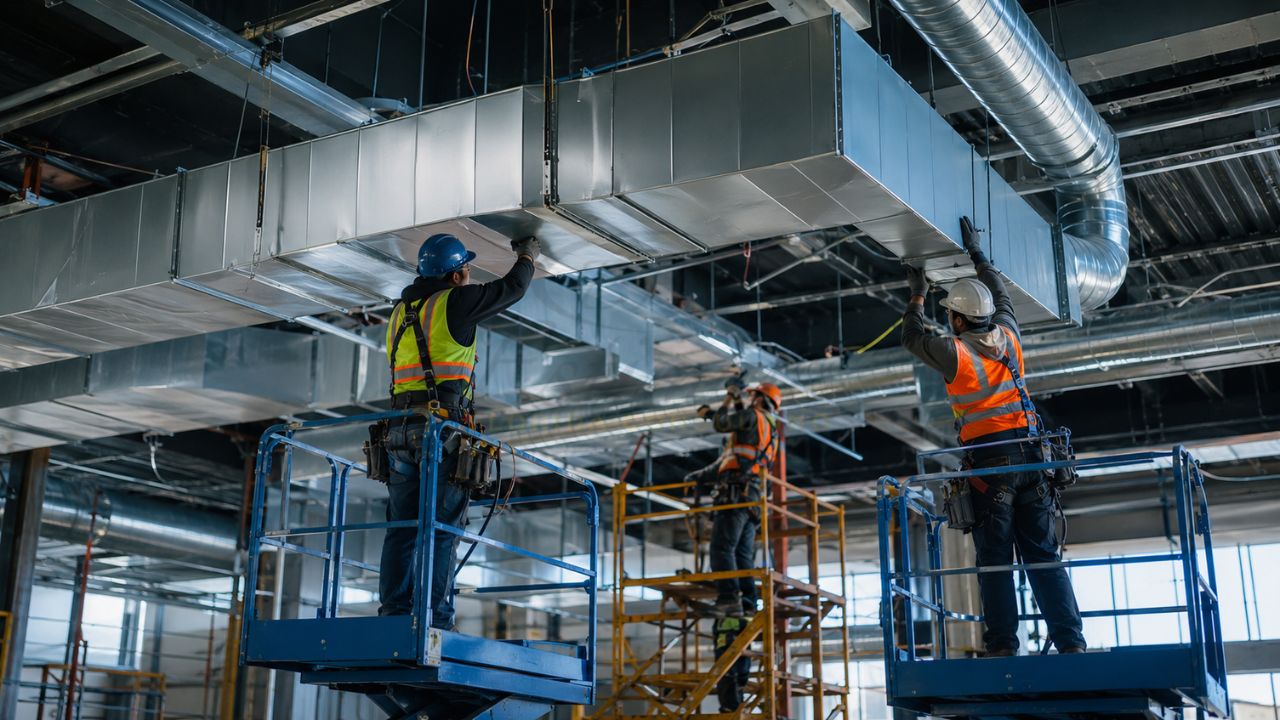
Types of Ductwork Used in Commercial Buildings
Choosing the right material is the first step in determining your commercial ductwork installation cost. Each material offers different benefits regarding durability, airflow efficiency, and thermal resistance.
1. Sheet Metal Ductwork (Galvanized Steel)
Sheet metal ductwork commercial building standards typically favor galvanized steel due to its incredible durability and resistance to mold.
- Best Use: Main trunk lines and high-capacity networks.
- Benefits: Leak-resistant, long lifespan (20-30 years), and superior airflow stability.
- Cost Factor: Higher upfront cost due to fabrication and specialized labor requirements.
2. Flexible Ductwork
Flexible ducts consist of a spiral-wire core wrapped in fiberglass insulation and a vapor barrier.
- Best Use: Branch runs for smaller rooms and tight, confined spaces where rigid ducts won’t fit.
- Benefits: Economical and fast to install.
- Cost Factor: Generally the most budget-friendly option.
3. Fiberglass Duct Board
These are rigid boards made of compressed fiberglass with a reinforced foil laminate.
- Best Use: Main trunk distribution where noise reduction and built-in insulation are priorities.
- Benefits: Excellent thermal insulation and quiet operation.
- Cost Factor: Moderate; fits between flexible and sheet metal options.
🚀 Win more bids and build with confidence using professional Commercial HVAC Duct estimates.
Key Factors That Affect Installation Cost
Estimating the new construction duct installation cost or a retrofit project requires looking at several variables beyond just the material price.
- HVAC System Tonnage: Larger systems require wider duct diameters (ranging from 10″ to 16″+) to distribute the necessary air volume without resistance.
- Insulation Standards (R-Value): Florida mechanical codes require R-6 or R-8 insulation for ducts in unconditioned spaces like attics to prevent heat gain.
- Building Complexity: Multi-story buildings or open-floor layouts with high ceilings require complex routing, vertical chases, and additional supports, increasing labor costs.
- Removal of Existing Systems: In renovation projects, tearing out and disposing of old, deteriorated ductwork can add $2–$6 per linear foot to the total.
- Permitting and Code Compliance: Florida has strict hurricane and energy-efficiency codes that require reinforced supports and sealed joints with UL-rated mastic.
Cost Ranges for Commercial Ductwork Installation
The following tables provide an overview of typical costs for commercial HVAC duct installation projects in Florida.
Average Installed Cost per Linear Foot (2025 Trends)
| Duct Material Type | Material Cost (LF) | Labor Cost (LF) | Total Installed (LF) |
|---|---|---|---|
| Flexible Duct (R-8) | $2 – $5 | $7 – $10 | $9 – $15 |
| Sheet Metal (Galvanized) | $8 – $18 | $12 – $27 | $20 – $45 |
| Fiberglass Duct Board | $6 – $12 | $7 – $25 | $13 – $49 |
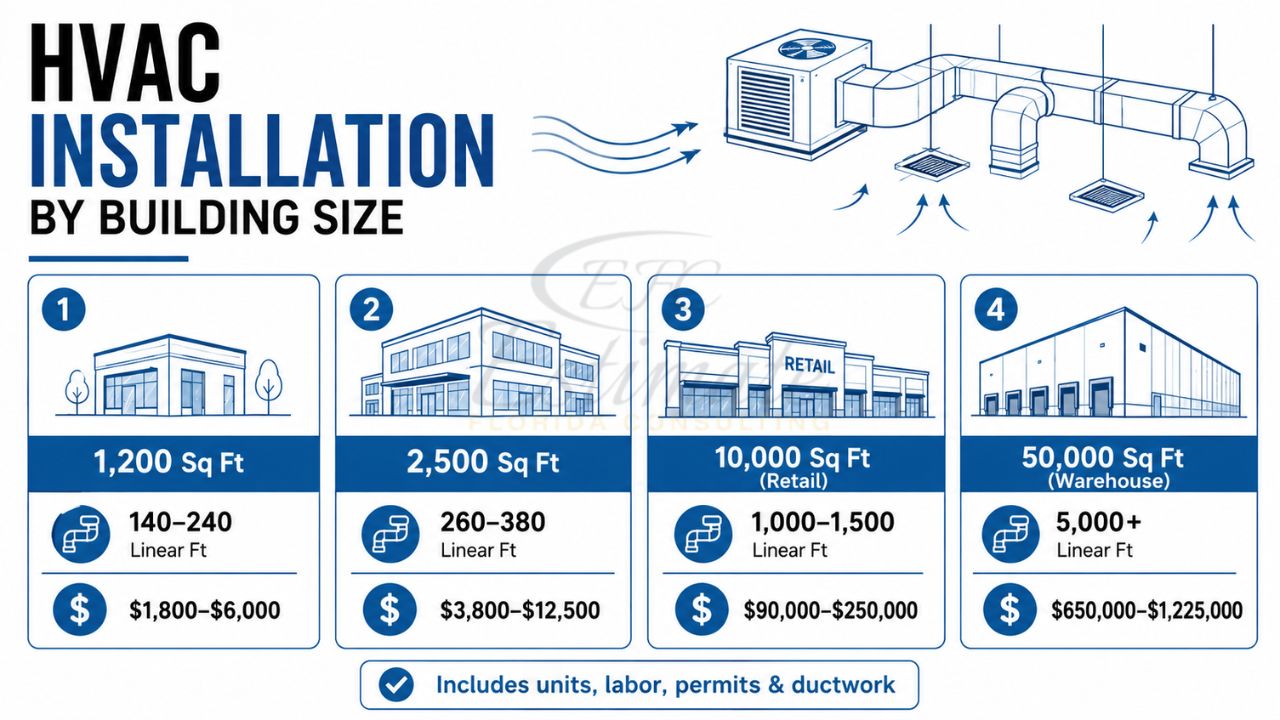
HVAC Installation by Building Size (Average Total System)
| Building Size (Sq Ft) | Linear Feet Needed | Total Estimated Cost |
|---|---|---|
| 1,200 | 140 – 240 | $1,800 – $6,000 |
| 2,500 | 260 – 380 | $3,800 – $12,500 |
| 10,000 (Retail) | 1,000 – 1,500 | $90,000 – $250,000 |
| 50,000 (Warehouse) | 5,000+ | $650,000 – $1,225,000 |
Note: Total system costs include units, labor, permits, and ductwork.
📊 Get the exact material and labor costs needed to keep your project on schedule and within budget.
New Construction vs. Retrofit Duct Installation
There is a significant difference in the HVAC duct installation per square foot cost when comparing new builds to retrofits.
New Construction
Installing ducts during a new build is generally more cost-efficient. The framing is open, there is no demolition required, and installers have clear access to plan the most efficient routes.
- Cost Advantage: Lower labor hours and easier routing around structural elements.
Retrofit and Replacement
Retrofitting ductwork in an existing building involves navigating around plumbing, wiring, and finished walls. It often requires “demo” work to remove old materials, which increases both the timeline and the labor budget.
- Challenge: Limited attic or ceiling clearance and the need to protect existing finishes.
Best Practices for Duct Installation in Florida
To ensure your system withstands Florida’s climate, installers should follow these professional standards:
- Strict Duct Sealing: Use UL-rated mastic sealant or foil tape on every joint. Air leakage in a Florida attic can lose up to 30% of conditioned air, causing the AC unit to overwork.
- Proper Vapor Barriers: Insulation must be tightly wrapped with a secure vapor barrier to prevent condensation that leads to mold.
- Balanced Airflow: Proper return air path planning is essential. Florida buildings often suffer from negative pressure zones if returns are undersized, pulling humid air into the structure.
- Hurricane-Grade Supports: Secure suspension and reinforced supports are required by Florida Building Codes to ensure the system remains intact during extreme weather.
Common Challenges and How to Avoid Them
- Undersized Ducts: Often done to save money, this leads to blower strain and uneven cooling. Solution: Professional Manual D-based duct sizing.
- Moisture and Mold: Caused by poor insulation or leaks. Solution: High R-value insulation (R-8) and meticulous sealing.
- Budget Overruns: Arising from inaccurate takeoffs. Solution: Secure a detailed commercial HVAC ductwork estimate Florida before construction begins.
How Professional Estimating Helps with HVAC Projects
For general contractors and developers, an accurate estimate is the foundation of a successful bid. Estimate Florida Consulting provides specialized mechanical estimating that goes beyond basic cost charts.
- Detailed Quantity Takeoffs: We measure every linear foot of trunk line, branch line, and fitting to eliminate material waste.
- Bank-Ready Documentation: Our estimates are formatted for lender approvals and contractor negotiations.
- Location-Based Pricing: We use zip-code-specific data for Florida labor and material rates, ensuring your budget reflects current market realities.
✅ Eliminate guesswork and maximize profitability with expert HVAC duct takeoffs and estimates.
Commercial HVAC Ductwork Budget Scope
A reliable commercial HVAC ductwork budget begins with the plans, air-distribution layout, equipment schedule, ceiling conditions, and installation access—not a generic square-foot allowance alone. A disciplined mechanical estimate can separate measured duct runs, fittings, insulation, supports, access equipment, demolition, testing, controls coordination, and local labor conditions before bidding or funding decisions are made.
For broader facility budgeting, connect this scope to our commercial estimating services and mechanical and HVAC estimating services in Florida. A complete plan review can also coordinate ductwork with construction estimating support and the statewide construction cost estimator in Florida.
Frequently Asked Questions
- What is the average commercial HVAC duct installation cost per square foot in Florida?
Typical costs range from $15 to $30 per square foot for a complete system installation, including equipment, ductwork, and labor. - Is sheet metal better than flexible ductwork for commercial buildings?
Sheet metal is more durable, offers better airflow for long runs, and is less prone to mold, making it the superior choice for main trunk lines in large buildings. - Why is duct sealing so important in Florida?
Florida’s high humidity can cause condensation if cold air leaks into hot attics. Mastic sealing prevents this energy loss and potential mold growth. - How long does a typical commercial duct installation take?
Small retail spaces may take 1-3 weeks, while large warehouses or hotels can take 1-2 months depending on the complexity. - What is the difference between R-6 and R-8 insulation?
R-8 is thicker and offers better thermal resistance. Many Florida codes now require R-8 in unconditioned attics to maximize energy efficiency. - Does Estimate Florida Consulting provide estimates for both new construction and retrofits?
Yes, we provide detailed mechanical takeoffs for new builds, renovations, and complete system replacements. - How can I lower my installation costs?
Accurate estimating prevents ordering excess material. Choosing the right duct material for the right application (e.g., using flex for branch runs only) also helps balance performance and cost.
Get a Professional Mechanical Estimate Today
Don’t let inaccurate pricing or poor planning derail your next commercial project. Ensure your HVAC system is budgeted with precision by partnering with Florida’s leading mechanical estimators.
Contact Estimate Florida Consulting today for a comprehensive cost breakdown of your commercial HVAC duct installation.
Email: info@estimatorflorida.com
Phone: 561-530-2845