
Building a home in the Sunshine State requires a structure that can withstand humidity, termites, and high-velocity winds. For many Florida homeowners and developers, concrete masonry units (CMU)—commonly known as cinder blocks—are the gold standard for durability. If you are planning a new project, the most critical question in your budget phase is: how many cinder blocks to build a 1500 sq ft house? On average, a standard single-story 1,500-square-foot house requires between 3,000 and 4,000 cinder blocks.
The exact number fluctuates based on your home’s perimeter, wall height, and the number of interior load-bearing walls. Because masonry materials are a significant portion of the concrete block house cost Florida developers face, an accurate masonry takeoff for residential construction is essential to prevent costly overages or project delays.
Understanding the Difference Between Floor Area and Wall Area
One of the most common mistakes in a cinder block house construction calculator is confusing floor square footage with wall square footage. A “1500 sq ft house” refers to the liveable floor area. However, blocks are used to build vertical walls.
To determine the block count, we must calculate the Surface Area of the walls. For example, a 1,500 sq ft house could be a simple 30’ x 50’ rectangle or a more complex L-shape with multiple corners. More corners and complex footprints increase the exterior wall perimeter, which directly increases the number of blocks required.
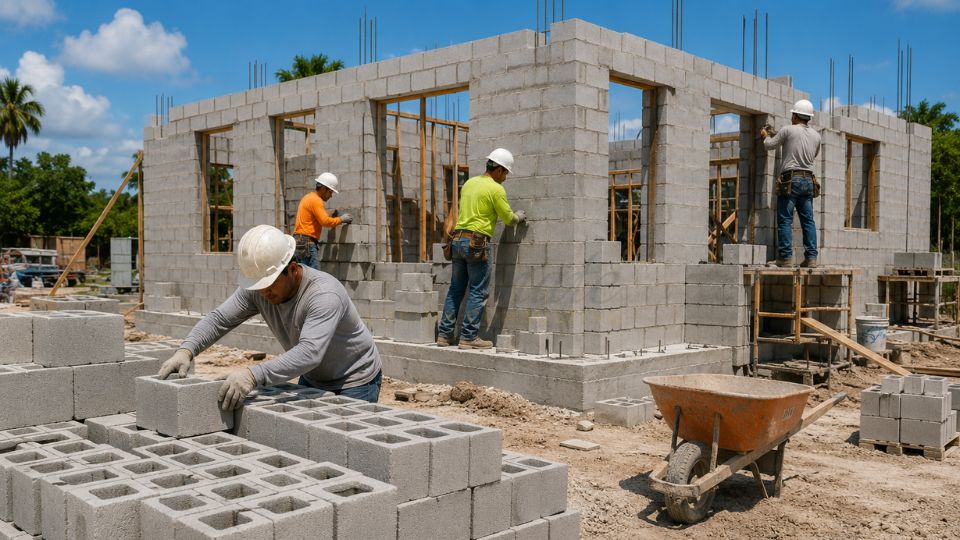
How to Calculate Cinder Blocks for a 1500 Sq Ft House
To get a realistic estimate for how many CMU blocks for 1500 sq ft home builds, you need to follow a specific mathematical process. Professional estimators use detailed architectural plans, but you can get a “ballpark” figure using these steps:
- Calculate the Perimeter: Add the lengths of all exterior walls.
- Determine Wall Height: Standard residential walls in Florida are typically 8, 9, or 10 feet high.
- Calculate Gross Wall Area: Multiply the perimeter by the wall height.
- Subtract Openings: Estimate the total square footage of all windows and doors and subtract this from the gross area.
- Apply the Block Multiplier: Standard 8x8x16 cinder blocks cover approximately 0.89 square feet. The standard multiplier used by professionals is 1.125 blocks per square foot of wall area (this includes the mortar joint).
📋 Get an accurate cinder block quantity takeoff and avoid costly material shortages on your build.
Standard Cinder Block Sizes and Coverage
In Florida residential construction, the most common unit is the 8″ x 8″ x 16″ CMU. While these are the nominal dimensions, the actual block is slightly smaller (7-5/8″) to allow for a 3/8″ mortar joint.
| Block Type | Nominal Dimensions | Coverage per Block | Multiplier (per Sq Ft) |
|---|---|---|---|
| Standard CMU | 8″ x 8″ x 16″ | 0.89 Sq Ft | 1.125 |
| Half Block | 8″ x 8″ x 8″ | 0.44 Sq Ft | 2.25 |
| U-Block (Bond Beam) | 8″ x 8″ x 16″ | Varies (Structural) | N/A |
Sample Calculation for a 1500 Sq Ft Single-Story House
Let’s look at a practical example for a rectangular 1,500 sq ft home (30′ x 50′) with 10-foot ceilings:
- Perimeter: 30 + 30 + 50 + 50 = 160 linear feet.
- Gross Wall Area: 160 ft x 10 ft = 1,600 sq ft.
- Opening Deductions: Assume 300 sq ft for windows and doors.
- Net Wall Area: 1,600 – 300 = 1,300 sq ft.
- Exterior Block Count: 1,300 sq ft x 1.125 = 1,463 blocks.
Note: This only accounts for the exterior shell. Most concrete block house cost Florida estimates also include interior load-bearing walls, garage partitions, and a 5-10% waste factor, which is why the total count typically lands between 3,000 and 4,000 units.
🏠 Know your material requirements before construction starts with detailed estimating services.
Factors That Affect the Number of Blocks Needed
Several variables can significantly shift your masonry requirements:
1. Wall Height and Story Count
Higher ceilings (e.g., 12-foot “great rooms”) require more courses of blocks. Multi-story homes also require thicker blocks (often 12″ CMU) for the first floor to support the structural load of the second floor.
2. Interior Masonry Walls
While many builders use wood or metal studs for interior partitions, some Florida designs utilize CMU for interior load-bearing walls or fire-rated barriers in multi-family units. This can double your block requirement.
3. Foundation Type
If your house is built on a stem-wall foundation rather than a monolithic slab, you will need an additional 400 to 450 bags of cement and roughly 2,000 to 2,200 blocks just for the footing and grade beams.
4. Architectural Complexity
A “box” house is the most efficient. Houses with bump-outs, bay windows, or integrated masonry porches increase the perimeter and the number of specialty blocks (like sash blocks or corner units) required.
Additional Masonry Materials Required
A cinder block house is more than just the blocks themselves. To meet the Florida Building Code (FBC), especially in High-Velocity Hurricane Zones (HVHZ) like Miami-Dade, your masonry system must be reinforced.
- Mortar: Typically a 1:6 cement-to-sand ratio for general masonry or Type S for load-bearing walls.
- Steel Reinforcement (Rebar): You will need 1.5 to 2 tons of steel reinforcement bars (Grade 500 TMT) to ensure the walls can handle high wind loads.
- Grout (Concrete Fill): In Florida, specific cells within the blocks are filled with wet concrete (grout) to lock the rebar in place.
- Lintels and Bond Beams: These are horizontal structural elements over openings (doors/windows) and at the top of the wall to tie the structure together.
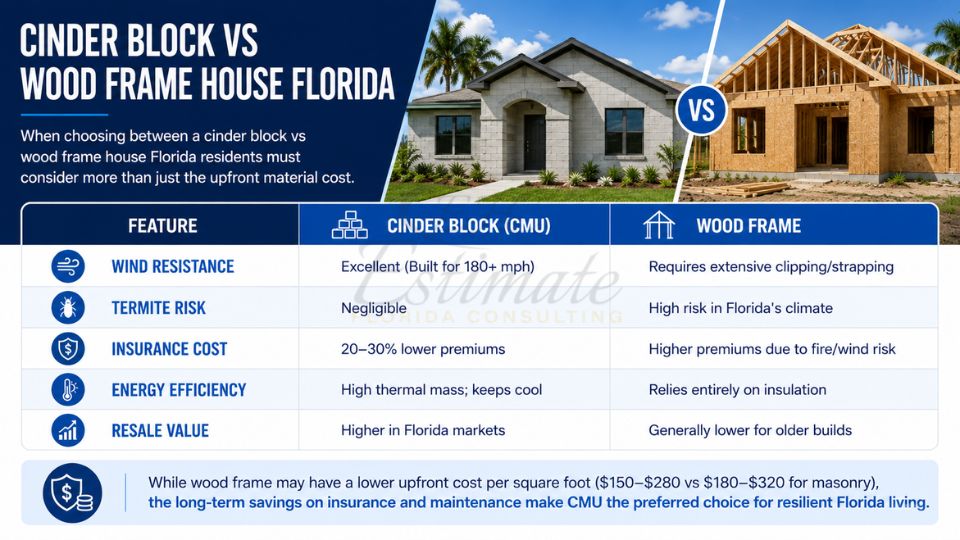
Cinder Block vs Wood Frame House Florida
When choosing between a cinder block vs wood frame house Florida residents must consider more than just the upfront material cost.
| Feature | Cinder Block (CMU) | Wood Frame |
|---|---|---|
| Wind Resistance | Excellent (Built for 180+ mph) | Requires extensive clipping/strapping |
| Termite Risk | Negligible | High risk in Florida’s climate |
| Insurance Cost | 20–30% lower premiums | Higher premiums due to fire/wind risk |
| Energy Efficiency | High thermal mass; keeps cool | Relies entirely on insulation |
| Resale Value | Higher in Florida markets | Generally lower for older builds |
While wood frame may have a lower upfront cost per square foot ($150–$280 vs $180–$320 for masonry), the long-term savings on insurance and maintenance make CMU the preferred choice for resilient Florida living.
🚀 Build with confidence using accurate quantity takeoffs prepared by experienced estimators.
Why Accurate Masonry Takeoff Matters
In a volatile market where material prices can fluctuate by 10-25% based on seasonal demand, “guesstimating” your block count is a recipe for disaster. A professional masonry takeoff for residential construction ensures:
- Budget Predictability: You know exactly what you are paying for before the first pallet arrives.
- Waste Reduction: Accurate counts prevent the common 15% waste seen on poorly managed sites.
- Bid Competitiveness: For contractors, an accurate takeoff is the difference between winning a bid and losing money on a project.
- Compliance: Professional estimators factor in Florida-specific code requirements for rebar spacing and bond beams, ensuring your build passes inspection.
At Estimate Florida Consulting, we utilize advanced technology and deep local expertise to provide the most reliable masonry estimates in the state.
Plan CMU Quantity Scope Before Comparing Block Counts
A useful masonry quantity plan starts with the actual wall geometry rather than floor area alone. Exterior and interior wall lengths, heights, openings, corner conditions, wall thickness, bond pattern, control joints, lintels, bond beams, cells to be grouted, reinforcement, mortar, flashing, scaffolding, delivery, waste, and access should be measured and listed before a block count is compared.
Florida wind design, structural drawings, local permitting requirements, soil and foundation details, multi-story loading, garage walls, service penetrations, and architectural changes can affect the correct CMU quantities and sequencing. A plan-based takeoff supported by current masonry pricing helps owners and contractors compare complete assemblies instead of relying on a broad count or single material allowance.
Related estimating support: masonry estimating services, rebar installation cost guide, new house construction cost calculator, and construction estimating services.
Frequently Asked Questions (FAQs)
- How many blocks are in a pallet?
Standard 8x8x16 blocks usually come in pallets of 75 to 90 units, depending on the manufacturer and weight limits of the delivery truck. - Is it cheaper to build with cinder blocks or bricks in Florida?
Cinder blocks are generally cheaper and faster to install for structural walls. Bricks are often used as a veneer ($500–$1,200 per 1,000 units) to provide aesthetic appeal over a CMU shell. - Does the 1500 sq ft estimate include the garage?
Usually, no. If your 1,500 sq ft house includes a 400 sq ft attached garage, you must add that perimeter to your calculation. A garage can add 800 to 1,000 blocks to your total count. - How much does it cost to lay a single cinder block in Florida?
Labor costs for masons in Florida typically range from $67.60 to $101.40 per hour. Per block, you might expect to pay between $1.50 and $3.50 for the material alone. - Are cinder blocks hurricane-proof?
No structure is “proof,” but reinforced CMU construction is the most “hurricane-resistant” residential method allowed by the FBC. It excels in resisting the impact of flying debris. - Can I use a cinder block house construction calculator for a DIY estimate?
You can use a calculator for a rough estimate, but for bank loans, permitting, and contractor bidding, a professional masonry takeoff is required to account for lintels, rebar, and grout volume. - How long does a masonry takeoff take?
At Estimate Florida Consulting, we typically deliver detailed masonry takeoff reports within 1 to 2 days.
Get a Precise Masonry Takeoff Today
Don’t leave your project’s success to chance. Whether you are a homeowner planning your dream 1,500 sq ft home or a contractor managing multiple residential developments, accuracy is your best tool for profitability.
Contact Estimate Florida Consulting today for a professional, code-compliant masonry takeoff and construction estimate. Our team ensures every block, bag of mortar, and piece of rebar is accounted for, saving you time and money on your Florida build.
Email: info@estimatorflorida.com
Phone: 561-530-2845